There are various “nifty ILRI tools” in development and I’m not sure that the SSA feeds database is the right one for what you’re suggesting. … The key issue is choosing technologies that deal with the major constraints: feed scarcity, feed quality and feed seasonality. And it’s also about much more than nutritive value – there are many other characteristics of feed technologies which will affect their suitability in different contexts. We do envisage a suit of tools to deal with some of these issues and will keep posting progress on the fodder adoption blog.
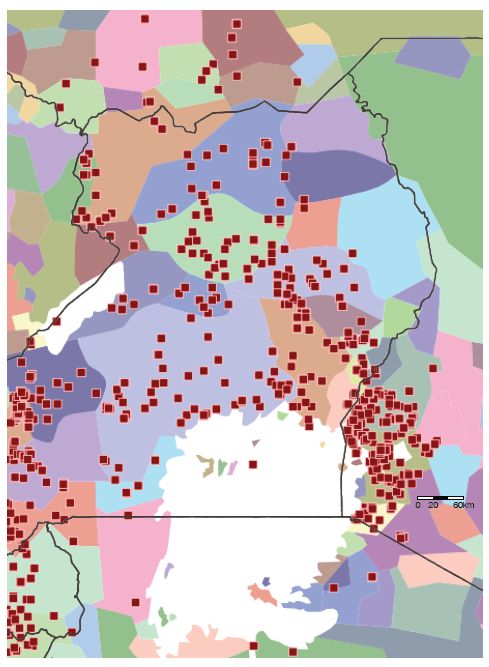
Ever since I contributed to A methodological model for ecogeographic surveys of crops, and suggested that collectors should do this, I’ve been waiting for the time when it would be easy — or even possible — to map the distribution of conserved germplasm on top of cultural, ethnic or language boundaries. The problem has been that maps of such boundaries, 1 though available in various printed formats, have not been much digitized. Or at least I hadn’t come across them. Until I happened on a blog post about the Center for Geographic Analysis’ (Harvard University) WorldMap, an open source web mapping system. The layers provided include one called Ethnicity Felix 2001, which “consist of polygons and labels depicting ethnicity information based on the ‘People’s Atlas of Africa’ by Marc Felix and Charles Meur, Copyright 2001.” Perfect, I thought.
Sorghum accessions (Genesys) and ethnic groups in Uganda.Well, not so fast. It was not altogether easy to download a shapefile of conserved African sorghum landraces from Genesys that would upload into WorldMap, plonk it on top of Ethnicity Felix 2001 and produce a shareable map. Not easy, but possible. It took some time and some divine intervention from Robert, but I do now have a map of African ethnic groups and sorghum collections that other people can have a look at. At left you have a snippet showing Uganda to whet your appetite. So now, in addition to things like ecogeographic gaps in collections, made possible by global climate surfaces, we can also begin to investigate cultural gaps.
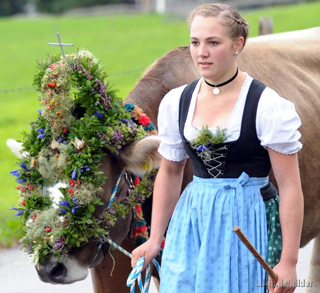
What goes up, must come down. Alpine farmers who take their livestock to higher pastures in the spring bring them down for the winter. The Human Flower Project shares the celebratory mood.
Glycaemic index of three Indian rice varieties. All three the same, high, GI. So, “There is an urgent need to study the GI of other commonly consumed rice varieties and to develop rice of a lower GI value”. Er, right.
Plant breeding for harmony between agriculture and the environment. “Plant breeding can be a powerful tool to bring “harmony” between agriculture and the environment, but partnerships between plant breeders, ecologists, urban planners, and policy makers are needed to make this a reality.” I was just going to ask, why can’t we all just get along.
Don’t forget the open Mendeley group for the papers we link to here. Even if you don’t use Mendeley, you can subscribe to the RSS feed from the group and get stuff that way.
The Economist’s hymn of praise for the Khan Academy naturally sent me over to explore those of their 2,400 educational videos that had anything to do with agricultural biodiversity. And there, between Logarithmic Scale and Proof by Induction in the New & Noteworthy section, I did indeed find Firestick Farming. But that, good as it was, alas, was all. At least for now.