So Bioversity are looking for a Research Leader, Nutrition & Biodiversity. Now, I know what you’re thinking. What about Jess? Yeah, well, looks like she’s moving on — as one does. She’ll be missed. But she does leave behind a solid strategy for future work in the use of agrobiodiversity for health and nutrition. Though not, alas, on the internet. So far.
More bhang for your buck
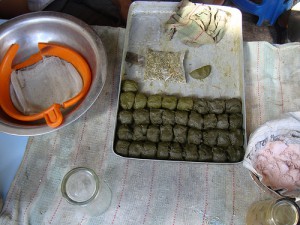 Yesterday’s Nibble about the way a high value-added agrobiodiversity product is produced in the Chu Valley of Kazakhstan…
It begins with a freshly showered person riding naked for hours on a clean, washed horse inside a two-meter-high “forest” … Afterwards, the human body and that of the horse are covered with a thick layer of resin mixed with sweat. This produces a substance that is usually dark brown in color, which is then thoroughly scraped off the human and horse’s bodies. The mixture is subsequently pressed, molded into bars, and dried.
…elicited from Dirk (on Facebook, via) the observation that in India “they must have a better method to collect concentrate…” The resulting product is shown above, thanks to ezola’s Flickr stream and a Creative Commons license. And thanks to Tom Maisey, and the same source, we can also see how the stuff is marketed in (some parts of) India.

Alas, I could find no conclusive photographic documentation of how they do things in the Chu Valley, although a music video and a movie trailer give some tantalizing hints.
Live, interactive, participatory UN webcast on biodiversity in a week
Ahmed Djoghlaf, Executive Secretary of the CBD and Monique Barbut, CEO and Chair of the Global Environment Facility (GEF), will discuss the CBD’s bold plans and the importance of taking action now to avert even more serious loss of biodiversity; how the entire UN system is driving to make the UNBD a lasting success, and the role of the GEF.
Or so it says here. Anyway, go and submit a question, and don’t forget to listen in on 20/9/2011 at 17:00 BST and hear what they have to say about agrobiodiversity. If anything.
State of the World’s Biodiversity for Food and Agriculture in the offing
Readers will be overjoyed to learn that the Commission on Genetic Resources for Food and Agriculture has requested FAO to spend the next five years preparing what will be the first ever report on The State of the World’s Biodiversity for Food and Agriculture. You can comment on the concept note until 15 November 2011 to cgrfa “at” fao.org.
Pavlovsk still up in the air
I don’t understand what is happening.
That’s VIR’s Director General Nikolay Dzuybenko commenting on the Pavlovsk situation just a few days ago. I have to say I know how he feels. Anyway, keep up to date with all things VIR, including the Pavlovsk saga, on their website.