Readers will be overjoyed to learn that the Commission on Genetic Resources for Food and Agriculture has requested FAO to spend the next five years preparing what will be the first ever report on The State of the World’s Biodiversity for Food and Agriculture. You can comment on the concept note until 15 November 2011 to cgrfa “at” fao.org.
Pavlovsk still up in the air
I don’t understand what is happening.
That’s VIR’s Director General Nikolay Dzuybenko commenting on the Pavlovsk situation just a few days ago. I have to say I know how he feels. Anyway, keep up to date with all things VIR, including the Pavlovsk saga, on their website.
Lois Englberger
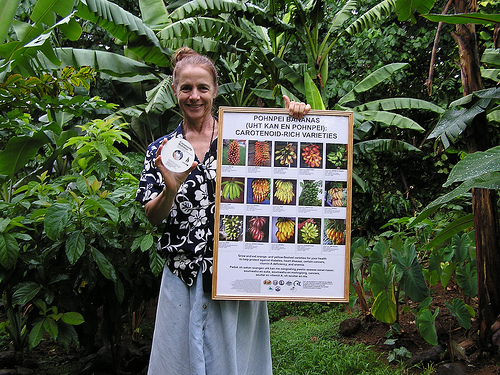 We should have pointed out way before now that our friends at ProMusa have put together a wiki dedicated to Lois Englberger’s pioneering work. We’ve blogged about Lois on a number of occasions. She’s “a nutritionist and advocate of local food who changed the way people look at bananas, or at least their colour.” A great scientist and teacher. A passionate campaigner. And a friend.
ILRI’s forage genebank in the spotlight
Includes discussion of push-pull technology, among many other things. Very nice indeed.
Brainfood: Millet diversity, Maize landraces and hybrids, Potato carotenoids, Wheat domestication, Value chains, Population modeling, Rhizobium diversity, Yeast diversity, Core collection, Wild Zea, Cotton geneflow, Forest fires, Forest diseases
- Identification of trait-specific germplasm and developing a mini core collection for efficient use of foxtail millet genetic resources in crop improvement. All the goodness of Setaria italica diversity in just 35 accessions.
- Farmers’ adoption of maize (Zea mays L.) hybrids and the persistence of landraces in Southwest China: implications for policy and breeding. There are pros and cons to both hybrids and landraces, and participatory plant breeding could bring together the pros and get rid of the cons.
- Carotenoid concentrations of native Andean potatoes as affected by cooking. Some carotenoids were decreased by boiling, others not so much.
- Domestication evolution, genetics and genomics in wheat. A big summary of what we know so far and what we might learn by sequencing some wild wheat relatives.
- Research Principles for Developing Country Food Value Chains. Multidimensional demands by consumers demand multidimensional research by scientists. I think.
- Range shift promotes the formation of stable range edges. Species can move for reasons other than climate change.
- Genetic diversity of rhizobia associated with indigenous legumes in different regions of Flanders (Belgium). A new genus? In Flanders?
- Assessment of yeast diversity in soils under different management regimes. Type of management and vegetation has an effect. Yeah, well, you had to be there.
- Efficiency of PowerCore in core set development using amplified fragment length polymorphic markers in mungbean. Software for making core collections seems to work.
- Three new teosintes (Zea spp., Poaceae) from México. New entities, apparently. Species? Subspecies? More study needed, natch.
- Recent long-distance transgene flow into wild populations conforms to historical patterns of gene flow in cotton (Gossypium hirsutum) at its centre of origin. Four out of eight populations have transgenes.
- Effectiveness of strict vs. multiple use protected areas in reducing tropical forest fires: A global analysis using matching methods. Indigenous areas and multiple use are best.
- The sudden emergence of pathogenicity in insect–fungus symbioses threatens naive forest ecosystems. It can happen anywhere, any time.