Not much change to our list of seed savers and suppliers lately, but today I spotted that Rhizowen had liked a Facebook page for New World Seeds and Tubers. So I did too, and they’re now in the list.
Agricultural research for the Horn of Africa
The CGIAR Consortium is holding a briefing on “Famine in the Horn of Africa: Challenges and Opportunities for Mitigating Drought-Induced Food Crises.” There’s a live video link. And a Twitter feed. So far, some interesting talk about the increasing importance of sorghum (and the role of beer in its commercialization) and camels. KARI’s Mwangi asked: “What type of seed are they going out there with?” Good questions. No answer yet.
Knowing your onions
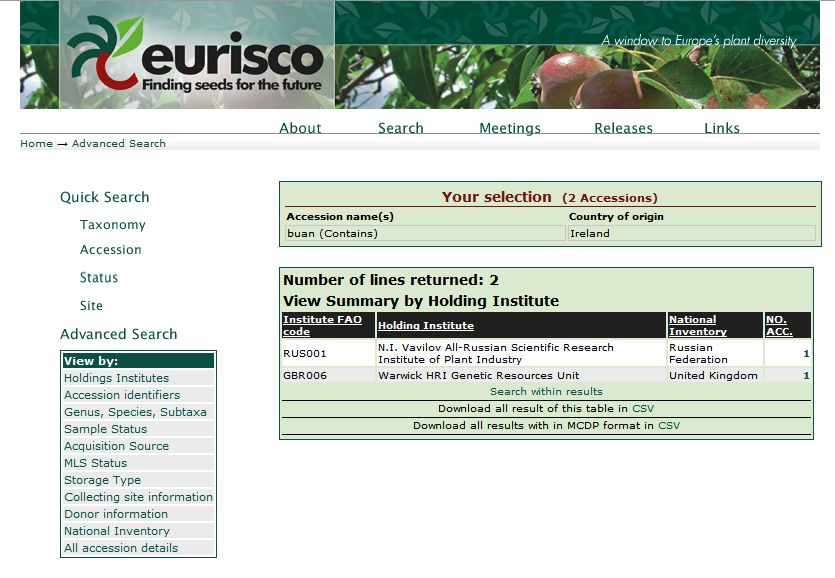
Occasionally — just occasionally — Genebank Database Hell doesn’t live up to its fearsome reputation. Or maybe it’s just diminished expectations on my part, I’m not sure. Anyway, Eurisco confirms that the Irish onion called Buan Jeremy blogged about yesterday is found in the genebanks at Warwick and VIR. Interestingly, a grand total of 7 onions of Irish origin are in existence in the world’s genebanks, most of them at VIR. Thank goodness for Europe’s amateur heirloom gardeners, eh?
Harvest time at Berry go Round
Dave at Osage + Orange has got the early harvest in with a round-up of the best botanical blogging around in this month’s Berry go Round. There are trees, hedges, haystacks and much, much more. Go, read, link (and consider submitting to A DC Birding Blog for Sep[tember.
Lafort onion, and Wellesbourne, revisited
Chasing stuff down, because we can, sometimes results in (very mild) disappointment.
When I read about an onion called “Lafort (sourced originally from the Wellbourne [sic] gene bank and regenerated by Irish Seed Savers,” we not only Nibbled it, I also dropped a note to Irish Seedsavers asking for the full story. I had hoped that, despite the frenchified name, it might be a long-lost Irish onion kept at Wellesbourne and now repatriated. Alas, it seems not …
Here’s the story, lightly edited by me:
Wellesbourne told the Irish Seed Savers that Lafort comes from Norway originally. Michael Miklis (who was instrumental in re-locating and re-propagating the Irish heritage grain collection from his farm in Kilkenny from 1998-2001) met Dave Astley [then head of the genebank at Wellesbourne] in 1999, and asked whether Wellesbourne had the Irish onion variety Buan. (Irish Seed Savers did get seed of Buan from the Vavilov genebank.) Miklis also asked about any other onions that would mature early in a long-day environment. Dave spoke to a Wellesbourne onion breeder, who suggested selections from Norway that are generally early maturing. The original sample of seed came to Wellesbourne from the Royal Norwegian Society for Development.
And so to answer the question, it came to Irish Seed Savers from an interested party who was in all likelihood trying to expand the open-pollinated gene-pool for onions in this country, making sure that suitable breeding material existed here. At Irish Seed Savers we often have things in the fridge collection that contain little mysteries, from a previous era when things weren’t written down and recorded so much. Your enquiries have certainly helped us to shed more light on this particular onion. And in order to secure our seed stocks, we have a regeneration programme of sorts that has the advantage that all the extra seed that is produced, as a result of allowing a largish population [to] flower and seed together (to maintain its genetic breadth), becomes seed available to members and the public. We take our own sample of the seed, foil-packet it, both fridge and freezer it, and the rest is for gardeners and, we hope, seed-savers to grow themselves. Anything without much merit doesn’t generally make it to this stage, although that’s a different story…
Indeed it is, and I hope this encourages seed savers everywhere to document their trials and tribulations. Was Lafort the only Norwegian onion to pass muster in Ireland? And is it, indeed, Norwegian in origin?
Wellesbourne’s glorious past segues nicely into a (new?) page by Dr Charlotte Allender, Assistant Manager of what is now called the Genetic Resources Unit, where she “explains more about the unit and the aims it hopes to achieve”.
What is the importance of preserving the genetic history of crops?
Far from being a museum or a kind of sealed time capsule, the seed collections in Warwick Genetic Resources Unit are in constant use. Around one thousand sub-samples are retrieved from the cold room and sent out every year. The foil packs which leave the arctic environment of the cold store do so at the request of a variety of people and organisations. Seed is conserved and managed for research, plant breeding, education and development. It can therefore arrive in the laboratory of a researcher interested in the network of genes that control aspects of plant growth and development, or to the field station of a plant breeder wishing to add new variation to their breeding programme. Seed can also find use in exhibits at public attractions such as The Eden Project or in small scale crop improvement programmes carried out by groups of farmers in countries as diverse as France and India.
The way in which the collections are being used is evolving too. Technological advances in DNA sequencing mean that potentially hundreds of genomes can be analysed in a shorter time and at a fraction of the price than when the human genome was sequenced. Comparing genetic differences between plants with contrasting appearance, maturity time or disease resistance (or indeed any interesting trait) allows researchers to understand and identify the genes responsible, and through doing this channel them into new crop varieties more quickly than traditional plant breeding would allow. However, once the genetic analyses have been completed, and DNA sequences are safely stored, the seed itself will still be required to transfer the genetic diversity forward into the new varieties ultimately destined to end up on our plates.
Seed collections such as that housed in the Warwick Genetic Resources Unit are a vital resource in the quest to produce more food in a less environmentally damaging manner. Entering the cold room and breathing in the frigid air, it is easy sense the history sealed in each of the foil pouches, and to pause and contemplate the potential of the diversity held in a cold-induced sleep. But not for too long – it is, after all, very cold in there.
Long may it thrive. And provide seed.