Kate Gold asked herself how those tree tomatoes got to Kenya from the Andes, and then answered her own question:
“missionaries or settlers moving north from the Cape of Good Hope after the Boer Wars may have taken seeds of C. betacea with them to Kenya and Tanzania.”
Seeds had come to the Cape from the Botanical Gardens in Jamaica. How tree tomato reached Jamaica is not clear, but it was well established there by 1884 (but, interestingly, is seldom seen there today).
Lots more information and a map showing dispersal routes around the world:
As promised, here’s my interview with the mother-in-law about her attempts to diversify into tree tomatoes. Which incidentally I gather we should be calling Solanum betaceum rather than Cyphomandra betacea. Thanks to Linda for the cinematography.
Sorry about the rather unprofessional ending. And sorry about the poor sound quality, which is due to the fact that I was using the built-in mike on my camera. In case you didn’t get some of the story, here’s a quick recap.
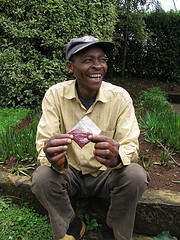
A local guy called Mr Muiruri came by a few months ago with an offer for grandma. Here he is at right with one of the packets of tree tomato seeds he also sells. He asked to plant some seedlings on her land. He would take care of them and then when they started bearing would pay her KSh 40 a kilo. He is able to sell the fruits for about KSh 60 to kiosk owners in Nairobi, who then sell them on for even more. Grandma agreed, and Mr Muiruri duly planted about 80 or so trees in two or three separate parcels on her land. Here is is harvesting one of these lots, which happens to be intercropped with cabbages. He says the leaves improve the soil.
Mr Muiriuri has similar deals with several other farmers in Gataka. He moves among them on foot, carrying the harvest in plastic bags, then makes his way to the main road, which thankfully is now paved, where he catches a matatu to Limuru and then another to Nairobi. It’s a lot of work, but he’s passionate about his tree tomatoes. And other fruits too. He’s got a small nursery where he plays around with new species as he gets hold of them. A true entrepreneur.
Too bad none of them are local. The “nathi” that the mother-in-law mentions towards the end of the interview is Physalis peruviana, a South American native that was introduced to the Cape about 200 years ago (hence the name, Cape gooseberry) and spread from there to other parts of Africa, where it is used for food and medicine. Not that there are no native edible fruits in the highlands around Limuru. ICRAF’s database lists about a dozen. I talked about some of them with Mr Muriuri. There’s not much he can do without seeds, though, and they’re difficult to find. But I like to think maybe the seed of an idea has been planted.
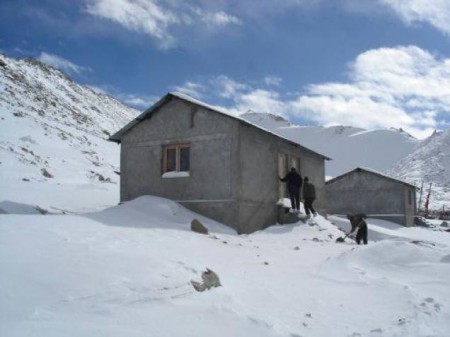
The Indian Council of Agricultural Research (ICAR) and Defence Research and Development Organization (DRDO) signed Memorandum of Agreement for conservation of plant genetic resources in the National Permafrost Repository at Chang-La, Leh, Ladakh (J&K).
So India now has its very own seed vault in the permafrost. The above is from an ICAR press release from a couple of days ago. But The Hindu reported on the Permafrost Repository as long ago as early last year. This photograph is from that article, so things may have changed since then.
It’s not altogether clear to me why India would wish to do this, when it can send safety duplicates of its material to Svalbard for free and under black box conditions, but anyway.
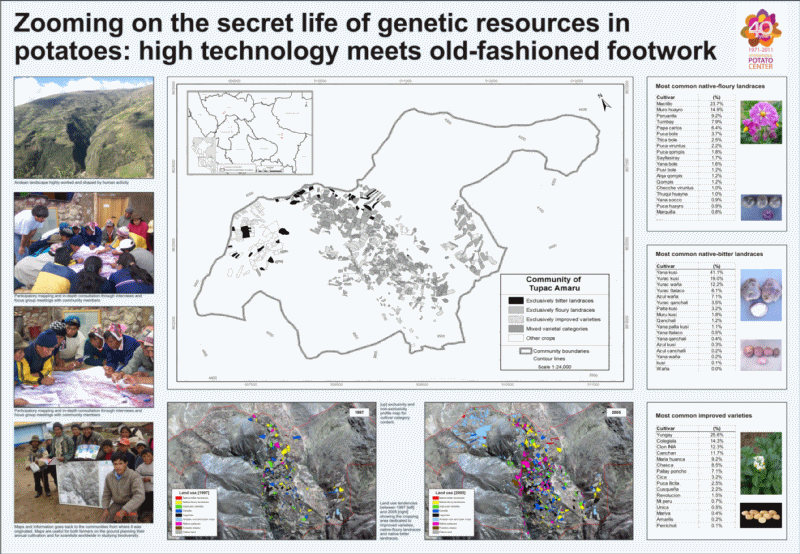
Land use tendencies between 1997 and 2005 shows that the total cropping area dedicated to improved cultivars has grown fast while the area reserved for native-floury and native-bitter landrace has remained more or less stable. Reduced fallow periods for existing fields and the gradual incorporating of high-altitude virgin pasture lands sustain areal growth. While areas of improved cultivars are proportionally growing fastest at extremely high altitudes between 3,900 and 4,350 m of altitude, overall cropping intensity or fallowing rates are inversely related to altitude. No evidence of a straightforward replacement of one cultivar category by another was found.
That’s from the winners of the third prize at the SCGIS/ESRI/SCB International Conservation Mapping Contest, Traditional Cartography section: CIP’s Henry Saul Juarez Soto, with Franklin Plasencia and Stef de Haan. Worth reading the whole thing.
“We tell farmers that diversifying to more drought resistant crops is key to cope with the changing climate,” Leakey says. To encourage them, she offers a “Leldet Bouquet”: Instead of 2kg maize seeds costing 300 Kenyan shillings ($3), the farmer can get a mix of five seed packets with an equivalent weight of cowpeas, sorghum, beans, pigeon pea, millet and maize. The mix of crops in the “bouquet” is adapted to the farmer’s location.
That’s from an AlterNet story from a few days ago, but we blogged about the Leldet seed company back in June. Now, how cool would it be to get some genebank samples into those Leldet Bouquets? Or maybe even the mother-in-law’s maize…