- Diversity, geographical, and consumption patterns of traditional vegetables in sociolinguistic communities in Benin: Implications for domestication and utilization. 245 species, from 62 families, 80% wild-harvested.
- Landraces in situ conservation: A case study in high-mountain home gardens in Vall Fosca, Catalan Pyrenees, Iberian Peninsula. 39 landraces of 31 species, disappearing fast.
- Origin, history, morphology, production, improvement, and utilization of broomcorn [Sorghum bicolor (L.) Moench] in Serbia. Summarizes 60 years of experience.
- The timing of flowering in barley and sunflower dissected. In the former, variation in photoperiod sensitivity occurred both pre- and post-domestication. In the latter, variation is clinal.
- Cultivated and wild Solanum species as potential sources for health-promoting quality traits. Some of the latter are pretty good.
- Microsatellite fingerprinting in the International Cocoa Genebank, Trinidad: accession and plot homogeneity information for germplasm management. A quarter of plots were mixtures. Well that’s no good. Huge amount of stuff in this issue of PGR-CU.
- Construction of an integrated microsatellite and key morphological characteristic database of potato varieties on the EU common catalogue. So that the above doesn’t happen.
- Footprints of selection in the ancestral admixture of a New World Creole cattle breed. Lots of African and zebu blood in Guadeloupe cattle.
- Inventory of related wild species of priority crops in Venezuela. Basically a big list.
- Potential of herbarium records to sequence phenological pattern: a case study of Aconitum heterophyllum in the Himalaya. Could be used to flesh out the above kind of thing.
- Refugia: identifying and understanding safe havens for biodiversity under climate change. How to spot refugia past and future, which would be useful for the above-but-one kind of thing.
- Modelling biome shifts and tree cover change for 2050 in West Africa. Climate change leads to greening, human impact to browning.
- Comparison of modern and historical fish catches (AD 750–1400) to inform goals for marine protected areas and sustainable fisheries. Along the Kenyan coast. Amazingly, comparisons are possible, and they show a deterioration in quality and quantity.
- The biodiversity benefits of botanic gardens. They are there, despite their history with invasives, but gardens need to get their act together. Which they are doing.
- Domesticated crop richness in human subsistence cultivation systems: a test of macroecological and economic determinants. Number of crop species grown depends on latitude, habitat heterogeneity and commitment to agriculture (as opposed to foraging, herding and exchange). Can’t make up my mind if this is interesting or predictable. Maybe it is both. Would be great to apply same method to infraspecific diversity too.
- The age of monumental olive trees (Olea europaea) in northeastern Spain. Maybe over 600 years.
Roads not taken
How to conserve animal genetic resources
And speaking of eloquent images, here’s another one, this time from the world of animal genetic resources conservation.
Ooops, no, that’s not the one I meant. It was this one:
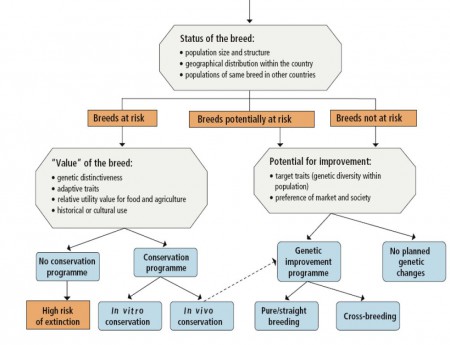
Which comes from the draft FAO Guidelines for the In Vivo Conservation of Animal Genetic Resources. Lots more details there. Via CGN.
Featured: Coconut map
Hugh Harries has a bone to pick with some lines on a map:
…Sailing ships, like floating coconuts, go with winds and tides. The introduction of coconut into the Atlantic and Caribbean by the Portuguese was via the Cape Verde islands not the Gulf of Guinea and annually, for more than 200 years, the Spanish carried hundreds of people and thousands of coconuts from the Philippines to the west coat of America (from Mexico to Peru) by a north Pacific route avoiding any islands…
Move over Bill Gates
We’ve blogged a few times about the System of Rice Intensification (SRI), and I don’t really want to do so again at any length now. Suffice to say that the jury is still out on whether it works as advertised. The reason I bring it up at all is that I’ve just found out from CTA via their Facebook page that there’s a new SRI manual out, which on further investigation led me to the mother lode of SRI manuals, which turns out to be part-supported by the Better U Foundation. Yeah, I never heard of it either. But it clearly has a great interest in SRI, not to mention an inventive web designer. The philanthropist behind it? Jim Carrey. Yeah, that Jim Carrey. That’s a pitch I’d have liked to witness.