Jeremy and/or Andy will no doubt correct me if I’m wrong, because they’re there and I’m not, but I believe it is the very presentation embedded below that was made a matter of only minutes ago by our friend and colleague Andy Jarvis of CIAT at the Special Information Seminar on CLIMATE CHANGE AND GENETIC RESOURCES FOR FOOD AND AGRICULTURE: STATE OF KNOWLEDGE, RISKS AND OPPORTUNITIES at FAO. How’s that for timeliness. If not, then Andy will probably give it at the CGRFA-13 side event on pretty much the same subject on Tuesday. Or maybe both? No online sign of the other presentations yet, but I’ll get the scoop on the event from the boys this evening, I expect.
More on those Azeri buffaloes
Thanks to Elli from the Save Foundation for this comment on our recent post on water buffalo in Azerbaijan.
They were crossed with Murrah in Soviet times, just like in the Ukraine and Bulgaria. I’m just preparing a report on Buffalo in SE Europe and we’ve been looking at the situation in Georgia too.
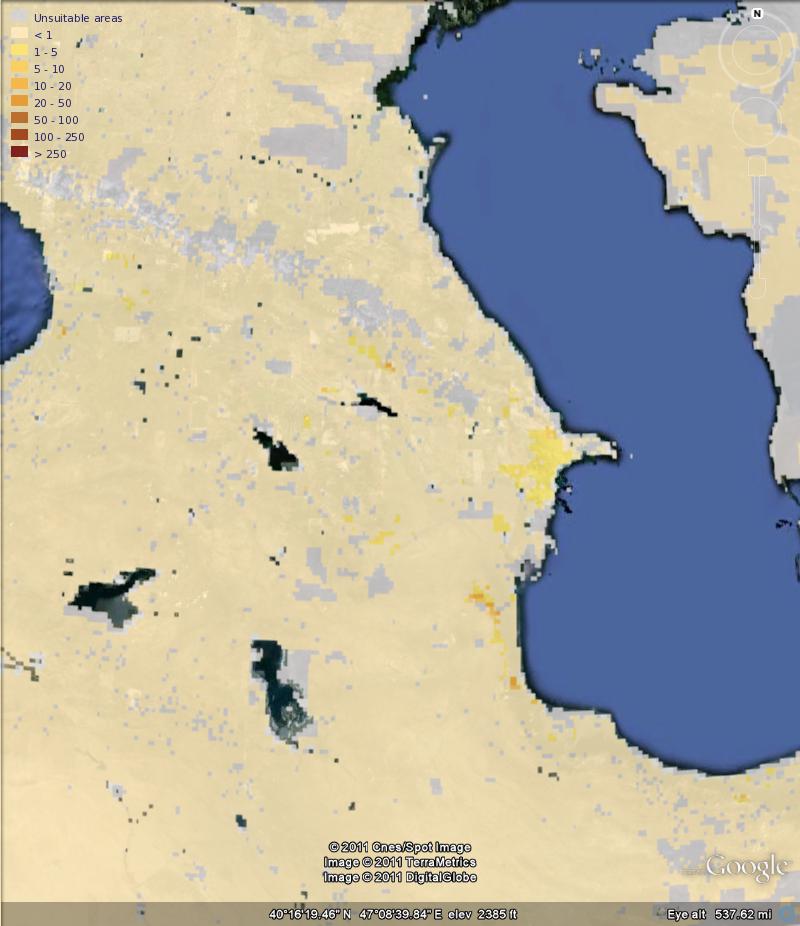 Good to know. Incidentally, I should have mentioned another source of livestock information on the previous post: Gridded Livestock of the World (GLW). If you squint, 1 you can just about make out that it does show some buffaloes in Azerbaijan and other countries in the southern Caucasus.
Quinoa phylogenetics unraveled
Our regular reader and occasional contributor Eve Emshwiller informs us that her student Brian Walsh has won the award for best student poster from the Economic Botany Section of the Botanical Society of America at Botany 2011 in St. Louis. Here’s the abstract. There’s some talk of the poster itself perhaps being made available online in due course. Fingers crossed.
Phylogeny of American Chenopodium species with focus on origins of the domesticated taxa.
The edible seeds of quinoa (Chenopodium quinoa, Amaranthaceae) have gained popularity worldwide, based on nutritional qualities and ease of growing. Most people do not know quinoa is one of four cultigens of Chenopodium domesticated in the Americas: C. quinoa and C. pallidicaule from South America, C. berlandieri ssp. nuttalliae from Mesoamerica, and the extinct C. berlandieri ssp. jonesianum recovered from archaeological sites throughout eastern North America. Despite nearly 100 years of debate researchers still do not agree on the relationship among these domesticates. Conflicting hypotheses have been proposed asserting whether cultigens were domesticated independently or represent introductions into neighboring regions. Alternative hypotheses suggest two, three, or four independent domestications of Chenopodium in the Americas, and proposed several putative wild progenitors of the cultigens. To investigate the relationships among cultigens of Chenopodium and assess potential wild progenitors, a phylogenetic framework of the genus emphasizing New World species is required. Phylogenetic analyses of DNA sequences of non-coding loci, both nuclear (SOS1 intron 17, COS at103, ITS) and plastid (trnQ-rps16, trnL-trnT, ndhJ-trnF-trnL, psbD-trnT, and psbM-ycf6), were conducted using parsimony, maximum likelihood, and Bayesian analyses. Taxon sampling includes 19 Chenopodium species from North and South America, with focus on the extant cultigens and subspecific taxa within C. berlandieri.
Findings include the following: Chenopodium pallidicaule is genetically distinct from other extant cultigens.
Sampled cultivars of the Mesoamerican cultigen, C. berlandieri ssp. nuttalliae, unite in a single subclade, nested within, but distinct from wild C. berlandieri.
Chenopodium quinoa is nested within the C. berlandieri complex, but not within the C. berlandieri ssp. nuttalliae clade. Interestingly, the southern-most range of wild C. berlandieri is southern Mexico, whereas quinoa is cultivated in Eduador, Peru, and Bolivia. These findings are consistent with independent domestications of the extant cultigens. Using nucleotide markers unique to C. berlandieri ssp. nuttalliae, ancient-DNA analyses will be conducted to determine the relationship of the extinct cultigen, C. berlandieri ssp. jonesianum.
Capt Bligh’s biopiracy medal to be sold
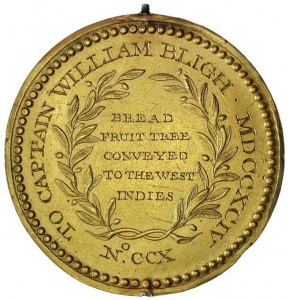 Speaking of breadfruit, two of Capt Bligh’s medals are up for auction. One of them was awarded by the Society for the Encouragement of Arts, Manufactures and Commerce, later the Royal Society of Arts, for taking breadfruit from Tahiti to the West Indies in 1794.
As you’ll remember, that enterprise did not start well. But Bligh did not let a little thing like a mutiny stop him, and threw in Blighia to boot.
By February 1793 the breadfruit mission had been accomplished. Bligh also took specimens of the ackee fruit (Genus Blighia) of Jamaica to England and introduced it to the Royal Society and provided specimens for the Royal Botanical Garden at Kew. The Genus Blighia, which consists of some four specimens of evergreen tropical shrubs and trees, is named in William Bligh’s honour. The most commonly cultivated of these is the Blighia sapida.
But would it have killed them to put breadfruit leaves on the thing, really? Or Blighia leaves for that matter.
Katherine’s monkey’s peanut
In the original the monkey is being offered a peanut.
Really? Well, it’s an innocent enough statement in most circumstances. But a little problematic if the monkey is being held by Katherine of Aragon in a portrait from the 1530s. Were there really peanuts, a South American crop, so easily available at Henry VIII’s court in England only forty years after Columbus? 2 It’s not inconceivable, but really?
Ok, so how did we get here? It all started with a podcast from the BBC History Magazine which came out in April 2009. 3 In it, Brett Dolman, the Curator of Collections at Hampton Court makes the peanut comment in an interview with the magazine’s editor about an exhibition of portraits of Henry’s wives that was on at the time, and which was featured in the magazine. You can hear it at about 8:40 minutes into the podcast.
What Dolman says is that the portrait of Katherine of Aragon they had in the exhibition, which I take to be the one on the Hampton Court website, 4 is a copy of an earlier painting. It is in the original that the monkey is being offered a peanut by the queen. In the copy, it is being offered a coin, but instead reaches for the crucifix at her neck. That’s apparently symbolic of Katherine’s belief in the sanctity of her marriage to Henry, and her refusal to accept money for a divorce.
Whatever. What we’re really interested is the original. The one with the peanut, remember? Well, I can’t be sure without too much more research than I can devote to this at the moment, but I think that original is probably “Katharine of Aragon with a monkey” (c1525) by Lucas Horenbout/Horenbolte, who was an official court painter. And here it is.
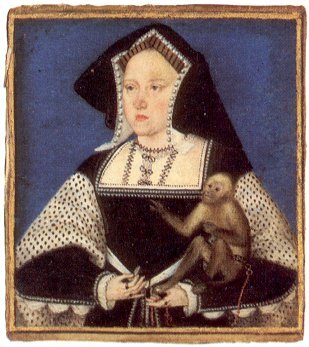
So is it a peanut? It’s difficult to tell, but I’m inclined to doubt it. The first European image of a peanut appears to come from a century later:
Another description of the Katherine portrait refers to “a scrap of food.” All in all, I’d go with that. And art historians of the world, I’m available for consultancies.