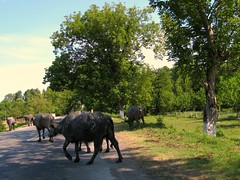
I have no doubt there are water buffaloes in Azerbaijan, though it did come as something of a surprise. I saw them and ate delicious cheese, butter and yoghurt made from their milk last week during my visit to the national genebank there. And there is stuff on the internet about them. But, frustratingly, no production data in FAOSTAT, though there are some head numbers from 1992 onwards. Nor is there any breed information at DAD-IS, though my hosts told me there was an active improvement programme involving crossing of the local breed with stock from other countries during Soviet times. Apparently, on independence the breeding farms were broken up and the animals were given out to the workers in lieu of wages. They seem to be doing just fine.
Food Vendor films
IRIN, “a service of the UN Office for the Coordination of Humanitarian Affairs,” has launched a new series of short films.
The Food Vendor tells the story of staple foods in different countries around the world and sheds light on the problems faced by the world’s poor in light of rising food prices.
I watched the first one, on lentils in Nepal, and found it rather tasty, so I thought I would share it here. Alas, unless I’m missing a trick, that does not seem possible. I can download it alright, and share the link on other sites, but I cannot seem to embed the movie here. Too bad, I suppose.
And if you’re into artisanal food processing, just look at the way the woman carefully wet-grinds the lentils at the start of the film.
Roadside fruit diversity

In Azerbaijan.
A banana is a banana
The identification of Musa paradisiaca with a plantain and Musa sapientum with a sweet banana probably reinforced the tendency to associate each name with a type of fruit, respectively plantain for the cooking types and banana for the sweet types. In fact this distinction is entirely semantic and artificial. It has no botanical basis, nor indeed any consistent culinary basis. A banana is a banana, whether it is cooked or eaten raw.
But you knew that, right? The quotation is taken from the Musapedia on the all-new, all-singing, all-dancing ProMusa website. So for more than you could possibly want to know about banana nomenclature, and much else besides, you now know where to go.
Now, just remind me, what is the difference between a banana and a plantain?
Potato flesh colors
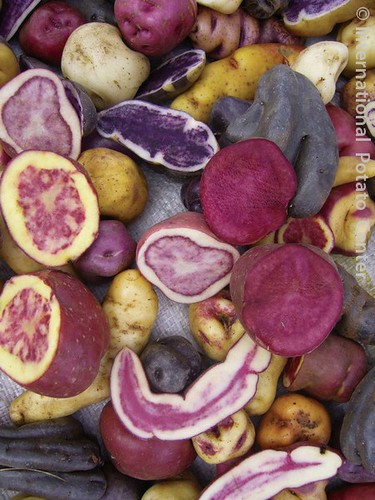
Potatoes’ flesh colors / El color de las pulpas en papas, a photo by CIP – International Potato Center on Flickr.
Great shot from CIP.