 Oh, pesky scientists! A bunch of them in Spain has taken a close look at one of the darlings of European tomato culture and found it, how shall we say, disappointing. 1 The subject of their investigation was a type of tomato known as Marmande, associated with the town of that name. There are several landraces of Marmande tomatoes, and in northeast Spain two of them, Montserrat and Pera Girona, are grown in adjacent areas. Each has its favoured consumers, who argue that their Marmande is better than the others’, although both Montserrat and Pera Girona are apparently facing competition in their respective niches from upstart Marmande tomatoes from France, Italy and elsewhere in Spain.
The researchers note that:
Often without experimental confirmation, many consumers consider that everything “traditional” tastes better than improved varieties.
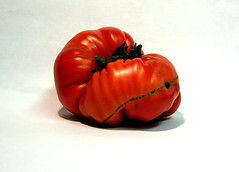 And they’re not going to stand for that. So, they went to growers and got samples of the two kinds of Marmande, a couple of controls from further afield, and some commercial varieties, grew them in the field and evaluated the hell out of them, including a slew of molecular tests. And here’s the bad news; while the controls and far-off Marmandes were quite distinct from one another and from Montserrat and Pera Girona on molecular data, those two could not be separated from one another, favoured consumers be damned. There were differences in the outward look of Montserrat and Pera Girona, but within each landrace the range of scores on sensory traits (what consumers are probably “preferring”) was far greater than any differences between the two.
There are differences, of course, mostly in what the two varieties look like. Montserrat has flattened fruit, while Pera Girona is pear-shaped. So, what’s going on? Farmers are clearly selecting to conform to the landrace stereotype, but not much else.
[T]he recent evolution of these tomato landraces has resulted in uniform fruit morphology and wide variation in texture, aroma, and taste. It seems farmers have selected seeds solely on the basis of fruit morphology, neglecting sensory traits. Texture, aroma, and taste do not correlate with the shape of the fruit; thus, the persistence of separate markets for these varieties is exclusively due to morphological differences in the fruit. It seems that consumers continue to identify certain morphologies with superior quality.
And this is by no means a unique phenomenon.
Selection for morphological traits while neglecting sensory traits seems to be practiced widely: variability in sensory attributes related to a genetic base has been reported in beans … and in eggplant. … In other cases, variability in sensory traits is related to cultivation practices, as in the RAF tomato, which can be acid, sweet, and crisp when cultivated in salty soils but of poor sensory value when cultivated in high yielding soils. As a result of cultivation expansion, the prestige of RAF tomatoes blossomed and wilted in a short time.
Inevitably, then, consumers are going to be disappointed by their chosen landrace at least some of the time. What’s to be done?
In order to consolidate the market, the link between organoleptic and morphological traits must be maintained and reinforced.
In other words, get back to basics: gather a group of keen consumers, identify what it is about each variety that attracts them, and then start selection to make sure that the tomatoes deliver more than appearance. As good as their word, the scientists have already done this for Pera Girona, and they say that just one round of selection has already “resulted in an improved inbred line”.
Ah, but is it still a traditional landrace?
 Having recently taken on a bit of the management responsibility for Berry Go Round, I am duty bound to give it perhaps more room than we might have in the past.