Religion, diet and nutrition

We tend not to set too much store by religion around these parts, so a letter in response  1 to The Economist’s recent pieces on nutrition piqued our interest. It read, in part:

In the March issue of their magazine, the Church of Jesus Christ of Latter-Day Saints reported on a food initiative which has taught many members to garden, even in small, urban spaces, and with whatever containers they can find. Started in 2009, these people have gone on to teach others in their communities how to increase their nutritional intake—and self-reliance—with just seeds, soil and sunlight.

Let me Google that for you. Better yet, having Googled it, let me fillet out the article in question and make it available all on its own. Turns out that not only are Mormons keen on urban and container gardening for diversity and nutrition, they’ve been so for quite a while. A former US secretary of Agriculture, Ezra Taft Benson, was President of The Church of Jesus Christ of Latter-day Saints, and set out a very familiar vision of how to prepare for the Days of Tribulation:

Get together with others and seek permission to use a vacant lot for a garden, or rent a plot of ground and grow your gardens. Some elders quorums have done this as a quorum, and all who have participated have reaped the benefits of a vegetable and fruit harvest and the blessings of cooperation and family involvement. Many families have dug up lawn space for gardens.

That sounds like a modern manifesto to me. Of course, there’s an appeal to authority too:

President Brigham Young said, “If you are without bread, how much wisdom can you boast, and of what real utility are your talents, if you cannot procure for yourselves and save against a day of scarcity those substances designed to sustain your natural lives?”

One to ponder. Meanwhile, I wonder whether those members of the Mormon faith who heeded their presidents’ advice saw any impact on their nutrition?

A coconut impostor unmasked

Are you one of those that gets upset when a film-maker, say, tries to get one part of the world to stand in for another without giving a thought to the possibility that the respective floras might be entirely different? I’m afraid I am, and many a movie supposedly set in Africa, for example, has been spoiled for me when I realized, by looking at the plants, that it was filmed in Hawaii or Costa Rica.

Roland Bourdeix has the same problem, if the recent exchange on the Cococnut Google Group is anything to go by.

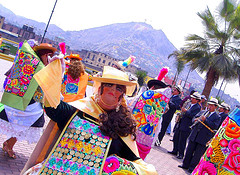
Roland received the following postcard from Guadeloupe.

Fair enough for most people, but being the coconut expert he is, Roland immediately realized that the photograph depicted Tahiti Red Dwarf (also called Rangiroa Red Dwarf or Haari Papua). Problem is, that variety is not recorded from Guadeloupe. So, either it has been very recently introduced, or, more probably, according to Roland, the postcard company simply used a picture of a coconut from another country, perhaps French Polynesia, and passed it off as being from Guadeloupe. And nearly got away with it…

Biofortified foods rolled out across Latin America and the Caribbean

Agro-Salud, “a multi-partner ‘biofortification’ program,” has announced on the CIAT blog that it is releasing new varieties of rice, maize and beans to poor communities in Bolivia, Colombia, Honduras and Nicaragua. The new crops are described as “nutritionally enhanced” and also “out-perform traditional crops in terms of disease resistance and yields”.

The new varieties add to more than 40 nutritionally-improved crops that Agro Salud and its partners have released across the region since 2007.

I wonder if they have had any impact on nutrition?

Onions of the Southwest

There may be a chili in the photograph which goes along with the NY Times piece on Gary Nabhan’s new book “Chasing Chiles: Hot Spots Along the Pepper Trail,” but I have it from a reliable authority 2 that most of the plants are i’itoi onions. Which have a fascinating story of their own.

Its journey to the Southwest began in the late 1600’s when Jesuit missionaries coming from Spain shepherded the onion across the ocean. It adapted wonderfully to the arid environment and was soon a valuable food source and also used for medicinal and ceremonial purposes. The first harvest was completed on the soil rich “bajadas” or slopes of the Baboquivari Mountain. This mountain was considered the birthplace of the Hohokam people, the ancestors of today’s Tohono O’odham (The Desert People). I’itoi,or Elder Brother, was the creator of the desert people and still resides watching over his people high up in the mountain in a cave where few can ever visit.