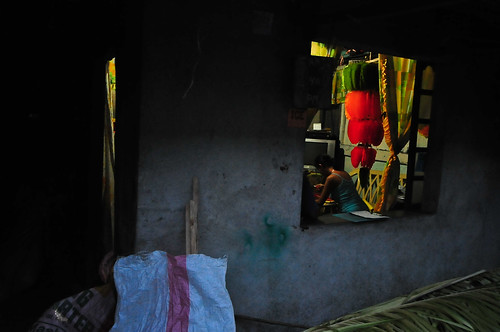
“Pahiyas is a Filipino term that means precious offering and predates the Spanish colonial period of the country by several centuries. This celebration was originally an animistic ritual practiced by the pre-Christian Filipinos to honor their rice god, Ampo’t Paray, and to ask for bountiful harvests in the coming year.”
What the UK’s DfID is doing about nutrition
Anna Taylor is Senior Nutrition Adviser at the UK Department for International Development (DfID). In this little video she discusses the Scaling-Up Nutrition initiative and the Montpellier Panel Briefing. I don’t think I heard the D-word …
Identifying the source of Bluefields’ breadfruits
Frank Lohmann asked an intriguing question in a comment on a recent post about breadfruit:
I have several breadfruit trees, which most likely go back to the trees captain Bligh brought to Jamaica, does anyone know which variety that is?
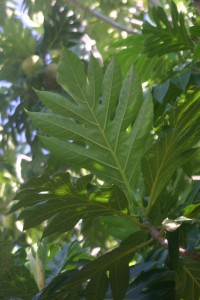 The reason Frank gave for believing his plants to date back to Capt. Bligh is “because he brought them to Bluefields were I live and planted them here.”
I asked for some photos and showed them to Diane Ragone of the Breadfruit Institute in Hawaii. She said that it is certainly plausible that the tree is from Tahiti.
Pressed for a variety name, this is what she said:
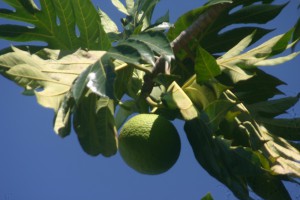
It’s so hard to tell with the Tahitian varieties. There are so many of these Polynesian triploid types with round fruit and deeply lobed leaves. Perhaps Rare, which was one of the varieties that Bligh noted in the Bounty log, but no mention in the Providence log as to what he actually brought to the Caribbean. A paper on that is on my too-long and neglected list of papers on breadfruit!
So we’ll just have to wait for a positive ID. But Frank could well be right that his breadfruits go back to the famed captain. I for one will choose to believe they do.
Discovering lost breeds in the US
I can’t help reproducing this fun piece from the latest e-newsletter of the American Livestock Breeds Conservancy.
One of the most important parts of ALBC’s work is the “discovery” element. “Discovery” means that ALBC uses its networks and resources to find rare breeds – out there, in the fields, woods, and barns where they have quietly survived for generations. Often, these are unique strains or in some cases, unique breeds with unique genetics.
Most recently, ALBC was contacted by the state of North Carolina about populations of goats on several islands off its southern coast. State officials were considering removing the goats from the island, but they wanted more information about the goats before they did.
ALBC’s technical staff traveled out to sea and visited a few of the islands. The goats have been feral on the island for over 25 years. The goats were skittish, but ALBC staff was able to capture images that were later evaluated for breed type and characteristics. Further explorations are planned for the coastal NC goat population, but evidence suggests several herds of these goats may have Spanish influence or be a unique strain of Spanish goats. In the meantime, the state has called off the removal of the goats from the island until more information is obtained. Discovery of America’s hidden breeds is an exciting and essential piece of ALBC’s work.
I bet it is!
Featured: Wheat landrace trials
Andrew Forbes of the Brockwell Bake Association writes in to point out that they also have heritage wheat trials:
…I think around 90 accessions growing on two allotments and other locations in South London + farm South from London – though around 25 of these are samples of three specific UK origin pre-19th C wheats (Red Lammas, Old Hoary aka Kent wooly eared aka Ble a Duvet and Old Kent Red) collected form JIC and other European gene banks. We also have some material including a larger quantity of Blue Cone Rivet than has been in UK for many years (centuries?) from French farmer/wheat breeder and collector Florent Mercier.
Planning to have an open day for viewing of these trials on Rosendale Allotments on July 17th. To stay in touch with arrangements for this probably easiest to join Brockwell Bake as member (its free).
I think I just might! Oh and here’s a follow-up.
You may also like to check our anticipated heritage wheat programme for next few years here.