Yemen spatial data online, sort of

For what it’s worth, I have enormous admiration for IFPRI and its products. Not that they give a damn about that, but I just want to get it out of the way before slamming them. First, the news item on a new interactive atlas of food security in Yemen doesn’t have a link to the new interactive atlas of food security in Yemen. Not to worry, though, Google is your friend, 1 and it’s not all that difficult to find the relevant page on the IFPRI website. But then the new interactive atlas of food security in Yemen turns out to be nice enough as to content, but highly frustrating to use. No way to download or export maps. I had to get the thing below (showing barley cultivation, for the record) through a screen grab. Yuch.
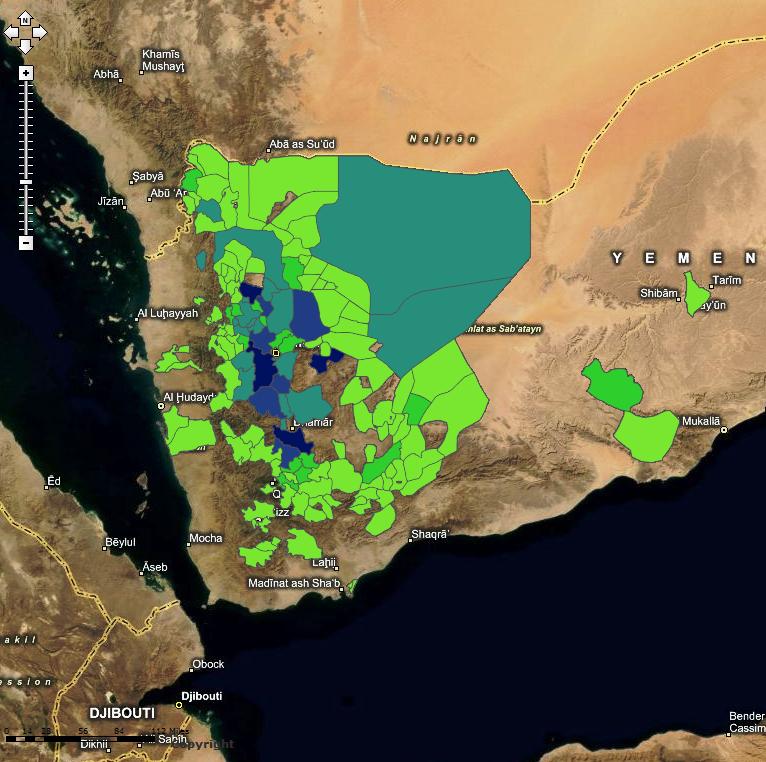
And no way to mash up the results with other stuff. Like, for example, barley accessions in Genesys. Which in contrast you can export in a number of ways.
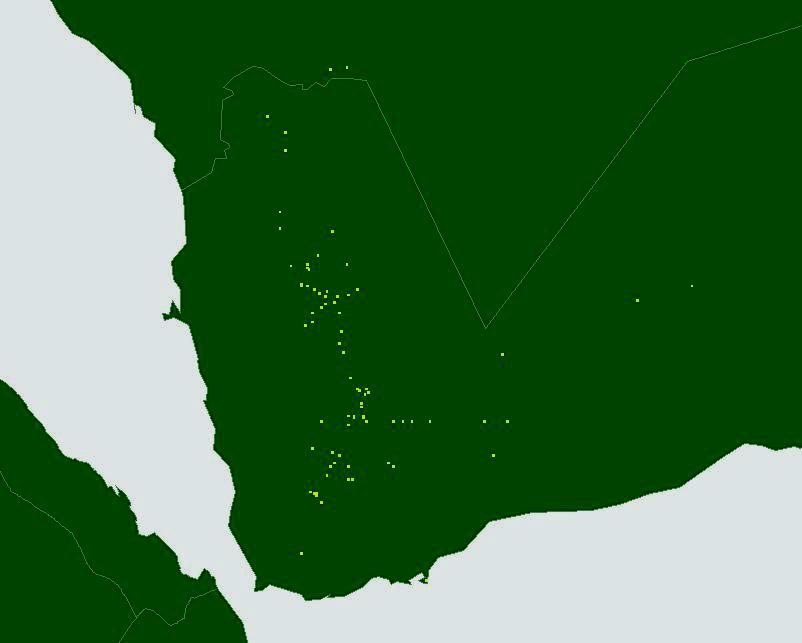
Oh, sure, there are some words of explanation, if not excuse:

The online version does not require installing software but it is more limited in the sense that the underlying data cannot be accessed by the user (unlike in the case of the download of the data package).

But I don’t believe it would be that difficult to allow some sort of exporting online. Maybe I’m wrong. Someone tell me, please.

So, anyway, two maps which cry out to be looked at together, for example in Google Earth, and no way of doing so, at least that I can see. As I say, very frustrating. Who do I complain to? There someone in the CGIAR to whom I can go with a query about spatial data, right? Isn’t there?

Back to Balinese rice production

Luigi goaded me into watching Stephen Lansing’s presentation on Balinese rice production, and I’m glad he did. It gives me the opportunity to make a couple of points.

A questioner, at about 1.08, finds it fascinating that the system Lansing described “works for monoculture crops,” and asks whether it might apply in any way to the monocultures of the American midwest. She’s using monoculture to mean single species, as do many others people. But it prompts a reflection on the genetic diversity of the Balinese rices. Lansing does say at one point that much of the diversity has been lost, although some survives up in the hills. And the introduction of the high-tech package based on very uniform improved rice cultivars, starting with the canonical IR-8, failed because it didn’t take Balinese practices into account. And yet those practices too depend on uniformity.

The Balinese system works because farmers synchronize their plantings, so that after harvest there’s nothing left for rice pests to eat and nowhere for them to go. But that requires all the local varieties to have the same maturity period. Indeed, the fundamental unit of the Balinese calendar, the master clock, Lansing said, was the growth cycle of old Balinese rice varieties. I guess that the same would hold true today. Neighbouring farmers must grow varieties with similar maturity dates, otherwise all the complexity associated with synchronizing planting and sharing water goes out of whack at the end of the season.

If the farmers all decided to plant a genetically uniform modern cultivar, but stuck with their older rituals for timing the rice cycles, would the system work as before?

Featured: PGR newsletter

Somewhat belatedly (but they have other things on their mind) a message from Vavilov’s institute supporting the rebirth of Plant Genetic Resources newsletter:

Scientists and curators from the N.I.Vavilov Institute fully support this initiative. PGR Newsletter very important valuable publication and source of information for PGR community.

So what’s the story, Theo and Robert? Is no news good news? Let us have an update.

Cooperation in Bali, now and then

As the Fourth Regular Session of the Governing Body of the International Treaty on Plant Genetic Resources for Food and Agriculture gets off the ground in Bali, Indonesia, it may be useful to reflect, as Steve Lansing does in a fascinating talk, on what modern agriculture can learn from Balinese rice production. It turns out to be a lesson about the benefits of cooperation. 2

Synchronised irrigation schedules improve harvest and also reduce variance in harvests. The reduction in variance is potentially significant, because large differences in harvest could discourage cooperation by farmers with suboptimal harvests.