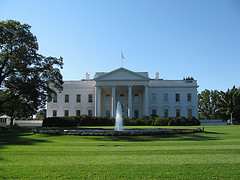
 There’s been a lot of talk lately about the demise of the Great American Lawn. Or at least its metamorphosis into something a little more sustainable. Even the White House lawn is not immune to re-development. But a recent post on the Native Plants mailing list of the Plant Conservation Alliance points to what may be the beginnings of a backlash. Here’s what Mark Simmons had to say in response to an article in the Star Tribune entitled Goodbye to Grass (Mark’s comments are reproduced here with his permission):
I really like my lawn – my low maintenance, species-rich, drought-adapted native lawn.
While I agree that lawns can be replaced with alternative vegetation, I think that the lawn is entitled to a place in the American landscape and we should be careful of following the current fashion of demonizing turf. It’s not the lawn that’s the problem is how lawns are manufactured. We take a usually single non-native species that’s been bred to rely on a life-support system of water, fertilizer, pesticides herbicides, and a crazy mowing regimen. If you look at native short grasslands around the world its clear that, in contrast, they are low nutrient, species-rich, systems which are at ecological quasi-equilibrium usually maintained by grazing and or fire. Here at the Lady Bird Johnson Wildflower Center we adopted an ecological approach to turf by testing different mixes of native turf grasses and against a commonly-used non-native turf lawn species (bermudagrass) and measured performance. The multispecies native mix needs less mowing, had less weeds and was a denser, finer (better looking) turf. The results were just published in the journal Ecological Engineering. Sure it can go drought-dormant and brown in summer if it’s not watered. But if that may be an acceptable alternative to no lawn at all.
My young children can’t play baseball in gravel and agaves. And I want to sink a beer on a Saturday evening bare foot in soft, cool turf. Let’s keep doing lawns, just do them smart.