Strange to have two long articles surface over the weekend that in some respects negate one another and yet that both seem to point to a different future for food security. The Des Moines Register points not merely to perennial grains, a favourite topic here, but specifically to perennial maize. The piece is packed with all that one might expect, including a couple of doses of reality. Who will do the research?
Perennial crops … have little appeal to today’s agribusiness, including seed giants like Pioneer Hi-Bred and Monsanto.
“They depend on selling a lot of seed every year,” said Bill Beavis, interim director of Iowa State University’s Plant Sciences Institute. “I’m not sure the perennials ever catch up [sic] just because they don’t have the resources” in terms of research funding, he said.
What funding would it take?
The USDA has asked Congress for $1 million in fiscal 2012 for perennial grain or sunflower research at its own labs, a slight increase over this year’s funding. In 2009-10, the department provided about $1.5 million in grants for perennial grains research at the Land Institute and a few universities, including Iowa State.
A serious effort to breed perennial corn crops would require spending $1 million to $2 million for five years to identify the genes necessary for perennialism, [Ed Buckler, an Agriculture Department scientist at Cornell University in New York] said. After that, $10 million to $20 million a year and dozens of scientists would be needed to breed a perennial corn that could eventually be commercialized, he said.
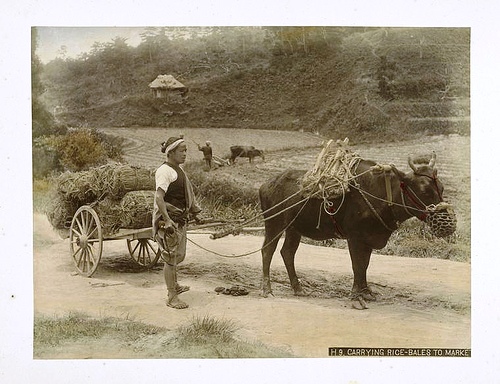
One beauty of perennial grain crops would be that they don’t need ploughing. Does that mean, then, that the burgeoning hoof-power movement will lose traction? The benefits are many.
[A]s diesel prices skyrocket, some farmers who have rejected many of the past century’s advances in agriculture have found a renewed logic in draft power. Partisans argue that animals can be cheaper to board and feed than any tractor. They also run on the ultimate renewable resource: grass.
Ploughing, of course, is just a part of it. Aside from other tasks around the farm, those perennial grains will still need to be harvested and processed,
Some young farmers are developing a hybrid practice, using oxen to supplement, rather than replace, tractors. Some use them just to log and plow, while others have their teams haul machines with engines. Even this can be energy efficient.
“If you use animals to pull a motorized hay-baler,” Mr. Roosenberg [the founder of Tillers International, a 430-acre farm learning center in Scotts, Mich] said, “you can bale hay pretty fast with about one-third the gas.”
I remember reading, ages ago, about engineers who were working to give farmers in developing countries options to adapt efficient machinery so that it could be used with draft animals. It may have been something like this — I honestly don’t remember — and there seems to be lots of good information on draft animal power for farming at the website of the National Sustainable Agriculture Information Service in the US. And yet, at the Open Source Ecology movement, which aims to offer blueprints for 50 essential items needed “to build a sustainable civilization with modern comforts” I couldn’t see anything about better animal-powered agriculture.
Maybe it is all just a form of eco-dreaming sustainable agro-tourism that couldn’t possibly feed the world.