The 6th European Forum on Agricultural Biodiversity will take place from February 25-26 in Szeged, Hungary. The programme looks fun. And they were kind enough to include us on their page of links. We’re more than happy to reciprocate. As ever, there’s space here for anyone who wants to report on the event.
Agricultural data made easier
How many time does it happen that you see something like this picture
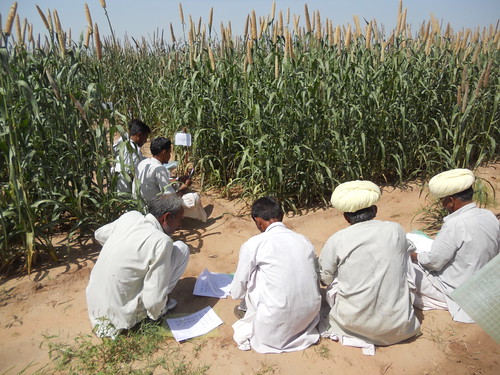
and you immediately ask yourself: What kind of yields are we talking about anyway? Just ballpark, mind. But what would constitute a good yield for these farmers looking at different millet landraces and varieties during this field day?
Well, of course there is FAOStat, but that can be clunky. And those colours! So now the good people at HarvestChoice have developed a little widget that makes access to some of FAOStat’s data a lot less painful, including on the eyes. It’s called HappyStat, and this is what it says about millet yields in India:
| Yield, kg ha-1 (Growth Rate, % yr-1) |
|||||
|---|---|---|---|---|---|
| Crop, Country | 1965 | 1975 | 1985 | 1995 | 2005 |
| MILLET in INDIA |
345 | 554 (2.82) | 457 (0.14) | 679 (4.31) | 750 (1.63) |
| Source: Aggregated from FAOSTAT 2006 |
|||||
Ah, but which millet I hear you ask. And won’t yields differ in different parts of the country? One step at a time, Grasshopper, one step at a time.
LATER: Oh, and by the way, when are we going to see FAOStat data googleized?
The wildness on your sofa
The question of what is the difference between the domestic pig and a wild boar, or the distinction between a broiler chicken and a wild jungle fowl is very similar to the question of what is the difference between a human and a chimpanzee.
Well, maybe. But Evan Ratliff’s piece in National Geographic is an entertaining summary of those distinctions, and of the different possible ways in which they may have come about.
It also reminded me of a great quote from another, much older National Geographic article, which is actually quite relevant again now. 1 Talking about using crop wild relatives, a breeder interviewed by the late Bob Rhoades for The World’s Food Supply at Risk in 1991 says this:
It’s a bit like crossing a house cat with a wildcat. You don’t automatically get a big docile pussycat. What you get is a lot of wildness that you probably don’ t want lying on your sofa.
Earth Microbiome Project sets an example
Is there any good reason why we should not do this with agrobiodiversity, starting with crops and their wild relatives? In fact, is there any good reason why we have not done it already?
Effects of looting of Egyptian genebank on film
We’ve heard again from El-Sayed Mohamed El-Azazi, who is Executive Director of the Egyptian Deserts Gene Bank at the North Sinai Research Station. This time it’s a video of the effects of the recent looting, which he sent to our colleagues at Bioversity International. He confirms that the tissue culture and molecular labs have been destroyed, as well as part of the herbarium, and all computers stolen. But also that the seeds are still ok in the cold room, as you can see towards the end of the video. El-Sayed suggests in his commentary, which is for the most part a sad enumeration of equipment destroyed or stolen, that the looters were perhaps afraid to go into the cold room, and that’s why they left it unharmed.
Egyptian Desert Genebank from Crop Trust on Vimeo.