- Made in Brazil? Brazil Nut, yes. The genus Manihot, not so much.
- The role of botanic gardens as resource and introduction centres in the face of global change. They have one. But they need to be more like genebanks.
- Global growth and stability of agricultural yield decrease with pollinator dependence. Analysis of time-series FAO production data shows that more pollinator-dependent crops have lower yield growth and lower yield stability. So both should benefit from more active management of wild pollinators and their habitats. Results can be extended to other ecosystem services but that was a bridge too far for this reader.
- Draft Policy Framework for Investment in Agriculture. “The purpose of this document is … to initiate discussion.” Off you go.
- Deterrent and insecticidal properties of bean seed (Phaseolus vulgaris L.) whole meal or protein extract incorporated into the diet of Callosobruchus maculatus (F.) (Coleoptera: Bruchidae). To protect chickpeas from bruchid beetles, add bean proteins.
- Community genetics: at the crossroads of ecology and evolutionary genetics, a special issue of the Philosophical Transactions of the Royal Society B, which includes …
- … Insect-resistant biotech crops and their impacts on beneficial arthropods. The abstract gives nothing away: “The findings … are discussed.”
- High connectivity among argali sheep from Afghanistan and adjacent countries means you need international collaboration for conservation. Good luck with that.
- Better phenomics and genomics means you can do really cool Genetic analysis of abiotic stress tolerance in crops, and their wild relatives of course. But we knew that.
- Five ways of Improving assessment and modelling of climate change impacts on global terrestrial biodiversity: more data, process-based modelling, better understanding of role of community interactions and of the effect of genetic variation, and better functional groupings of species for improved simulations of vegetation distribution.
To Serve and Conserve presentations
The presentations given at the Eucarpia To Serve and Conserve meeting are now up on the conference website. Have fun!
Different genebanks, different roles
I feel a little more needs to be said about the video I nibbled earlier about the Philippine Rice Research Institute (PhilRice) genebank, in particular in light of the questions that were asked at the recent To Serve and Conserve conference about the relative roles of national and international genebanks. Here’s the video again:
I don’t speak Tagalog, but some things are pretty obvious. If you go to 1:57, for example, you get the following shot:
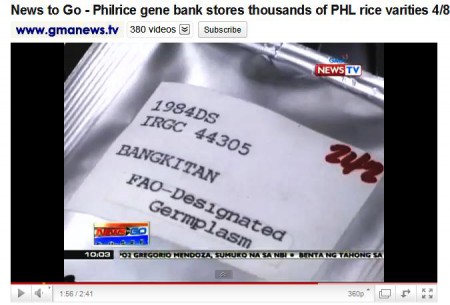
Fortunately, Genesys knows about this IRGC 44503. 1 It’s an IRRI accession, as the IRGC prefix implies:
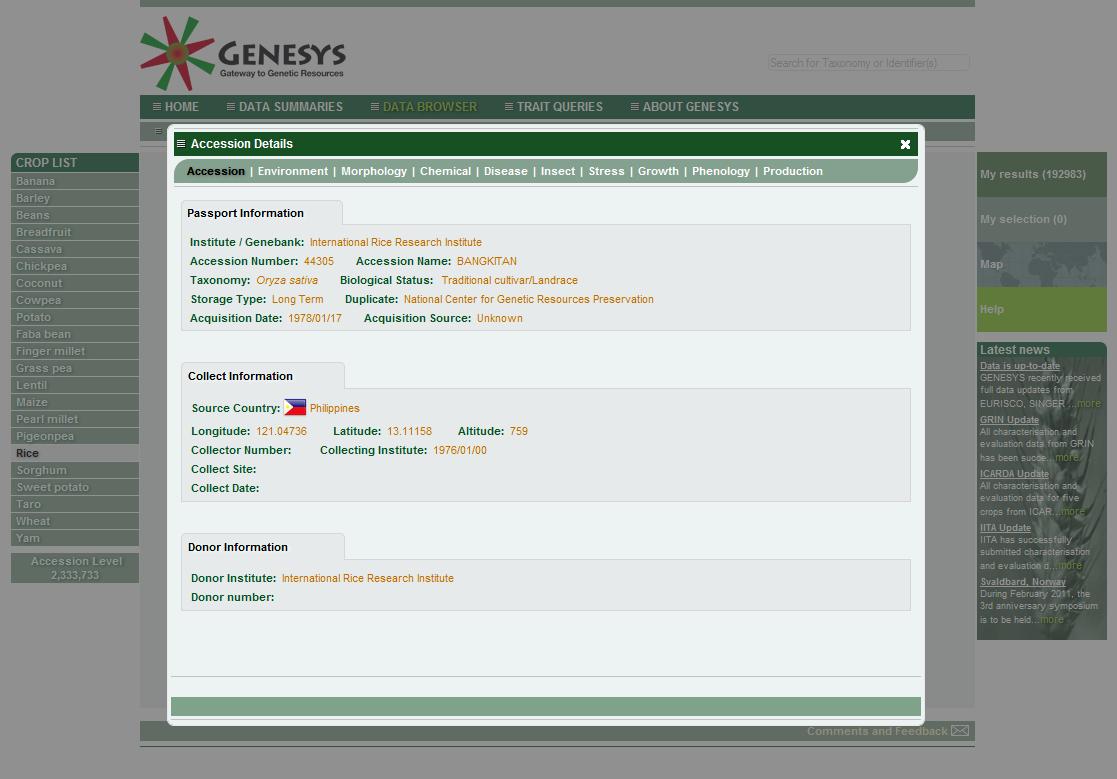
Now, I understand the need for safety duplication. But for proper safety you’d want it to happen in another country, another continent preferably, and the IRRI and PhilRice are both in the Philippines, although on different islands. 2 I can also understand that PhilRice might want a sample of IRGC 44503 to hand for research or whatever. But that looks like a seed sample going into long-term storage, and IRRI is not that far. And I understand there’s a measure of historical contingency involved. But things are different now. There’s Svalbard. And there’s the International Treaty on Plant Genetic Resources for Food and Agriculture. So is it really necessary for PhilRice to do long-term storage of an IRRI accession? Couldn’t they leave that to, well, IRRI? It’s not as if they don’t collaborate all the time.
Does it matter? Does it really matter if some rice accessions are kept in long-term stores in several place? Well, for a start it’s not some rice accessions, but many. And not just rice, but many crops. Maybe only about 20% of the world’s 7.2 million accessions are unique, some of those are not duplicated at all, others many times. If you’re trying to work out how much it would cost to conserve, safety duplicate and make available forever that 20%, rather than the full 7.2 million, it most certainly does matter.
The CATIE peach palm collection
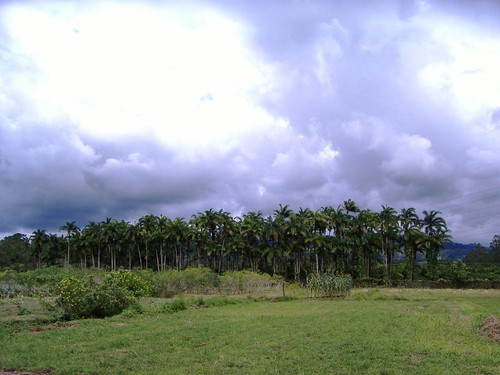
It’s been in the news recently…
Isolated agrobiodiversity

Tristan da Cuha is the most remote inhabited island in the world. When I saw this photo from the island (used by permission from Maurits Heech, who has a lot more on his Flickr site) in a post earlier today I had to wonder whether there might possibly still be some interesting old(ish) agrobiodiversity lurking in the fields and gardens of the place. Would make a nice little project.