If I added a bit of chopped grass (or cactus, or Capsicum leaves or acacia leaves…) to my polished-rice diet, could I reduce vitamin deficiencies? Could I persuade other people to do likewise?
Social engineering certainly helps — people copy people they admire. Essentially, the answer is yes.
How many times have we heard the (para-) phrase: “It’s simply impractical to bring populations of critically endangered species up into the thousands”?
Well, my friends, if you’re not talking thousands, you’re wasting everyone’s time and money. You are essentially managing for extinction.
The table includes 173 foods and 30 components. It is mainly a compilation of data from other food composition tables, theses and the scientific literature. It is one of the first regional food composition tables not only including data on commonly consumed raw foods but also cooked foods and on food biodiversity, i.e. data on variety level and on underutilized foods.
Well, that is all true as far as it goes, but I’m afraid it doesn’t really go very far. There are indeed data on things like fonio and baobab leaves in the table, which is very welcome. But the variety-level data are very limited, with maybe a dozen pearl millet and a few maize entries. Still a lot of work to be done there. Interestingly, the pearl millet varieties all have ikmp numbers (like ikmp-5), which suggests that they are selections made in Burkina Faso by INERA (Institut de l’Environnement et de Recherches Agricoles).
I’m puzzled. Having taken one attendee at the recent biofortification conference to task for utterly ignoring dietary diversity as a source of good nutrition, we were told, privately, that “biodiverse diets are 1st choice, but high nutrient crops can help in the mean time or in addition to a diverse diet”. And yet I have just read another stirring report from that conference that does not mention diversity of diet.
Over at National Public Radio, a story of an inveterate tinkerer who built a better peanut sheller (and much else besides). Not the kind of thing I personally need. I enjoy creating masses of biodegradable debris while I snack. In Africa, however, the hero of the story:
noticed African women shelling thousands of peanuts by hand. It was slow, painful work that made their fingers bleed. Before he left the country, he made a promise that he was going to send them back a peanut sheller. But he ran into a problem. “When I came back to America to buy it, it didn’t exist,” he says.
Bottom line. He made it, it works. And rather than simply give it away, he sells the plans.
That makes farmers investors in a minifactory. They get a set of instructions and concrete molds that allow them to build their own … shellers.
And here it is in action. I like that they don’t bother separating the debris from the nuts, which is easy and satisfying to do by hand.
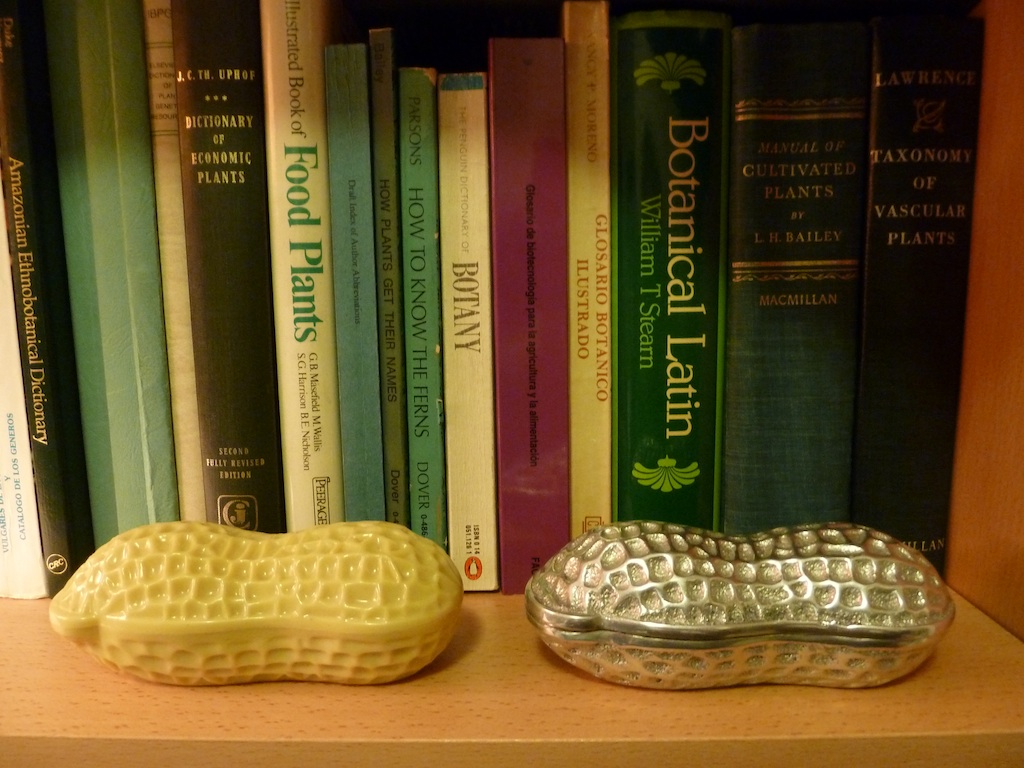
But that’s not all the peanut news for today. Remember the “cute plastic peanut-shaped toys which open to play a jingle“? 1 Well the toy in question finally made it to its intended owner, our very own friend, the genuine Mr Peanut. 2 And he noticed a very strange thing.
That’s right! The cute plastic Chinese peanut on the left is absolutely identical to the handcrafted Mexican pewter peanut box on the right, down to the last little cell on the surface. And it seems that the pewter version is actually less crisply detailed then the Chinese. So did the Mexican artisan use the Chinese peanut as the form for a mold? Is there some third megapeanut ancestral to them both? Are there other examples of a more-or-less worthless trinket being copied in a more valuable material, rather than the other way round? And is this enough questions for now?