Europe maps its soil biodiversity

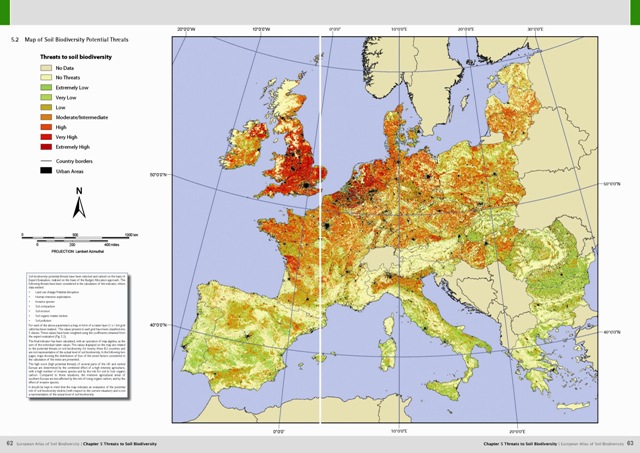
The Land Management & Natural Hazards Unit of the EU’s Joint Research Centre has just announced the publication of a European Atlas of Soil Biodiversity. Here’s the map showing where soil biodiversity is most at risk.

This is part of JRC’s European Soil Database, which complements similar soil mapping projects for other parts of the world. Grist to the FIGS mill. Here, for example, is the map of saline soils in Europe. Seems like Spain and Hungary may be the places to go if you’re looking for salt-tolerance in crop wild relatives.

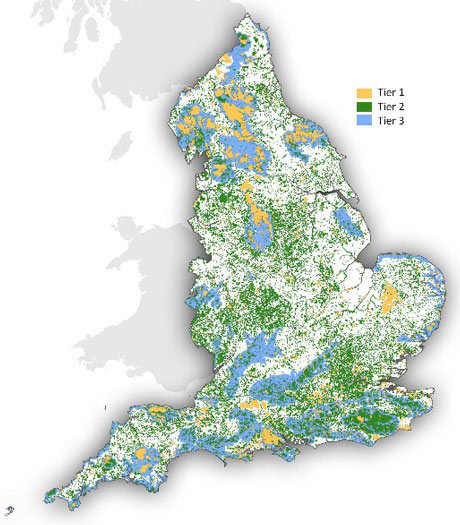
Meanwhile, in England they’re worried about how effective their protected areas are at, well, protecting biodiversity, though I’m not sure to what extent that includes the soil kind. And since we’re on the subject of maps, here’s one of the protected area network of England (Tier 1 is the highest level of protection).

We’ve noted here before how our friend Nigel Maxted and his co-workers at the University of Birmingham are working to have crop wild relatives included in the thinking about protected areas in the UK. We know from their research that in fact many important crop wild relatives fall outside the protected area network altogether. It would be interesting to know to what extent these species were considered in the review of the effectiveness of the system.

Institutionology and scale in agricultural biodiversity conservation

The third in a series of dispatches from the front lines of agrobiodiversity conservation and use. That is, the 6th Henry A. Wallace/CATIE Inter-American Scientific Conference on “Agrobiodiversity in Mesoamerica — From Genes to Landscapes” at CATIE in Costa Rica.

Today we heard about the institutionology of agrobiodiversity — everything from the International Treaty to micro-credit systems — and something of the efforts to link the results of scientific study and market knowledge to practitioners and producers in the field. A representative of Starbucks, Jessie Cuevas, described the Coffee and Farmer Equity (CAFE) Practices, developed with the assistance of Conservation International, and the mission of their Farmer Support Centre in Costa Rica to ensure the quality of Arabica coffee by helping farmers to maintain good processing and production methods. Their guidelines include measures for agrobiodiversity management for watershed and shade preservation. When asked, Jessie said Starbucks was also interested in increasing the genetic base of the crop to improve quality and disease resistance, but are still exploring possible approaches.

Central American Markets for Biodiversity (CAMBio) run a $17million financing scheme for micro-, small- and medium-sized enterprises in Central America in support of biodiversity conservation and sustainable use, including organic coffee agroforestry in El Salvador, organic vegetable producers and wild blackberry exporters in Costa Rica. We also heard about INBio’s inventorying and mapping of 368 edible plant species gathered from 14,573 specimens in Central America herbaria. You can search the online database. One of the Symposium co-organisers, EcoAgriculture Partners based in Washington D.C., have set up an exchange between students at leading universities and practitioners in the field to help the transfer of on-the-ground experiences (and potential research questions) and the results of scientific research. Finally, an unscheduled presentation from a farmer network reminded us that farmers do all of the conservation and need to see some of the benefits.

The formal discussions were brought to an end with interventions from two CATIE staff that summed up nicely the difficulties that us agricultural biodiversity types face. After two days featuring numerous case studies of coffee and cacao agroforestry as probably the most species-rich agricultural systems in existence, Wilbert Philipps — the well-respected cacao expert — observed that the coffee and cacao cultivated within these systems is dangerously uniform and crop genetic diversity is seriously under-exploited. This was followed up by a remark from John Beer, CATIE’s Research and Development Director, that it might actually be quite useful to consider some of the disadvantages of diversity on farms. Clearly, we are still stymied by what we mean by the all-encompassing and usually misleading term agrobiodiversity, and we need to be ever conscious of the scale at which we are probing — what looks diverse and good at a landscape level may not look so diverse in the genes, and vice versa.

Diversity at your service

More from a participant at the 6th Henry A. Wallace/CATIE Inter-American Scientific Conference on “Agrobiodiversity in Mesoamerica — From Genes to Landscapes” at CATIE in Costa Rica.

The ecologists at the Wallace Symposium today waded deeply into the functional role of diversity in agricultural systems. How much diversity do we need in order to get the full benefit of ecosystem services? Is some diversity redundant? What is the trade-off between a world of all things bright and beautiful and one of increased yields, healthy children and growing economies?

Prof. Teja Tscharntke of the Georg-August University in Göttingen presented numerous studies to illustrate the importance of at least a certain amount of wild biodiversity within or in close proximity to agricultural systems. In Andean potato systems, simpler landscapes, lacking heterogeneity in natural habitats, led to higher levels of the pestilential tuber moth and reduction in yields. Coffee systems in Indonesia near natural forest had higher bee species diversity and higher levels of seed set. Hand pollination of cacao had remarkably higher impacts on yields compared to the effects of other major variables, indicating the supreme importance of the near invisible midges that pollinate one of the most revered crops in the world.

But just how much of this wild biodiversity we need, and in what form, are just two of the many questions that are being posed. Teja brought up the SLOSS debate, dating back to the 1970s, of whether single, large or several small reserves will conserve more biodiversity. His findings suggest that many small habitats capture more heterogeneity. Fabrice DeClerck was back with a study of the relationship between species richness and function, using food crops as a model. In a study of households in Sauri in Kenya, he categorized food crops according to the nutrient services they provided — whether high in carbohydrates or proteins or specific vitamins, etc. Not surprisingly, functional richness (i.e. provision of all the major nutrients) was not necessarily associated with the highest species richness. You don’t have to grow everything to get your daily needs of protein and carbs, and for some nutrients (e.g. vitamin C) there is more species redundancy than others (e.g. folates). Well, I guess you had to be there!

The functional role of agrobiodiversity changes as you move from species to landscapes, and few principles can be transported across scales or systems. But that doesn’t stop a little healthy application of diversity when it’s needed. There was a nice case study of the use of plant diversity in and around Costa Rican farms of Dracaena to reduce pest populations that were causing exports of the ornamental plants to be held up by the US quarantine service. Secondary forest or certain types of cover crop can host populations of natural predators to the cicadellid pests. Consequently, the healthy plants passed through quarantine without a hitch and increased Costa Rica’s export revenues.
The Importance of Scientific Collections

The American Institute of Biological Sciences and the Ecological Society of America are among the scientific organizations around the world that have urged the Russian Federation to reconsider the decision to destroy the collections at the Pavlovsk Experiment Station. And they remind us that we do occasionally need to relate our concerns about agricultural biodiversity to wider concerns about biodiversity: it isn’t only our favoured collections that are threatened.

Lack of funds, loss of technically trained staff and inadequate protection against natural disasters, are jeopardizing natural science collections worldwide. For example, in May of this year an accidental fire destroyed roughly 80,000 of the 500,000 venomous snake-and an estimated 450,000 spider and scorpion-specimens at the Butantan Institute in São Paolo, Brazil. The 100-year-old collection featured some rare and extinct species and contributed to the development of numerous vaccines, serums and antivenoms. The building that housed these specimens, including what may have been the largest collection of snakes in the world, lacked fire alarm or sprinkler systems.

“Biological collections, whether living or non-living, are vitally important to humanity,” says Dr. Joseph Travis, president of the American Institute of Biological Sciences. “Natural science collections have provided insights into a wide variety of biological issues and pressing societal problems. These research centers help identify new food sources, develop treatments for disease and suggest how to control invasive pests. Natural science collections belong to the world and cannot be limited by geographic borders.”

Good points, well made.

Prizes for agrobiodiversity movers and shakers

Two of the recipients of the 16th Heinz Awards for “providing solutions to global environmental challenges,” announced yesterday, have agricultural biodiversity connections. Cary Fowler’s work is of course well know to our readers:

At a time of massive environmental change, it is an absolute necessity to preserve the world’s crop biodiversity. Lack of crop diversity threatens the world’s basic food security, and it is highly significant that scientists like Dr. Fowler work to strengthen inventories of plant genetic resources.

Gretchen Daily’s perhaps less so.

Dr. Gretchen Daily is a globally renowned scientist and Stanford University professor who is acknowledged for her innovative work to calculate the financial benefits of preserving the environment. Dr. Daily has advanced a remarkable new vision that harmonizes conservation and human development. Her work illuminates the many valuable benefits that flow from “natural capital” – embodied in Earth’s lands, waters and biodiversity – to supporting human well-being.

Today she also won a Midori biodiversity prize.

Much of Daily’s research seeks to get businesses thinking about the environment. In 2004, she published a paper showing that coffee plants located near forests in Costa Rica are more productive than other plants because they are pollinated by bees living in the forest. The bees boost the yearly income of the average farm by $60,000, she estimated.

Maybe the two recipients should get together and figure out how to get business to pay for genebanks. Congratulations to both.