- Constructing Seed Boundaries: Foundation and Evolution of Scientific Conceptions and Practices of Crop Diversity from the Green Revolution to date. We need to put the knowledge, expertise, activities and needs of farmers at the centre of conservation and use of crop diversity.
- Open Source Seeds and the Revitalization of Local Knowledge. Open-source seeds is one way we can put the knowledge, expertise, activities and needs of farmers at the centre of conservation and use of crop diversity.
- Evaluation of Global Composite Collection Reveals Agronomically Superior Germplasm Accessions for Chickpea Improvement. We need detailed, multi-location, multi-year agronomic evaluation of chickpea diversity to figure out what diversity we should use to give farmers the diversity we think they will need.
- Home gardens of Central Asia: Reservoirs of diversity of fruit and nut tree species. We need homegardens.
- Data-driven, participatory characterization of farmer varieties discloses teff breeding potential under current and future climates. We need detailed, multi-location, multi-year agronomic evaluation of teff diversity done in collaboration with farmers to figure out what diversity we should use to give farmers the diversity they will need, and what they already have.
- Cultural Effects on Sorghum Varieties Grown, Traits Preferred, and Seed Management Practices in Northern Ethiopia. We need detailed, multi-location, multi-year studies of farmers’ sorghum diversity, practices and needs to figure out what diversity we should use to give farmers the diversity they will need, and what they already have.
- Metrics for optimum allocation of resources on the composition and characterization of crop collections: The CIMMYT wheat collection as a proof of concept. We could use genotyping and this fancy maths to figure out what to have in our wheat genebank collections so we can then figure out which diversity to use to give farmers the diversity we think they will need.
- From marginalized to miracle: critical bioregionalism, jungle farming and the move to millets in Karnataka, India. Forget wheat. We need local food activism. But critical local food activism.
- G-DIRT: a web server for identification and removal of duplicate germplasms based on identity-by-state analysis using single nucleotide polymorphism genotyping data. We need this fancy software to get rid of duplicates from our genebank collections so it’s cheaper to maintain them and ensure that they’re always around for people to use to get to farmers the diversity they need.
- “Famine Foods” and the Values of Biodiversity Preservation in Israel-Palestine. We need recipes.
After the flood
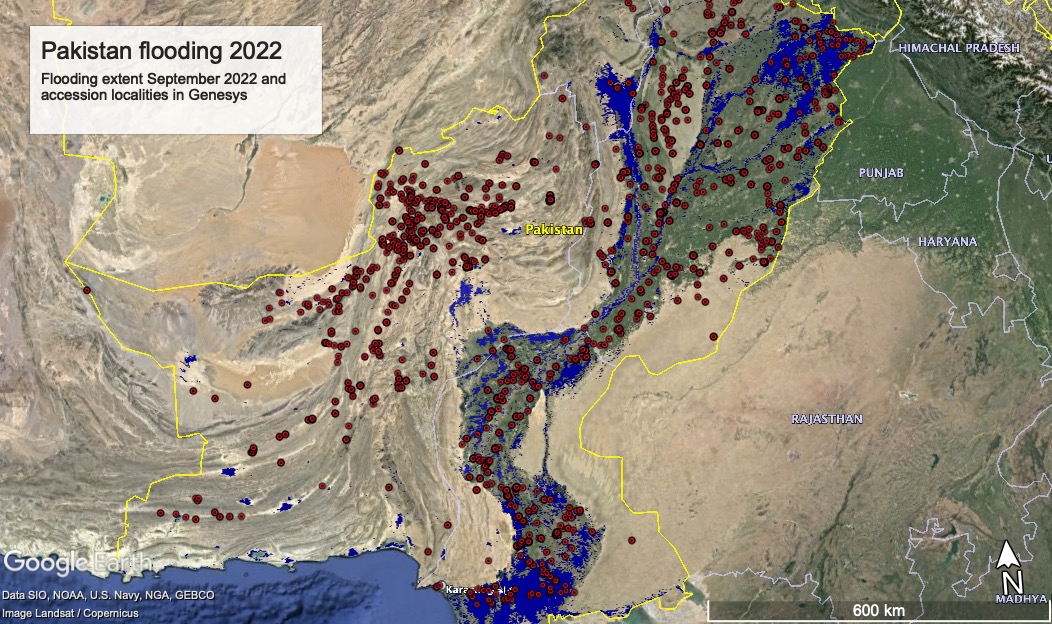
Pakistans farmers are going to need seeds after the floodwater recede. That could include local landraces, if we start planning for it now. Here’s a map of the current extent of flooding, courtesy of UNITAR, plus the collecting localities of crop landraces conserved in genebanks around the world, according to Genesys.
Brainfood: Species mixtures double, Crop diversification, Local adaptation, Speed of adaptation, Essential Biodiversity Variables, Effective population size, Monitoring diversity
- Drought-exposure history increases complementarity between plant species in response to a subsequent drought. Repeated stress makes plant species get along better, sustaining diversity. If only it worked so well with people…
- A quantitative synthesis of soil microbial effects on plant species coexistence. Meta-analysis shows soil microbes work against plant species getting along better.
- Does crop diversification lead to climate-related resilience? Improving the theory through insights on practice. Crops getting along well together is pretty well linked to better livelihoods, but less strongly to increased resilience.
- Local Adaptation: Causal Agents of Selection and Adaptive Trait Divergence. You need to do reciprocal transplant experiments really well to find out where plants are best adapted and why. Probably means taking microbes into account.
- Genetic variance in fitness indicates rapid contemporary adaptive evolution in wild animals. Natural selection can be quicker than climate change. I hope they did the reciprocal transplant experiments really well.
- Global genetic diversity status and trends: towards a suite of Essential Biodiversity Variables (EBVs) for genetic composition. Genetic diversity, Genetic differentiation, Inbreeding, and Effective Population Size (Ne). Who needs reciprocal transplant experiments?
- On the feasibility of estimating contemporary effective population size (Ne) for genetic conservation and monitoring of forest trees. Ouch.
- Selecting species and populations for monitoring of genetic diversity. All of them, right?
Brainfood: Diversity & breeding in Coix, Triticum, Phaseolus, Manihot, Oryza, Vigna, Glycine, Zea, Malus
- Nutritional profiling and GIS-based grid mapping of Job’s tears (Coix lacryma-jobi L.) germplasm. 2 genebank accessions out of 32 are especially good.
- Diversity and Adaptation of Currently Grown Wheat Landraces and Modern Germplasm in Afghanistan, Iran, and Turkey. Some wheat landraces were just as productive as modern varieties, so crossing landraces with other landraces could be a good breeding strategy. Maybe even for Job’s tears.
- Mining of the national gene bank collection identifies resistance sources for loose smut of wheat in Northern Himalayan conditions. 58 of 586 were resistant. Let the inter-landrace crossing begin!
- Are Traditional Lima Bean (Phaseolus lunatus L.) Landraces Valuable to Cope with Climate Change? Effects of Drought on Growth and Biochemical Stress Markers. Oh no, the commercial variety is more drought-resistant than the, ahem, two landraces.
- Low-cost, handheld near-infrared spectroscopy for root dry matter content prediction in cassava. A faster and cheaper way of figuring out which cassavas are better than others.
- Mutations in DNA polymerase δ subunit 1 co-segregate with CMD2-type resistance to Cassava Mosaic Geminiviruses. Now for a faster and cheaper way of spotting the gene in your crosses.
- Phenotypic Variation and the Impact of Admixture in the Oryza rufipogon Species Complex (ORSC). Sometimes there’s no short-cut to the slog of detailed phenotyping if you want a short-cut to pre-breeding.
- Evaluation of black gram varieties using crowd source citizen science under northern hilly climatic condition of Chhattisgarh. Let the farmers do the slog of phenotyping.
- A view of the pan-genome of domesticated cowpea (Vigna unguiculata [L.] Walp.). The genes not shared by all six sub-populations of the cultivated cowpea are very important to the overall diversity of the crop. Let scientists do the slog of genotyping.
- Breeding for disease resistance in soybean: a global perspective. 800 resistance loci/alleles for 28 varied diseases from all over the world. Imagine one variety with all of them :)
- Genetic diversity in early maturity Chinese and European elite soybeans: A comparative analysis. Two equally diverse but distinct genepools. Unclear how the above 800 loci divide up.
- Association mapping across a multitude of traits collected in diverse environments in maize. More slogging through phenotyping, this time to uncover pleiotropy.
- Incorporating male sterility increases hybrid maize yield in low input African farming systems. But I guess you need the above to decide on the parents for your fancy hybrids.
- Pedigree reconstruction for triploid apple cultivars using single nucleotide polymorphism array data. Triploids apples may be bigger and stronger, but they’re also genetic dead ends.
- Evidence of an additional center of apple domestication in Iran, with contributions from the Caucasian crab apple Malus orientalis Uglitzk. to the cultivated apple gene pool. Another example of multiple domestication “events”.
So are soybeans sorted or not?
Readers may have seen press coverage of a paper in Science suggesting that a biotech tweak to photosynthesis has led to significant yield boosts in soybeans. The tweak involves getting leaves to respond more nimbly to changes in light intensity, including due to shading by other leaves. It has successfully increased biomass production in tobacco in the past: would it also increase seed yield in a food crop under field conditions?
Yes, by up to a third, said the headlines. Not so fast, said Merritt Khaipho-Burch on Twitter: we’re going to need many more and much better field trials before we’re convinced.
That got some push-back, basically saying those kinds of trials are too expensive to be a precondition of publication. But now one of the authors of the original study, Steven Burgess, has weighed in, also on Twitter, saying the criticism is valid, it’s all very complicated, and the paper is just a proof of principle at this stage.
Now to get the press to explain all that.