The International Scientific Symposium Biodiversity and Sustainable Diets: United Against Hunger, on until tomorrow at FAO in Rome, is streaming live. Mainly in English. Read a precis of yesterday’s session over at Bioversity.
Climate change, agriculture and web 2.0
A new website to do with agriculture and climate change for you to explore: Climate-Smart Agriculture from FAO. Basically just a static selection of case studies, but interesting for all that, and maybe it will evolve into something a little more interactive. The Challenge Program on Climate Change, Agriculture and Food Security (CCAFS) has a blog if you’re into the whole web 2.0 experience thing.
Markets and on farm conservation: it’s complicated
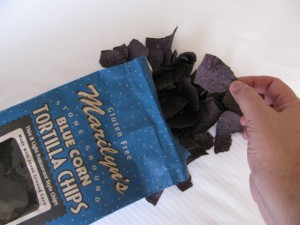
Eating blue tortilla chips during a recent visit to the US reminded me that I had intended to blog about a paper just out in the Journal of Latin American Geography. 1 Entitled “Specialty maize varieties in Mexico: A case study in market-driven agro-biodiversity conservation,” it looks in detail at the economics of growing blue and pozole maize in the areas around the huge market represented by Mexico City. Blue maize is used to make antojitos, savoury meat-, cheese- or vegetable-filled snacks. Pozole is a traditional Mexican maize and meat soup.
 The authors, Alder Keleman and Jonathan Hellin, carried out a value chain analysis for both of these distinctive maizes and concluded that “while existing specialty markets clearly provide a strong incentive for farmers to continue to plant blue and pozole maize landraces, this in-and-of-itself … does not provide a complete in situ conservation system.” For one thing, it is not clear to what extent the demands of the market may be driving genetic “standardization” within these specialy types. And in any cases, other types of landraces are not benefiting from these markets, and may indeed be suffering as a result of them.
So, although on-farm conservation interventions which involve strengthening these specialty maize value chains, for example through geographical indications, may meet development goals like increasing incomes and food production, they will need to be carefully planned and implemented, and form part of a larger strategy. Which will need to involve genebanks.
Interestingly, another recent paper also looks at the role of markets in on-farm conservation in Mexico (among other things), though for another crop. 2 Kraft and co-workers found that all the landraces of green chile have disappeared in Aguascalientes due to the introduction of hybrids. Farmers still grow landraces for dried chile, in part because of laxer uniformity requirements for dried chile compared to fresh, but are open to the idea of hybrids for this market too. As with specialty maizes, the link between the market and diversity in complicated, and can go both ways. Genebanks are less fun, sure, but at least we know what they do to diversity. Mainly.
Innovation in African farming
From the JSTOR plant science blog, a link to a fascinating site called AfriGadget, which showcases ideas that solve “everyday problems with African ingenuity”. There are some wonderful ideas in there, from the farmer that reversed one of his ploughshares in order to capture water, to a simple seed planting gizmo made in northern Ghana. And, of course, keyhole gardens and other approaches to better nutrition. Definitely an inspirational one for the RSS feed.
Featured: Heirloom tomatoes
We recently Nibbled a request for information sources of seeds of heirloom tomatoes. That apparently galvanized MikeH into action:
You said: Do you have these heirloom tomatoes? I said: Nope, not this year but I’ll bet I know where they are.
The result? Satisfaction all round.
Ain’t it great when A gets connected to F quickly and seamlessly through B, C, D, and E who are only intermediaries?
That’s what social networking is for, I guess.