Worthy of support?

Global Giving, mentioned yesterday as a possible source of funds, is running a Global Open Challenge: projects have 30 days in which to secure themselves a spot on Global Giving’s roster of projects. And there are 3 days left. So just for fun, I skimmed through 150 projects to find those that are directly connected with agriculture, ignoring some that might be borderline, such as nutrition projects. Here’s the list:

Personally, I wouldn’t support this last one, because it describes Moringa and amaranth as “super-foods”. They’re good, but to pin your hopes for “a long term solution to poverty, malnutrition & food insecurity” on two species — any two species — is to miss the point comprehensively.
We are not an organization

We’ve had a couple of flattering comments on some obscure pages lately. 1 One asked:

Please, let me know, if your organisation supports our research work.

The first response is that we are not an organisation. Just a couple of guys discussing agricultural biodiversity. With occasional wonderful contributions from our friends. But, hey. Thanks.

The second, possibly much more important response is that no, we don’t support anyone’s research. We can barely support ourselves. We often get asked about support, and all we can do is sympathise with the difficulties researchers face, especially those outside the mainstream. There really isn’t much we can offer.

In the very traditional realm, IFAR has a small grants program that might be a source of funding.

Thinking a bit sideways, it could be worth trying to get something like Global Giving to take a project on board, although pure research is unlikely to make it. I discovered them through a campaign to educate girls, and it seems like they have some really interesting ideas.

Finally, a completely off the wall suggestion that first emerged in our posts about the Plant Genetic Resources Newsletter: Kickstarter. Sure, they say they’re mostly about creativity, but what could be more creative than finding new ways to use agrobiodiversity to solve problems of food and nutrition security?

If you are aware of other possible sources of small grants, why not add them to this post in a (totally legitimate use of a) comment?

Brassica bounty

Couldn’t resist today’s trifecta of Brassica papers. At the meta level, there’s “Origin and Domestication of Cole Crops (Brassica oleracea L.): Linguistic and Literary Considerations” in Economic Botany. Then some of the same authors follow up in GRACE with “AFLP analysis of genetic diversity in leafy kale (Brassica oleracea L. convar. acephala (DC.) Alef.) landraces, cultivars and wild populations in Europe.” And finally, in Plant Breeding, enjoy “The cytoplasm effect comparison between Brassica napus and Brassica carinata on floral characteristics of Brassica oleracea.” Enough to keep brassica boffins busy for weeks.

Europe maps its soil biodiversity

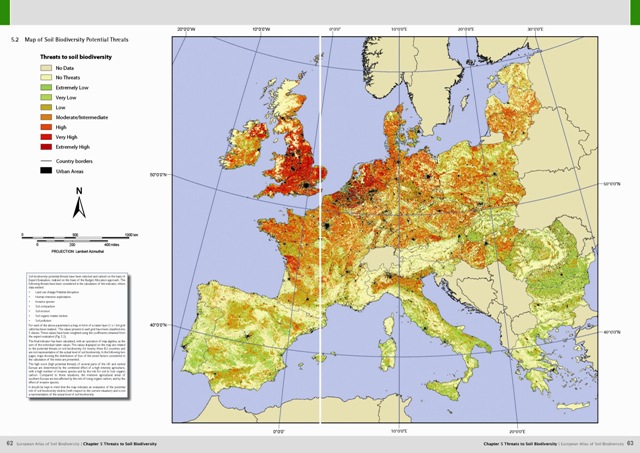
The Land Management & Natural Hazards Unit of the EU’s Joint Research Centre has just announced the publication of a European Atlas of Soil Biodiversity. Here’s the map showing where soil biodiversity is most at risk.

This is part of JRC’s European Soil Database, which complements similar soil mapping projects for other parts of the world. Grist to the FIGS mill. Here, for example, is the map of saline soils in Europe. Seems like Spain and Hungary may be the places to go if you’re looking for salt-tolerance in crop wild relatives.

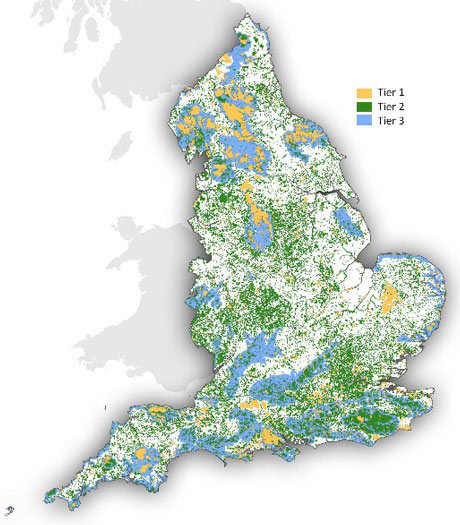
Meanwhile, in England they’re worried about how effective their protected areas are at, well, protecting biodiversity, though I’m not sure to what extent that includes the soil kind. And since we’re on the subject of maps, here’s one of the protected area network of England (Tier 1 is the highest level of protection).

We’ve noted here before how our friend Nigel Maxted and his co-workers at the University of Birmingham are working to have crop wild relatives included in the thinking about protected areas in the UK. We know from their research that in fact many important crop wild relatives fall outside the protected area network altogether. It would be interesting to know to what extent these species were considered in the review of the effectiveness of the system.

Institutionology and scale in agricultural biodiversity conservation

The third in a series of dispatches from the front lines of agrobiodiversity conservation and use. That is, the 6th Henry A. Wallace/CATIE Inter-American Scientific Conference on “Agrobiodiversity in Mesoamerica — From Genes to Landscapes” at CATIE in Costa Rica.

Today we heard about the institutionology of agrobiodiversity — everything from the International Treaty to micro-credit systems — and something of the efforts to link the results of scientific study and market knowledge to practitioners and producers in the field. A representative of Starbucks, Jessie Cuevas, described the Coffee and Farmer Equity (CAFE) Practices, developed with the assistance of Conservation International, and the mission of their Farmer Support Centre in Costa Rica to ensure the quality of Arabica coffee by helping farmers to maintain good processing and production methods. Their guidelines include measures for agrobiodiversity management for watershed and shade preservation. When asked, Jessie said Starbucks was also interested in increasing the genetic base of the crop to improve quality and disease resistance, but are still exploring possible approaches.

Central American Markets for Biodiversity (CAMBio) run a $17million financing scheme for micro-, small- and medium-sized enterprises in Central America in support of biodiversity conservation and sustainable use, including organic coffee agroforestry in El Salvador, organic vegetable producers and wild blackberry exporters in Costa Rica. We also heard about INBio’s inventorying and mapping of 368 edible plant species gathered from 14,573 specimens in Central America herbaria. You can search the online database. One of the Symposium co-organisers, EcoAgriculture Partners based in Washington D.C., have set up an exchange between students at leading universities and practitioners in the field to help the transfer of on-the-ground experiences (and potential research questions) and the results of scientific research. Finally, an unscheduled presentation from a farmer network reminded us that farmers do all of the conservation and need to see some of the benefits.

The formal discussions were brought to an end with interventions from two CATIE staff that summed up nicely the difficulties that us agricultural biodiversity types face. After two days featuring numerous case studies of coffee and cacao agroforestry as probably the most species-rich agricultural systems in existence, Wilbert Philipps — the well-respected cacao expert — observed that the coffee and cacao cultivated within these systems is dangerously uniform and crop genetic diversity is seriously under-exploited. This was followed up by a remark from John Beer, CATIE’s Research and Development Director, that it might actually be quite useful to consider some of the disadvantages of diversity on farms. Clearly, we are still stymied by what we mean by the all-encompassing and usually misleading term agrobiodiversity, and we need to be ever conscious of the scale at which we are probing — what looks diverse and good at a landscape level may not look so diverse in the genes, and vice versa.