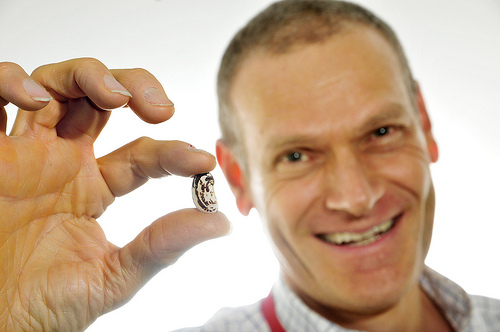
You may remember our post a few months back about the heroic Mrs Sanaa Abdul Wahab Al-Sheikh and her efforts to save the Iraqi genebank. Well it seems that those efforts have attracted the attention of documentary film-maker Emma Piper-Burket and her team. I’ll be following their work, and really look forward to seeing the results of the project.
Swap crops and feed 9 billion people
From Jacob van Etten.
Some demographic projections tell us that global population numbers will grow to 9 billion in 2100 and stabilize around this number. So how can people three generations down the line feed themselves, while still conserving biodiversity?
Lian Pin Koh offers a solution based on simple economic principles. Grow the most productive crop to produce cereal, oil or protein, and grow each crop where it grows best. He presents an interactive world map to demonstrate that no extra land needs to be taken into production to feed 9 billion people.
The results are interesting. Strikingly, Brazil is doing just fine. Just a bit more of rice and Brazilian agriculture is optimal. Other countries need to change drastically. North European countries need to switch from barley to wheat. Canada and Russia need to abolish wheat agriculture and adopt maize. West Africa and the Cono Sur needs to grow more rice but northern South America and the US need to grow more maize. Yields will go up automagically, as each crop is planted on land that is more suited to it, fulfilling the dream of the 1980s land use evaluators.
The study is still in preparation and no background info on the methodology is available yet. Transport costs and climate change do not seem to be taken into account. “Optimal” seems to refer to yields per hectare, not to labour and inputs. Overall, the trend seems to be towards more high-yielding crops, which also require more inputs. With more people, more labour is available. But other inputs, like water, are limited.
Another question would be why crop use is sub-optimal now. Is it trade barriers? Cultural preferences and agricultural traditions? Or is it economics, really?
There is of course more to conservation than making agriculture more efficient. Another study shows that intensifying land use does not in fact put a break on crop land expansion. Additional measures would be needed to ensure that more efficiency indeed stops crops taking over non-agricultural land, and impacting biodiversity.
Even so, this is an interesting thought experiment. In an ideal world, swapping crops is enough to raise crop production some 30%. Feeding 9 billion people suddenly appears a bit easier.
That caterpillar fungus — in depth
Maybe you weren’t tempted by the Nibble of caterpillar mushroom we served up a week ago. Today the Guardian gives you another bite at the cherry, as it were.
[T]he value of Yartsa Gunbu has increased more than ninefold since 1997, creating what mycologist Daniel Winkler calls a “globally unique rural fungal economy” on the Tibetan Plateau.
It has everything, this story — poor people, over-exploitation, lack of diversity, government meddling — and the report includes some great photographs. Is anyone, though working to cultivate or domesticate the Summer Grass Winter Worm?
Oh, and here’s some science again. And our post from three years ago. 1
A very cold hotspot
Seeds of some 10% of the world’s flora are stored in the coldroom behind this door…

You can see a few more pictures on my Flickr set, and read all about the Millennium Seed Bank on their web page. If you do, you may well be intrigued by this story:
Recently we have conducted germination tests on seeds of 33 South African species collected in 1802/3. The seeds were found at the National Archives in London among the papers of a Dutch merchant, Jan Teerlink whose ship was captured by British privateers during its return from the Far East via the Cape of Good Hope, South Africa. Seeds of three species germinated: two legumes (Liparia sp. and Acacia sp.) and a Proteaceae (Leucospermum sp.). Our report in Seed Science Research 2 of seeds surviving for over 200 years (supported by carbon-dating) under sub-optimal conditions, suggests adaptation for extreme seed longevity in species of seasonally dry, Mediterranean environments.
And if you are so intrigued, and would really like to see what a Leucospermum plant germinated from 200-year old seeds looks like, well, here it is:

Crop genebanks taken for granted, again
The Crop Science Society of America suggests that in order to adapt agriculture to climate change we will need to
Genotype the major crop germplasm collections to facilitate identification of gene treasures for breeding and genetics research and deployment of superior genes into adapted germplasm around the globe.
Which is all well and good, but it does rather assume that “the major crop collections” will be there to genotyped in the first place. 3
‘Twas ever thus with genebanks. It’s just assumed that they will always be there, ready, willing and able to provide breeders and geneticists with the material they need, forever, no matter what. It’s really scary to realize that, actually, such an assumption is unjustified. Somebody should tell CSSA that.