So I was idly reflecting on the recent paper by Magurran et al. in Trends in Ecology & Evolution on long-term datasets for biodiversity monitoring which I Nibbled earlier, then I ran across another paper, and that really got me thinking. When we talk about protected areas, we usually mean national parks and reserves and the like (or at least that’s what I usually mean), but I wonder whether that misses something. I’m thinking here of long-term exclusion experiments, 1 such as the one in Kenya that second paper talked about, for example. There must be other such things around the world: long-term experimental areas, rather than legally recognized reserves, but still (somewhat) protected, and with time series of vegetation and floristic data to boot. Is this something that has been looked at, either regionally or on a global scale, in the context of crop wild relatives conservation? Will investigate.
Mini cows threaten to oust pocket pigs
We hate to come over all smug, but when the mainstream media pick up on a story almost a year after we first brought it to your attention, it’s hard not to. Such is the case with The Guardian’s recent discovery of the environmental and eating delights of mini cows. Our post more than a year ago featured a discussion on minicows on DAD-Net 2 which, among other things, objected to the word “miniature” because it is misleading. The Guardian has the latest on minicow taxonomy:
Micromini cattle are less than 96.5 cm tall (at the shoulder, presumably, ed.) — those shorter than 92 cm are known as “teacup cattle”.
The major outstanding question now is whether teacup cows will prove to be cuter or more adorable than pocket pigs, our number one search term. Personally, I doubt it.
Orphan crops to the rescue
Egged on a bit by Wally Falcon, Chris Fedor of Stanford University basically says in a new article that the best way to combat Ug99 is not to grow wheat. Well, not really. Rather, that if more money had been spent in the past on crops that are not wheat (or maize or rice or even potato), wheat wouldn’t have been grown so much in East Africa and we wouldn’t be having this problem now:
Ug99 … occurred because there was not enough research on more agro-climatically appropriate crops. Perhaps the lesson, then, is that agricultural research should spend more time and money developing yield improvements for native, local crops like teff, cassava, sorghum and pigeon pea so that developing countries will have viable alternatives to just wheat, rice and maize.
I’m not so sure about the Ug99 bit, but I’m all for more money for orphan crops. Problem is, it’s hard for a Cinderella to compete with her Big Sisters when you’re looking for the biggest, fastest impact and research funding is perceived as a zero-sum game. Witness the CGIAR megaprogramme saga. Not to say that there’s no hope, though.
Livestock breeding strategies discussed
The discussion of livestock breeding continues apace on DAD-Net, touched off by a comment on a Science paper (picked up by the BBC among others) on African livestock genomics. 3 It’s a very rich exchange, but unfortunately I can’t find a way of linking to contributions online: it seems to be entirely based on email, with no central, public archiving like with Yahoo or Google Groups. Anyway, I just want to pick out one thing. Philippe Leperre, a vet based in Laos, has this to say:
I am one of the very many specialist that advocate for selection/improvement of the local breed rather than mostly useless, haphazard, costly and non sustainable import of bulls and semen from “developed” countries. I think we are a majority in that respect, but what can we do when the local ministries and the donors prefer to buy from big foreign multinationals rather than from the (poor or at least poorer) local producers?
Now, I have two questions about this statement. To livestock breeders I’d like to ask whether they agree that there is a majority among them which advocates selection/improvement of local breeds. And to plant breeders I’d like to ask what percentage of their community would advocate such a strategy. Because it doesn’t seem to me to be anything like a majority. 4 But maybe I’m wrong.
Spore on agricultural biodiversity
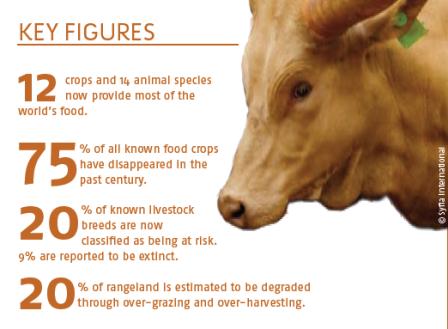
CTA’s newly redesigned Spore has a special section on agrobiodiversity, highlighting work going on in Kenya and the Pacific, among other things, that we have mentioned here in the past. One is, however, disappointed to see the dreaded 75% figure flourished yet again. We also talked here about how many species feed the world.