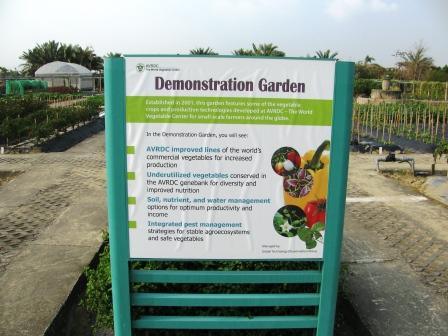
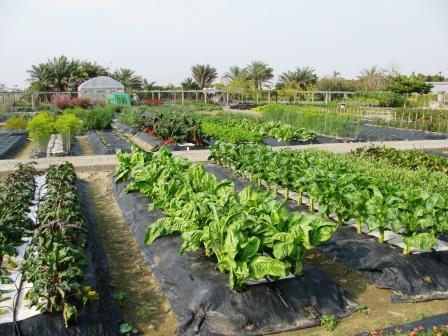
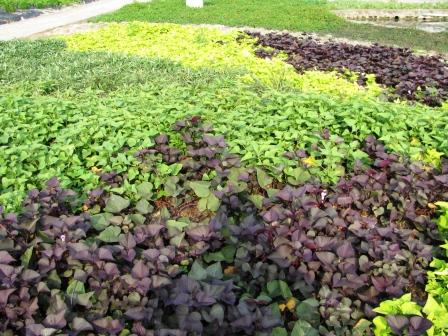
Via our friend Lois Englberger comes news of the nth project involving orange crops, where n is a large positive integer. This one is on orange-fleshed sweet potatoes — and indeed other high beta-carotene crops — in the Solomon Islands. The International Potato Centre (CIP) has a catalogue of orange varieties for Africa. I just hope everyone is not forgetting all the other varieties.
Getting to grips with ecological interactions
Something just in from our occasional contributor Jacob van Etten.
Climate change will shift the limits of the suitable areas of many wild animals and plants, including crop wild relatives. Some species may adapt by gradually moving into areas which resemble their current home area. In other cases, no bridges exist to connect old and new suitable areas and a helping hand may be needed. Translocating species, or “assisted migration” has complex risks and ethical implications. Another approach would be to intensify ex situ collection efforts aimed at those species vulnerable to climate change. “Niche modeling”, which matches species to specific climatic conditions is helpful to locate problem areas.
All of this assumes that currently animals and plants are mainly held in place by climatic factors. 1 But what if this is not the case? Imagine the aftermath of a glaciation. The ice retreats and species start to move towards the poles to occupy new territory. Two competing species, A and B, start to expand their range, but A is a better disperser than A. Since species A arrives first in most places, competing species B is absent, but not because the area is not suited climatically for species B. This would seriously confuse a niche model and its ability to predict future distributions after climate change.
Gilman and co-authors review the evidence on how interactions between different species influences the impact of climate change on species in a recent paper. 2 Experiments with fruit flies, literature reviews and modeling studies all show that biotic interactions are crucial in predicting the effects of climate change. However, most models to predict the effects of climate change on species survival ignore these interspecific interactions. The complexity of webs of ecological interactions makes it difficult to draw general conclusions.
Gilman et al. suggest a divide-and-conquer approach to solve the puzzle. They propose to split communities in small modules of 2-4 interacting species, each characterized by a different network of interaction (mutualism, predation, competition, etc.). Through coupled modeling and empirical studies focused on such modules, Gilman et al. hope that some general trends will emerge. Lots of work needs to be done, however, before ecologists will be able to distinguish those trends. Gilman et al. also note that putting the modules together in communities may not be straightforward.
Obviously, this approach requires massive data collection and experimentation, premised on the idea that in the end some pattern will emerge from the data and that it will be possible to predict community level phenomena from the constituent elements. In spite of the importance of all this work to gain insight in the workings of ecological communities, there is no guarantee that we will end up being able to predict species extinction before it happens. In my view, ecological interactions are just too complex to draw any hard conclusions from bottom-up studies. For instance, pollinator networks can change from year to year. And only part of this information on ecological interactions is relevant to predict species survival/extinction. The approach proposed by Gilman et al. seems to steer towards a mismatch between ecological work and the hard questions of management, conservation and policy making.
How can the ecological interactions relevant under climate change be understood without losing ourselves in the details while working with available data? The decreasing costs of DNA analysis and the push for citizen science for conservation will hopefully make more data on gene flow and species occurrence available for monitoring purposes. Would it be possible to infer interactions from these data?
In molecular biology inferring complex interactions from massive data is very common. Vera-Licona and Laubenbacher (2008) apply mathematical methods originally developed for the inference of biochemical networks to ecological interactions. The method makes it possible to pinpoint the sources of remaining uncertainty. It seems that the method is being picked up by others. My feeling is that work along these lines will become important to bring ecology closer to management practice.
Mango symposium
This just in, in response to Bhuwon’s wonderful report on the mother of all Dashehari mangoes.
National Seminar on Mango
Biodiversity For Livelihood, 25 to 28 June, 2005, Lucknow
Dear Sir / Madam,
I am pleased to inform you that the Central Institute for Subtropical Horticulture is organizing a four-day National Seminar “Mango Biodiversity For Livelihood” during June 25th and 28th 2010 at CISH, Rehmankhera, Lucknow. The Seminar is being organized jointly by ICAR, and Society for Advancement of Subtropical Horticulture, Lucknow under the auspicious of National Biodiversity Authority Chennai, Bioversity International, New Delhi, National Horticulture Board, Protection of Plant Varieties and Farmers Rights and National Horticulture Mission. It gives me great pleasure to invite you and your colleagues to the Symposium and request you to contribute to the deliberations. I am sure with your contributions to the field of mango research and development you would be deeply interested in this Symposium.
Alas, we cannot be there. More details at the website.
School gardens
[I]nstead of building up and knocking down an army of straw men from a distance, Luke Tsai actually visited the [Martin Luther King, Jr. Middle School in Berkeley, California] garden to see how it works and talked to the teachers and principal about the Edible Schoolyard.
What a strange idea, to go and look at something you’re reporting on and see what the people involved make of it, rather than just using your own gut feelings. But Luke Tsai did just that before he wrote about The Edible Schoolyard. Let’s hope this kind of effort never catches on. The Ethicurean wrote about Tsai’s piece and gives lots of context and links.
Let’s define success, shall we?
Professor Robert Paarlberg has a long article in Foreign Policy that takes a critical look at feeding the poor. There’s much in it I agree with, and probably more I disagree with. I do have one important question, which I’m loathe to see buried among the comments at Foreign Policy.
Paarlberg devotes some time to attacking the “myth” that the Green Revolution was a failure. “In Asia,” he writes “the Green Revolution was good for both agriculture and social justice.” So here’s my question:
Why are 44% of the children under 5 years old in India malnourished?
Answers in the comments, please.