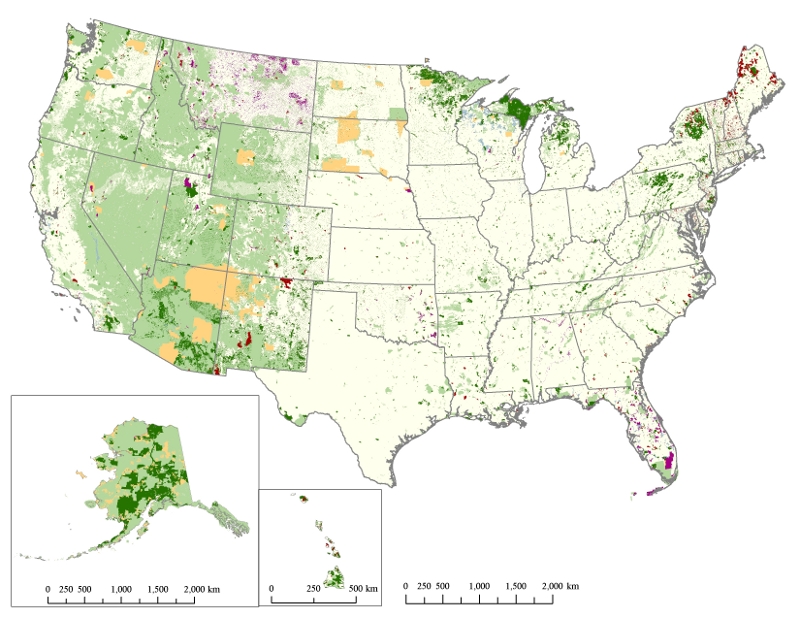
Speaking of mashing up funky GIS datasets with crop wild relatives distribution data — and we do; a lot — how long will it be before someone does it with the new US protected areas database?
Speedy rice
Here’s a time-lapse video of the long-term continuous-cropping experiment at IRRI. I didn’t dare turn the music off in case someone was going to tell me something interesting about it all. They didn’t, which makes it just interesting eye-candy. In my opinion, the video would also benefit if it gave some sense of the passing of real time — maybe an animated timeline?
The birthplace of the Dashehari mango
Our dear friend and colleague Bhuwon Sthapit has prepared this post for us with input from Dr H. Ravishankar, Dr BMC Reddy, Dr S Rajan and farming communities. Thanks, everyone!
‘Dashehari’ is one of the most popular mango varieties of North India, widely acclaimed for its exquisite taste and pleasant aroma. It is also my favorite. Naturally, I was excited to visit the Dashehari Village in Malihabad where the 200 years-old mother tree of the variety, a cultural heritage of the community, still lives.
It is believed that the trees on 80% of the area covered by mango in northern India can be genetically traced back to this very tree. The heritage is exciting, but the risks resulting from massive uniformity of orchards and lack of home gardens to harbour other interesting types of mangoes are terrifying.
Legend has it that a Pathan of Khalispur village of Malihabad Tehsil, transporting choicest mangoes for trade, happened to halt for rest in a hut of a poor Momedian, a monk. The Momedian helped travelers by offering water and shelter and the travelers reciprocated with ripe mangoes.
At the time of departure, the Pathan and the monk had an argument. In a fit of rage, the Pathan shoved one of his choicest ripe mangoes into the soil instead of gifting it to the monk, who however maintained the utmost calm and restraint. In the ensuing rainy season, a mango sapling emerged from the spot, which was duly nurtured to a robust tree by the Momedian. After about twelve years, the tree profusely flowered and yielded fruits of excellent quality.
The news of this unique mango reached the Nawab who owned the land. Being aware of the importance of genetic wealth, he took due care to protect and conserve this exquisite mango variety, which later became the popular ‘Dashehari’ variety of North India.
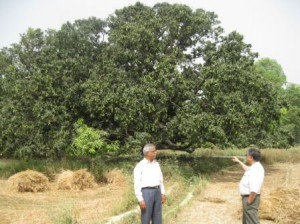
The tree is still very healthy and impressive, about 10m tall, having a mean canopy spread of 21.0 m and a trunk circumference of about 3.0 m (see picture 1).
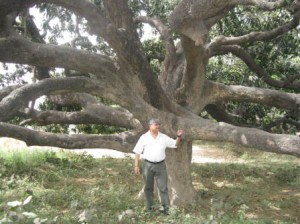
The tree has a robust trunk with twelve main scaffolding branches originating and radiating at 1.5 m height almost parallel to the ground.
The tree has spreading canopy architecture with impressive fruiting at the time of the visit, completely overshadowing neighboring trees.
A scientist from the Central Institute of Sub-tropical Horticulture in Lucknow told me that fruits of this Dashehari tree are oblong, elliptical and medium size (13cm long and 8 cm breadth) weighing 130 to 260 g.
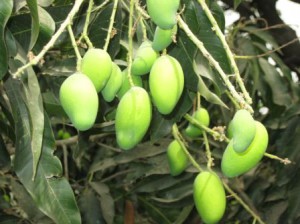
It has attractive yellow pulp, firm and non-fibrous, with very sweet taste (researchers told me that it has oBrix score of 21-23 as measure of sweetness in fruits) and pleasant aroma. CISH collected scion material of the tree for clonal propagation in 1977 and thereafter elite clones spread to northern Indian farmers from a network of private and government nurseries.
This cultural heritage tree belonged to the great-grandfather (Mr Ishtida Hussain) of farmer Mr Shamir Zaidi, now 30 years old, who has named his house in honour of the variety — Dashehari Kothi. Mr Kamil Khan, an 87 years old but rather progressive orchardist of the small hamlet of Kakori (close to Dusseheri village) of Malihabad Tehsil shared local legends with the visitors. He told us that the tree, under natural care, is free from stemborer and termites attacks, both common problems of mangoes. It is also free from Loranthus infestation. This tree has yielded on an average 80-190 kg in the last eight years, with a moderate biennial bearing habit.
In September 2009 the area was registered with Geographical Indication No 125 in the name of “Mango Malihabad Dusseheri” by India’s Geographical Indication Registry. The communities around the mother tree have also been selected for the UNEP/GEF Project “Conservation and sustainable use of wild and cultivated fruit tree diversity: Prompting sustainable livelihoods, food security and ecosystems services” in Malihabad, Lucknow. Communties such as Sarsanda, Kasmandi Kalam and Mohammad Nagar Talukedari have 7-29 cultivated varieties each.
They are also blessed by rich diversity in seedling mango trees, with an estimated population of 3000 to 5000 mango seedling trees. Almost all current commercial mango varieties in India are selected from the seedling population. Potentially research can identify many more consumer- and farmer- preferred diversity of mangoes and innovative farmers can work together with researchers and nurserymen to identify, select and popularize the elite materials from existing farmer’s orchards. The project aims to empower farming communities and local institutions to identify unique varieties from the orchards and scale up genetic resources and associated traditional knowledge for sharing wider benefits to farmers and consumers.
Almost all orchards in Malihabad are dominated by Dashehari (80%), with over 10-20 varieties of other cultivated types, but few trees of each. Around the orchards farmer maintain many seedling types and all of these trees produce diverse fruits with diverse shape, size, color and taste. There is thus scope to increase diversity in the market by sharing information with consumers in urban areas to stimulate demand for other varieties there, and thus minimize the risks posed by uniformity while also providing livelihood security for mango growers.
Crop wild relatives mashed up with deforestation
The recent PNAS paper on deforestation has been getting a lot of attention. The data are available, and our mole at CIAT (thanks, Julian!) kindly mashed them up with the distribution of a selection of crop wild relatives (Cajanus, Cicer, Eleusine, Hordeum, Lens, Pennisetum, Phaseolus, Sorghum, Triticum, Aegilops, Vicia, Vigna, and Zea). Here’s the result. In red are shown area where forest loss is >10%. Green shows areas where >15 species in the above genera are expected to be found from niche models. You’ll have to click on it to see it properly.
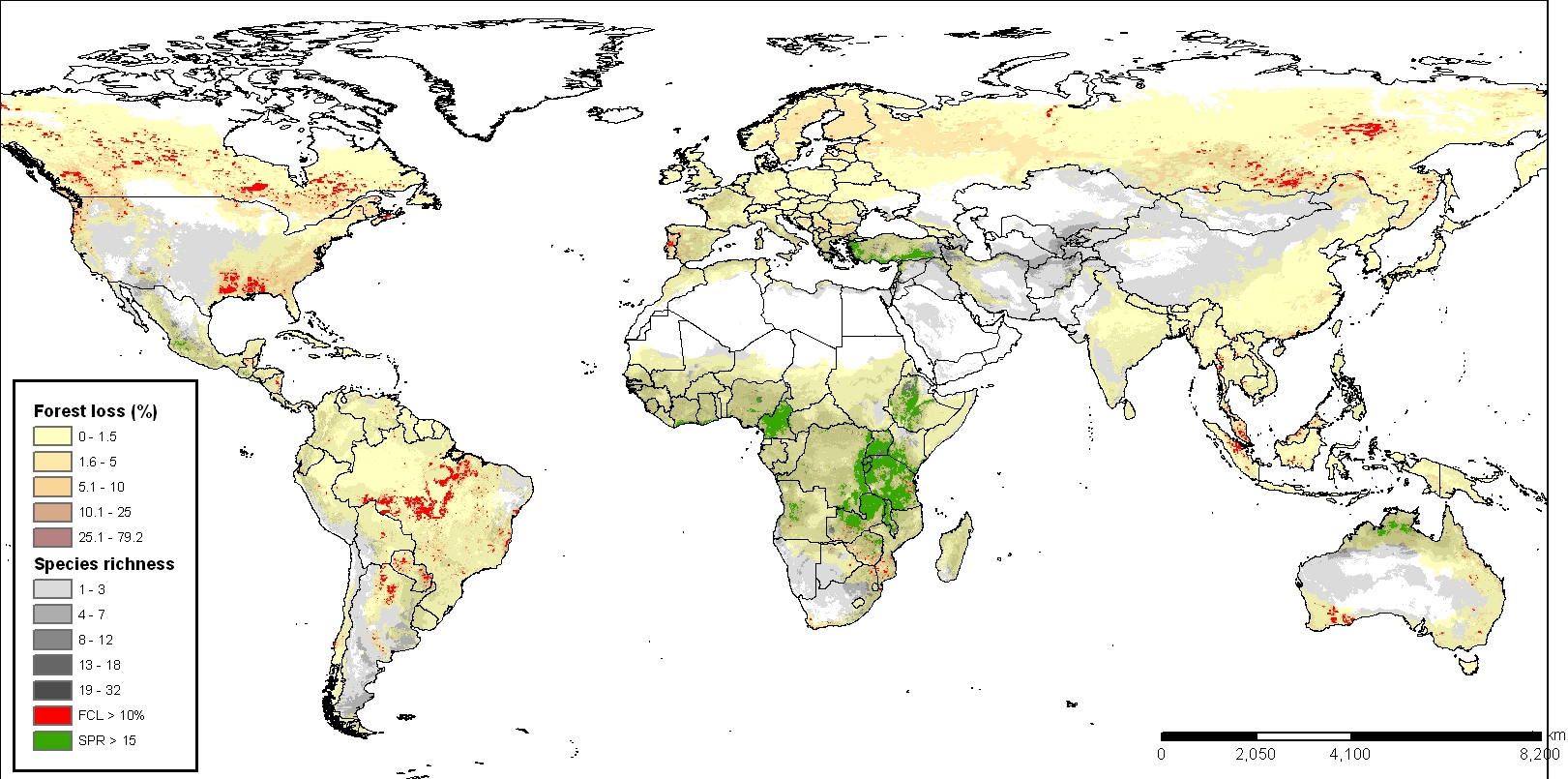
Perhaps not surprisingly given the genepools involved, there’s not much overlap between crop wild relative richness and deforestation. These particular species don’t seem to have much to fear from the loss of forested land. Except for a few small areas in southern Africa, that is.
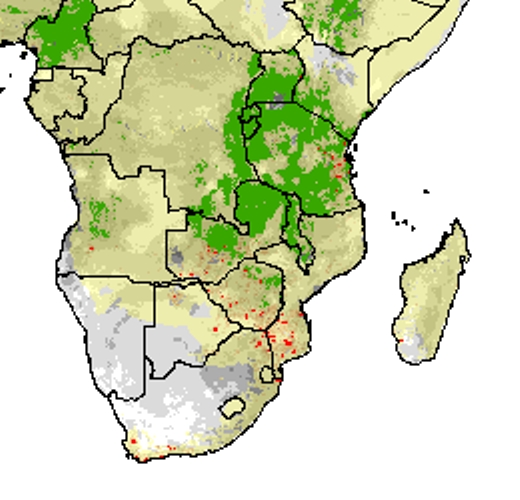
The picture would clearly be somewhat different if Julian had included wild cassava, rubber, apples or mangoes. I’m sure he will very soon.
Trouble in St Petersburg
Russian Ministry of Economic Development adopts resolutions destroying the European largest field genebank and replacing it with commercial cottages.
That’s quite a title. It refers to the Vavilov Institute’s Pavlovsk Experiment Station.
The Station was organised in 1926 near St. Petersburg. Being one of the major stations of VIR, it studies perennial grasses and cruciferous tubers cultivated in the Non-Black-Soil area. There are over 3000 accessions of fruit and berry plants maintained in vivo in its gardens. More than 40 of these fruit samples have been commercialized. This station operates an experiment farm, a quarantine nursery and greenhouses.
The article itself piles on the pain. The staff are doing what they can. Strongly worded letters have apparently been written:
The administration of the Vavilov Research Institute of Plant Industry (VIR) and the staff of Pavlovsk Experiment Station have forwarded open letters to the President of the Russian Federation D.A. Medvedev and the Prime Minister V.V. Putin seeking their support in shielding the world’s heritage against irresponsible acts of certain Russian functionaries.
Our feelers are out. We’ll keep you posted.