It is well known that plant populations do best when they grow close to where they originally came from. A myriad reciprocal transplant experiments going back decades attests to the power of local adaptation. But how close is close? The question is of very real practical importance if you’re trying to restore a habitat. By definition, the local population is gone. What is the maximum distance you should be willing to go to collect material to re-establish it?
Three hundred kilometers is the answer given in a paper just out in Ecological Applications. 1 There’s also a discussion over at Conservation Maven. The authors worked on the salt marsh grass Spartina alterniflora, which is commonly used in ecological restoration of wetlands in North America. They collected germplasm at 23 sites from Texas to Maine, genotyped them using neutral markers, and then grew them all in a “common garden” experiment in Louisiana, where they measured in various ways how well each population did. The control was a population just across a canal from the experimental site.
It turned out that clone diameter, number of stems and number of inflorescences at the experimental site, as well as genetic distance, were all significantly affected by measures of the geographic distance between the source and the experimental site. For populations up to about 300km away along the coast, performance in the common garden was similar to the control. Go further, and the source populations do not do as well where they are planted.
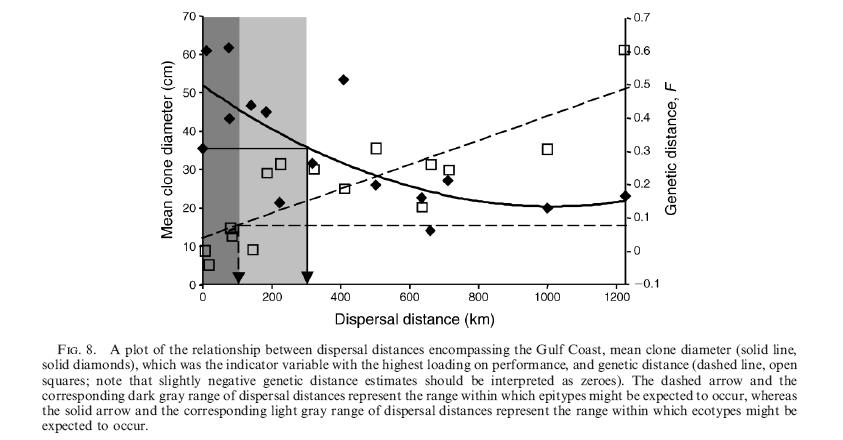
The authors make quite specific recommendations for restoration. Use material from at least three populations within 300km of the restoration site, and 100km if you want material that is not only maximally locally adapted but also not significantly genetically different from the original population at the restoration site.
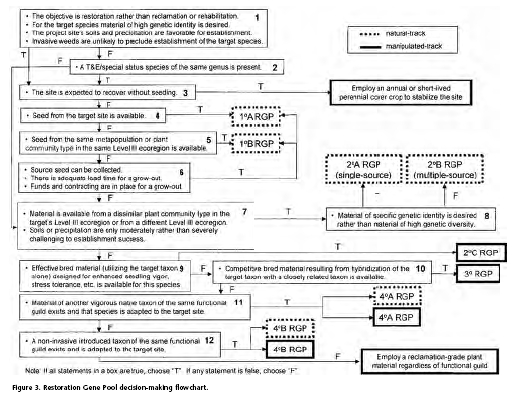
Now, I don’t know how widely applicable these recommendations might be. I don’t know the restoration literature at all. A cursory look revealed a fairly well-developed theoretical framework, the “restoration gene pool concept.” Which has been used to develop a decision support tool.
As I say, I don’t know much about restoration. So I don’t know to what extent this sort of thing has been applied to crop wild relatives. To me, “use” of crop wild relative germplasm means use in breeding. But that is clearly very narrow thinking, and I should be ashamed of myself.