Is mole… “an ingenious Mexican version of curry, or is curry a Hindu adaptation of a Mexican sauce?”
Good question.
Crops, livestock, microbes, pollinators, wild relatives, agroecosystems, foodways …
Is mole… “an ingenious Mexican version of curry, or is curry a Hindu adaptation of a Mexican sauce?”
Good question.
MAT’s post on the cultural consequences of corn colour, which we nibbled earlier today, has been brought to my attention. Immodesty forces me to note that we have explored similar byways here ourselves. Luigi experienced first hand contempt for yellow corn among a small sample of ethnic Africans. MAT’s assertion that “corn meal in the United States is yellow,” is undone by the clear north-south divide in preferences, noted here. 1 The whole business of yellow foods’ nutritional value is touched on in many places, not least here. And, of course, there’s the whole orange-fleshed sweet potato saga. Somehow, these “soft” ideas about culture seldom get the respect they deserve when talk turns to improving staple crops.
A message to the CropWildRelatives mailing group yesterday really piqued my interest:
The Julius Kühn-Institute has launched a new version of the Crop Wild Relative Information System (CWRIS) – AEGRO – Population Level Information System (PLIS) = CWRIS PLIS, originally set up to locate Beta occurrences within protected areas in Europe. The PLIS for Beta is functioning while work continues on Avena, Brassica and Prunus.
As the project ends in September 2010, JKI would be grateful to all those willing to test the system and send their feedback to allow further improvements. It also declines any responsibility with regards to the data content as they have only compiled the data from various sources and did not generate the data.
For more information and to test the system visit the AEGRO Home.
So of course I did. The interface is not hugely attractive but workable. 2 You can search by location, protected area, taxon or taxon + locations. You can see the results as a list (downloadable), in Google Earth or as a kml. This is what you get for Beta corolliflora, which is nice enough.
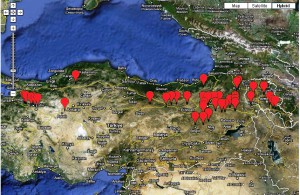
But it’s not so much more than you get with GBIF, and there you get synonymy information as well, and the possibility to do some niche modeling.
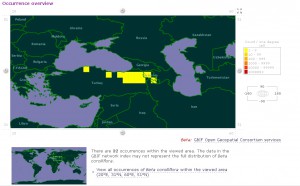
And in neither case is it easy to download an image. However, AEGRO does mash up the crop wild relatives distribution data with protected areas. Now, this is not a feature that is particularly easy to explore, as there are over 400 protected areas in the system. If you don’t a priori know of one that has a Beta wild relative, you’re left to guessing. If you’re an idiot like me, that is. The other thing you can do is simply look at the records list for a given species and find if it is known from any protected area. Anyway, after a few minutes of trial and error, I eventually found a protected area in Cyprus which has a record or two for Beta vulgaris var. maritima. Well named, because it seems to be growing offshore, but that’s clearly a problem with the original data the system is harvesting. Caveat emptor, as ever in genebank database hell.
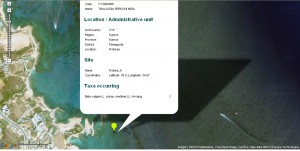
So it looks like the only real extra over GBIF is the fact that you can search for the crop wild relatives in specific protected areas. But even then you don’t get in the final map any indication of the geographic boundaries of said protected area. That would be my main recommendation for improvement.
Data quantity? AEGRO has 15,935 geo-referenced occurrences of Beta, and 8,460 records without geo-references. GBIF has 12,795 geo-referenced records from a total of 23,529. Not really that much in it. Disappointing, overall, I have to say. But there is time before the end of the project.
It hasn’t really taken all that long for the Jatropha backlash to begin. It is still often…
…claimed to produce biofuel and enhance socioeconomic development while reclaiming marginal and degraded lands in (semi-)arid regions (Francis et al., 2005), without competing with food production or depleting natural carbon stocks and ecosystem services.
But doubts are arising.
…the current knowledge gaps and uncertain economic perspectives, together with competition on the global biofuel market, might drive Jatropha investors away from marginal or degraded lands towards agricultural or lands that are valuable for biodiversity, in order to reduce financial risk.
That’s all according to a paper in Journal of Arid Environments. There’s certainly evidence to that effect from India, according to “ATREE, an Indian environmental research group promoting sustainable development.”
…new research shows jatropha, which has received huge government backing in recent years, yields less than experts had first predicted and is now being grown on fertile farmland — undermining two of its best selling points.
There have also been marketing problems. Listen, from Kenya, to “Mr Joseph Odembo of the Nam Lolwe [Jatropha Caucus] … and a member of the lobby, Action Resort for Change (ARC), the local NGO that invited the international [bio-diesel] agents:”
We have not been able to find a market for the trees which have been ready for the last two years but farmers are still optimistic that one day a good deal will come and they will be able to see the fruits of their labour.
What’s the answer? Is there one, indeed? Well, according to the Arid Environments paper, the problem is one of scale.
…the global hype could be harnessed to increase rural development by considering small-scale, community-based Jatropha initiatives for local use, like small Jatropha plantations, agroforestry systems with Jatropha intercropping, and agro-silvo-pastoral systems.
It wont come easy, though.
Implementation of this model needs important extension efforts through cooperatives and local networks having good insight in local environmental, economic, cultural and social processes. Their assistance in the introduction of Jatropha should start with the communication of correct information on land suitability including potential yield range, risk of yield loss, management practices and possible water competition (Maes et al., 2009), as Jatropha will not yield well on all sites for which its suitability has been claimed (Trabucco et al., 2008). Furthermore, these extension efforts should assist in acquiring plant material at low cost and in the post-harvest processing and product use as well (e.g., multifunctional platforms, see Havet, 2003).
The right sort of plant material, I would add, and not just at the right price. The germplasm collections are certainly out there. But are they being used?
Amid all the hype about Michelle Obama’s blitz on child obesity, USDA has come out with an interactive Food Environment Atlas, which has been much commented on in the blogosphere. Here’s what the distribution of fast food restaurants in the US looks like:
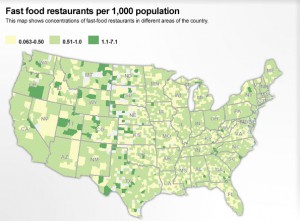
Coincidentally, Pete at PeteSearch has mined Facebook profile data and come up with this visualization of the connections among users:
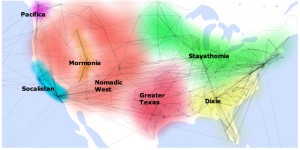
Is it me, or there a coincidence between the maps? Here’s one of the things Pete says about the Nomadic West:
Starbucks is almost always the top fan page, maybe to help people stay awake on all those long car trips they must be making?
Geography is destiny?