Onkel Bob seems to know a lot about the Silk Road, do read the whole thing:
The exchange of food was very much a one way exchange, and surprisingly few staples went over this route.
Agrobiodiversity is crops, livestock, foodways, microbes, pollinators, wild relatives …
Onkel Bob seems to know a lot about the Silk Road, do read the whole thing:
The exchange of food was very much a one way exchange, and surprisingly few staples went over this route.
Here’s part two of that series on late blight I mentioned back on Wednesday. Of course you cannot do justice to the whole story in a teeny blog post, and the author does link to one of the books about the Great Famine. There are many, many more.
Part three digs deep into late blight’s genome to show how it manages to penetrate almost all the defences so far erected against it.
Today’s Economist has a Leader and two articles about feeding the hungry, one on Monsanto and one on markets. Not surprising, coming hard on the heels of this week’s World Food Summit.
There’s also this at the Economist blog, a neat information-rich video that explains IFPRI’s view of climate change (including differences in prediction between two models) and the consequences for global food supply. 1
Of course one could quibble with details, but the bigger quibble is with the Economist’s own double-vision. Or do I mean blindness? The Leader has a headline of How to feed the world and Business as usual won’t do it as a snappy sub-head. But the solutions it offers — GM drought-resistant crops, access to markets — are business as usual.
As speaker after speaker at the World Food Conference reminded us ad nauseam, the problem of global hunger is not about quantity of food, it is about availability and affordability. And as we’ve written before, it would be a doddle to grow all the food the world will need in 2050 on a small fraction of the land currently occupied by agriculture. The Economist’s “solutions” do nothing to help the poorest rural farmers, who want to minimize risk, not maximize production. Nor do they want to sit about waiting for a shipment from somewhere or other. They need research that will help them make better use of agricultural biodiversity. But as long as economists build their models on foundations of old data (and to be fair, what else are they to do?) it will never make sense to them to invest in a new approach.
What is needed is for someone — donor or private foundation — to back a hunch.
Over at his other place, Jeremy expounds on an unusual idea for “solving” hunger. What do you think? Does he have too much time on his hands?
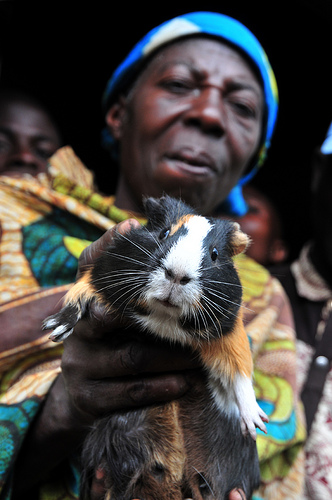
This picture really made me sit up and take notice when I saw it at CIAT’s Flickr photostream. I had absolutely no idea that people in Kivu, DR Congo, kept guinea pigs as mini-livestock, and a simple Google search turned up almost nothing of relevance. I went a bit deeper, and unearthed an article — Think big with minilivestock — in Spore from February 2008. That told me that in Kivu women often breed guinea pigs to provide their children with animal protein, which is otherwise not available to these most vulnerable members of the household. The article also says:
Throughout Central and West Africa and as far east as DRC and Tanzania, as well as in Haiti (Caribbean), small-scale guinea pig farming based on a few animals contributes to food security. It is a relatively easy activity, aside from problems caused by inbreeding which can eventually affect the health and weight of animals.
But it doesn’t tell me how this started, or what CIAT’s involvement might be. Can someone from CIAT or FAO please enlighten me?
And while we’re on the subject of introduced mini-livestock, has anything moved the other way? Luigi assures me that grasscutters (aka cane rats, Threonomys spp.) are delicious, but I’m pretty sure he didn’t taste them in Colombia.