Where did that come from, I asked myself, as we looked around the home garden of an agrotourist lodge near Cotacachi in Ecuador. No, not the wonderful neotropical fruits, or the fiery Brugmannsia, or the tree they called guava that looked to me like a carob; certainly a legume of some sort. Not any of the exotica that were at home here, but this thing, a brassica looking for all the world like a small tree.
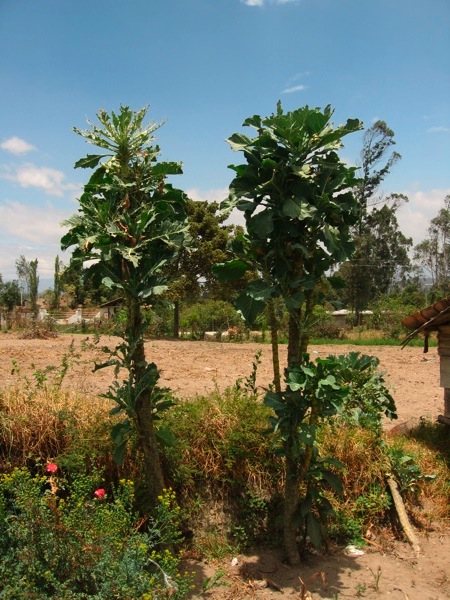
To me it looked like one of the perennial kales, or even the Jersey Walking Stick Cabbage that I’ve grown in the UK and seen in Basque country and parts of Portugal. On the other side of the path was a red-leaved variety that had a much more dissected leaf, a little like Red Russian kale but again growing like a tree.
Fortunately the lady of the lodge, Dona Digna, who has every reason to be proud of the accomplishments of her community, was there with us, and even more fortunately I had the services of an expert translator. I asked how they used it, and was told that they picked individual leaves as needed, and that now it was not good at all, much too tough. OK, well then how do you get tender leaves? In the spring, we make new plants. How?
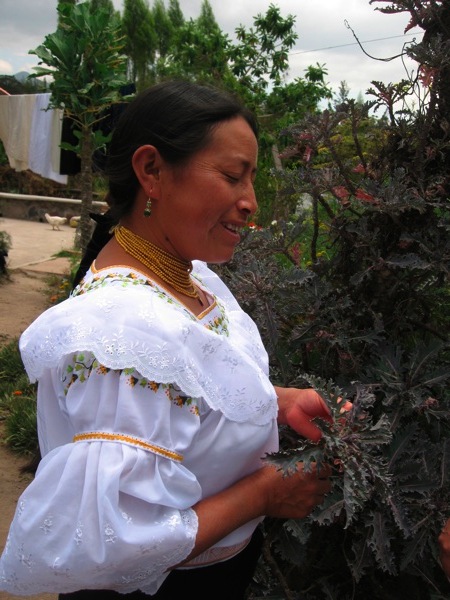
At which Digna snapped off a branch of the red kale and said that you just plant a stem in the ground. So it never has flowers? No, never.
So it really is a perennial brassica, not one of the walking stick types, which do flower and set seed. But that’s as far as I could go in my investigation. I have no idea how long the local people have been growing it, where they first got it from, or what they think of it. But it was fun to see something truly exotic in Ecuador. And maybe it could add a datapoint to a study that revealed a high degree of duplication among perennial kale accessions.