I’ve blogged about ProMED before a couple of times. It’s advertised as a “global electronic reporting system for outbreaks of emerging infectious diseases & toxins.” But it is actually a bit more than that, as a recent piece on cassava brown streak disease revealed. There have recently been some stories in the Ugandan popular press about this disease. And one of the early ones made it to ProMED. That’s useful enough, but it also elicited a reply from Prof. Mark Laing of the School of Biochemistry, Genetics, Microbiology and Plant Pathology, University of KwaZulu-Natal in Pietermaritzburg, South Africa. He noted that “that there is hope on the horizon versus both cassava mosaic disease (CMD) and cassava brown streak virus (CBSV)” and quoted a couple of breeding programmes that are having some success. That’s really how you want an early warning system to work. It should not only give warning of the problem, but also get people to discuss possible solutions. It doesn’t seem all that complicated to set up. Is it too much to hope for that there’ll be something along these lines for genetic erosion before I crawl away to my well-earned retirement?
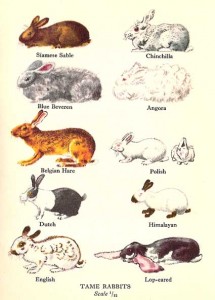
Tame rabbits
Livestock genetics symposium online
DAD-Net informs us that the presentations given at the symposium on Statistical Genetics of Livestock for the Post-Genomic Era, held at the University of Wisconsin-Madison, USA, on May 4-6, 2009, are now available online in the form of both PDFs and videos. Quite a resource.
Featured: FIGS
Jacob has an idea why using climate data won’t always make the haystack smaller:
To me, the potato results mean that we shouldn’t be looking at selection, but at migration and drift. Selection reduces diversity, migration and drift determine where it goes.
Millet news from the front
I could spend all day reading the blogs of volunteers in different countries. One I keep coming back to is Jessica’s Letter from Niger. It’s an exciting time:
There is a rush to do as much planting as possible before the soil dries out, so families spend all day every day out in the fields, working hard to get all of their millet, sorghum, beans, sesame, and peanuts in the ground. Millet is the priority; once an entire field is planted in millet, people will go back and plant the other crops in the spaces between.
I hope their crops survive and do well.