I suppose this means genebanks have hit the mainstream, but I wish the guy had got it right.
Snorkel rice
 Yoko Hattori and colleagues report in Nature 1 that they have identified two genes involved in the awesome elongation of deep water rice; the type of rice that can grow in several meters deep water. The genes, baptized SNORKEL1 and SNORKEL2, can now be identified with molecular markers and crossed into popular rice varieties. The BBC has a nice video comparing — I assume — genetically otherwise nearly identical rice varieties with and without the genes.
The avid reader will remember the runner-up entry in The Competion about the sub-1 gene 2, that is used by IRRI to make rice flood-proof. Some of these new sub-1 varieties, such as Swarna-sub1 are already grown by farmers in India and Bangladesh.
Interestingly, sub-1 does the very opposite of SNORKEL. Sub-1 shuts the plant off to stop elongation, so that it saves its energy, and can recover later. This works great with flash floods if the water recedes after a week or two. But if the water stays for longer than that, the crop dies. With stagnant deep water, a variety with the SNORKEL gene could be a better bet.
If farmers know beforehand that the water is going to be very deep (because it happens most years), they probably already plant deep water varieties (or plant later or do some other smart thing). Deep water rice is somewhat in decline, because of low yield, but it is grown on a very large area, probably about 3.5 million ha worldwide, mostly in India, Bangladesh, Myanmar, Thailand, Indonesia, Vietnam and Cambodia.
However, if flooding is rare it could be more profitable, though risky, to plant other than deep-water varieties. For their earliness, yield, quality, or what not. Adding either the sub-1 or the SNORKEL gene 3 to those varieties would be an insurance policy for flood years. But which gene to choose? And in what variety? And where to grow it? Not an easy question, but we have been trying to answer it.
Pulses and the Renaissance
I’ve been trying to get to the bottom of an intriguing, vaguely familiar assertion about legumes made by Tom Jaine in his recent Guardian review of a clutch of food books:
the 12th-century renaissance that gave us Heloise and Abelard was due mainly to better agriculture and more protein-rich legumes rather than heightened sensibility or appreciation of the classics — for Abelard, not so much cherchez la femme as cherchez le pain.
Intriguing, but ambiguous. Legumes which were more protein-rich? Or more legumes? More yield of legumes, or more species of legumes? I remembered having read similar things in the past — medieval agricultural innovation and all that — but I had never looked into the subject in any detail.
I suppose the easiest way to find out more would have been to read the source of the statement, Tom Standage’s An Edible History of Humanity. This is about how foods have influenced history, which sounds pretty interesting. And hopefully one day I will get to it. But until then, there is the internet. 4
The most accessible elucidation I’ve been able to find online of the assertion that pulses drove the 12th century mini-Renaissance is an article by Umberto Eco. He points out that the population of Europe began to increase again at the turn of the second millennium after a long period of stagnation, perhaps tripling in the next 500 years. Why? Eco suggests that agricultural innovation was behind this explosion of population, and of physical and intellectual energy. There was a new(ish) three-field rotation, iron horseshoes, a new collar and ploughing methods. But there were also beans, peas, vetch and lentils.
All these fruits of the earth are rich in vegetable proteins, as anyone who goes on a low-meat diet knows, for the nutritionist will be sure to insist that a nice dish of lentils or split peas has the nutritional value of a thick, juicy steak. Now the poor, in those remote Middle Ages, did not eat meat, unless they managed to raise a few chickens or engaged in poaching (the game of the forest was the property of the lords). …[T]his poor diet begat a population that was ill nourished, thin, sickly, short and incapable of tending the fields.
So when, in the 10th century, the cultivation of legumes began to spread, it had a profound effect on Europe. Working people were able to eat more protein; as a result, they became more robust, lived longer, created more children and repopulated a continent.
I tried to find out a bit more online about the dynamics of the spread of these crops through Europe, presumably from their Mediterranean heartland, but was not all that successful. There’s a little something in a book on medieval population growth.
And also a bit in a book on medieval agriculture. But nothing on exactly how pulses were adopted across the continent. Best I can figure is that they were already known to some extent, and perhaps cultivated on a small scale in gardens, and were gradually incorporated into the field system, replacing bare fallows, as suitable agricultural land ran out and intensification became necessary. 5 Anyway, surely the process is fairly well understood by historians and I’m just showing my ignorance here. Who will instruct me?
Mapping Argentinian pests and diseases
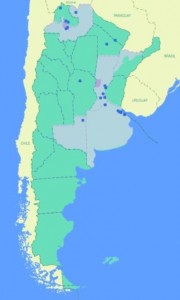
The Instituto Nacional de Tecnología Agropecuaria in Argentina has a new online pest and disease atlas out. It’s in Spanish, but pretty intuitive to use. You can search by host or by pest/disease organism. And you get a bunch of references, descriptive notes, photos and a map, albeit a static one — not sure how updating will be done. Below is the distribution of Setosphaeria turcica, the causal agent of Northern Leaf Blight in corn, for example. Would be interesting to mash this kind of thing up with the distribution of tolerant material. Must look into that. And of course one could do some climate change prediction modeling too. Thanks to IIALD.
Bolivians going back to their roots
I blogged a couple years ago about what might be called the “1491 controversy,” which hinges on whether you think the Amazon and adjacent areas were densely populated and closely managed before Columbus arrived, or an unproductive, largely pristine wilderness. One of the areas in question is the basin of the Beni River in Bolivia. Whatever your stand on the 1491 debate, it is undeniable that the Beni is a heavily modified landscape.
Shallow floodwaters cover much of the low-lying lands in the Llanos de Moxos during part of the rainy season. The rest of the year, dry conditions prevail and water is scarce. The alternation between seasonal flooding and seasonal drought, combined with poor soil conditions and lack of drainage, make farming in these areas difficult. The ancient inhabitants of the area created an agricultural landscape to solve these problems and make the area highly productive. They constructed a system of raised fields, or large planting surfaces of earth elevated above the seasonally flooded savannas and wetlands. Experiments have shown that the raised fields improve soil conditions and provide localized drainage and the means for water management, nutrient production, and organic recycling.
Well, Bolivian researchers are now suggesting that farmers return to these “camellones,” or raised fields, to harness the seasonal flooding, rather than succumbing to its depredatioons. Oxfam is supporting the project. The BBC was there.
If, as predicted by many experts, the cycles of El Niño/La Niña are going to increase in intensity and frequency, then the project has the capacity to help poor families cope better with the extreme weather events and unpredictable rainfall that are to come.
It would also allow them to cut down on fertilizers, and dabble in aquaculture. There is some scepticism, which has to do with the necessary investment in time and effort. But early results show gains in productivity, apparently, although it’s unclear from the BBC article what exactly is being compared. Anyway, there is much optimism.
This process could be repeated in various parts of the world with similar conditions to the Beni like parts of Bangladesh, India and China.
In the words of local farmer Maira Salas: “We are only just now learning how our ancestors lived and survived.” Well, yes, but with a difference. Some of the crops that are been grown in the camellones are exotic, which is fine, of course. But will there also be a revival of neglected traditional indigenous crops?