“Can I have one of these plums,” I asked the friend with whom we were staying in California.
“They’re not plums, they’re pluots. Some kind of cross between a plum and an apricot.”
Skeptical as ever, I rushed off to check such an outlandish claim, and, chastened, realized that there’s a lot I do not know about fruit. Not only is the pluot genuine, there are apriums and plumcots too. The one I tried was apparently called Dino Egg, a trademarked (and exceedingly fanciful — I mean, who knows?) name for a variety registered as Dapple Dandy.
Pluots are simply stunning. They are sweeter than most plums I’ve ever bought, and not in the least bit stringy. The flesh is not just sweet though; it has complex smells and tastes, slightly spicy, maybe, with — there’s no other way to put it — the taste of sunshine. And the flesh parts easily from the stone, at least the one I had did, which may be related to the lack of stringiness.
Fast forward a week and we’re barreling along I-5 from Los Angeles to San Francisco, through the heart of the San Joaquin Valley. I’ve seen intensive industrial agriculture before, but this was still an eye-opener. 1 We pulled over to visit the store at Murray Family Farms, and found more kinds of pluot than you could shake a stick at. Time was pressing, so we couldn’t chat long to the two really friendly guys in the store, but we did buy a couple of bags of pluots to take Back East, where we’d never seen them.
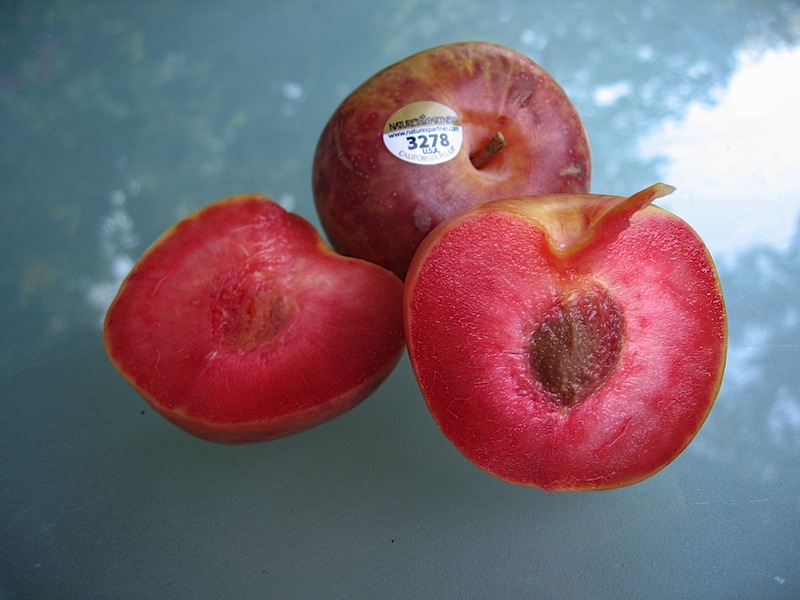
They went down pretty well, with about as much skepticism about their origins as I had originally. That’s one of them, grown by a Nature’s Partner (and bought at a supermarket, not Murray Family Farms). The number ought to tell me which particular partner was responsible for that particular pluot, but although the Nature’s Partner web site does everything except squirt cider in your ear it doesn’t easily let you peer behind the number.
The day before my return to Rome, I noted in the local paper that the following day’s edition would contain an article entitled The hunt for the elusive pluot. Coincidence? I think not. In the end it turned out to be a review of a book about the hunt for the elusive pluot. Of course I haven’t read it yet, but judging from another review it might well be a tasty read.
Meanwhile, someone tell me whether pluots have spread beyond California? I stalk the supermarkets of the US as often as I can, but I’ve never seen it.