Have you got your own urban farming story? Upload it to iReport.
Forget Cuba, we’ve got Detroit
A food desert is defined by those who study them as a locality from which healthy food is more than twice as far away as unhealthy food, or where the distance to a bag of potato chips is half the distance to a head of lettuce.
Cost per calorie should figure in that definition too; either way, here’s a dream of an idea for greening Detroit, symbol of all that is urban decay in the US. It could happen, I suppose. But what are they going to grow during those Michigan winters?
Mark Dowie, the article’s author, “lives on an island floating in the Pacific” it says here, but I’m sure he has researched the topic as thoroughly as he does all his articles and will be moving to Motor City any day now.
Cuba’s urban ag miracle has feet of clay
Proponents of urban and peri-urban agriculture, ourselves included, have a poster-child: Cuba. In the wake of the collapse of the Soviet Union as a big market for sugar exports, the Cubans became more self reliant and replaced the food they could no longer afford to import with bounteous harvests from small urban plots.
Alas, all is not quite so rosy in the organopónico. A new book, noted at HungryCity, points out that these plots supply just 5% of Cuba’s food. Furthermore, 75% of Cuban farmers use agrochemicals, and 83% would apply more if they could. Despite masses of evidence that organic land in Cuba really was more productive than conventional farms, the country is reverting to a conventional model.
I came to that post via this one at Spillway, where Will Wiles dissects the issue:
[T]he proponents of urban farming often muddle up doing it because we must (that is, we face shortages if we do not) and doing it because we should (self-reliance being a virtue, food security being desirable and so on) — necessity and desirability. And it’s the questions of necessity that tend to be the most powerful arguments: no one wants to face shortages. But if people see urban farming as only a necessity, it will only ever be seen as an emergency response to a crisis, to be rolled back when (if) more secure times return. This appears to be the condition Cuba is in. But that simply sets society back on the road to consumer-dependence of food produced invisibly elsewhere.
Moving to a more diverse and stable system of food production — including some urban farming — has to accent that is is a desirable option in good times and bad.
That makes a lot of sense to me; urban ag and greater diversity can deliver both resilience and better nutrition, health, incomes etc etc. I wish I had the skills and time to do a decent analysis of an idea that has long intrigued me. At the moment global food supply is dominated by cheap refined carbohydrates and appalling meat. People are not fools; they buy the cheapest calories they can. And that does not include good nutrition. So, why not integrate intensive (but preferably less harmful) production of storable, shippable commodities with local production of the extras that are so vital for a diverse diet that is tasty and nutritious?
There’s more at Spillway about Art and Food, but time is short today and I can’t summon the energy to unpack it or to respond. You might fare better.
Featured: Copper
Back40 sets Robert straight on the use of copper as an “organic” fungicide:
Copper is no more “inorganic” or “unnatural” than nitrate. Yes, they are both minerals but that’s what plants eat and what microorganisms make. However, it is well to remember that it’s the dose that makes the poison. So long as they are not present in high concentrations they are food rather than poison.
Actually, copper is probably the least of organic’s dirty secrets.
What I did on my holidays: The Pluot
“Can I have one of these plums,” I asked the friend with whom we were staying in California.
“They’re not plums, they’re pluots. Some kind of cross between a plum and an apricot.”
Skeptical as ever, I rushed off to check such an outlandish claim, and, chastened, realized that there’s a lot I do not know about fruit. Not only is the pluot genuine, there are apriums and plumcots too. The one I tried was apparently called Dino Egg, a trademarked (and exceedingly fanciful — I mean, who knows?) name for a variety registered as Dapple Dandy.
Pluots are simply stunning. They are sweeter than most plums I’ve ever bought, and not in the least bit stringy. The flesh is not just sweet though; it has complex smells and tastes, slightly spicy, maybe, with — there’s no other way to put it — the taste of sunshine. And the flesh parts easily from the stone, at least the one I had did, which may be related to the lack of stringiness.
Fast forward a week and we’re barreling along I-5 from Los Angeles to San Francisco, through the heart of the San Joaquin Valley. I’ve seen intensive industrial agriculture before, but this was still an eye-opener. 1 We pulled over to visit the store at Murray Family Farms, and found more kinds of pluot than you could shake a stick at. Time was pressing, so we couldn’t chat long to the two really friendly guys in the store, but we did buy a couple of bags of pluots to take Back East, where we’d never seen them.
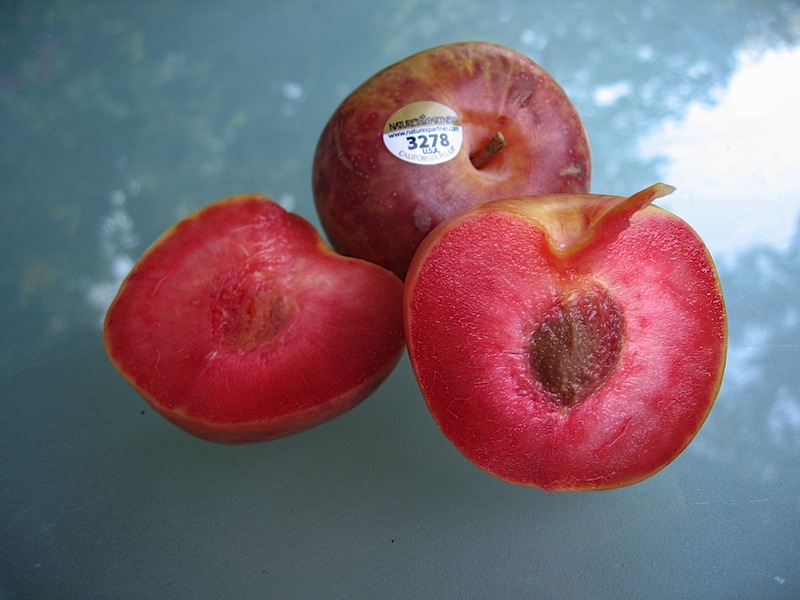
They went down pretty well, with about as much skepticism about their origins as I had originally. That’s one of them, grown by a Nature’s Partner (and bought at a supermarket, not Murray Family Farms). The number ought to tell me which particular partner was responsible for that particular pluot, but although the Nature’s Partner web site does everything except squirt cider in your ear it doesn’t easily let you peer behind the number.
The day before my return to Rome, I noted in the local paper that the following day’s edition would contain an article entitled The hunt for the elusive pluot. Coincidence? I think not. In the end it turned out to be a review of a book about the hunt for the elusive pluot. Of course I haven’t read it yet, but judging from another review it might well be a tasty read.
Meanwhile, someone tell me whether pluots have spread beyond California? I stalk the supermarkets of the US as often as I can, but I’ve never seen it.