The Communications Team in the CGIAR Secretariat launched a new blog a few weeks ago called “Rural Climate Exchange: Connecting Agricultural and Environmental Science to the Climate Agenda.” It looks nice. It seems to have all the requisite bells and whistles. You can subscribe to an RSS feed or email notifications. We’ll be keeping an eye on it, and contributing as appropriate. Welcome to the blogosphere, Nathan, Danielle, Amelia et al.!
Monitoring plants of “Community interest” in Europe
There’s been an item in the news the last couple of days to the effect that “[a] report by the European Commission shows that habitat and wildlife protection targets across Europe will be missed…” Digging a bit deeper into that seemingly simple statement led me to a hitherto unknown (to me) world of EU rules and regulations and reporting requirements.
Let’s start at the beginning. There’s a thing called the Habitats Directive (1992). This requests all Member States “to monitor habitat types and species considered to be of Community interest.” It’s unclear to me how they were selected (perhaps someone out there can tell us), but these species are listed in various annexes to the Directive, though that sounds more simple than it is:
Where a species appears in this Annex but does not appear in either Annex IV or Annex V, the species name is followed by the symbol (o); where a species which appears in this Annex also appears in Annex V but does not appear in Annex IV, its name is followed by the symbol (V).
Anyway, Article 17 provides for regular reports on implementation of the Directive, and the report “for the period 2001-2006 for the first time includes assessments on the conservation status of the habitat types and species of Community interest.”
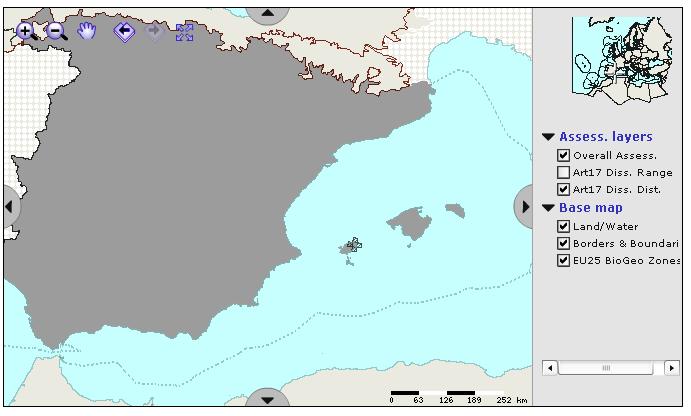
The website which houses the Article 17 reports is, well, complicated, but well worth exploring. The most interesting bit from an agrobiodiversity perspective is the page from which you can get species reports. These include all kinds of information about the status of those “species considered to be of Community interest,” country by country (there’s also an overall summary). Some of these species “of interest” are crop wild relatives such as Allium grosii, an endemic to the Balearic Islands (click the map to enlarge it).
There’s a few more CWRs in those annexes, though not all that many. A Hungarian Pyrus, for example. Any chance to get a few more on there? The bureaucratic infrastructure and mechanism for regular monitoring and early(ish) warning of any threats would seem to be well and truly in place, European Union-style.
Mind boggling potato breeding
Tom Wagner explains how he does what he does, kinda, sorta.
Anyway, I had some extra pollen of Nordic October (one of my best reds) and went to a potato seedling growing in a raised bed. I emasculated several buds of the yet un-named seedling and proceeded to tell my neighbor of the pedigree. I said that the original line was CT8406-33, a chacoense/tuuberosum hybrid with slightly blue rings in a purple skinned white flesh potato that was but one of some seedling tubers lines bred for high glycoalkoloids in the foliage to repel Colorado Potato Beetles. This line was either selfed or OP’ed and the result was Red Cat, a red skinned, red fleshed line that had lots of berries. I crossed Red Cat to a male parent called Lenape, a white skinned, white flesh line with high glycoalcoloids. The cross led to the Negro y Azul, a very black/blue skin and fleshed line that saw it’s origin on some certified organic ground off I-5 near Buttonwillow, California. Negro y Azul was crossed to Kern Toro, one of my best reds at that time, a combination of NorDonna and Fontenot. The cross of Negro y Azul and Kern Toro led to Azul Toro, an excellent early blue flesh variety. I crossed the female Azul Toro with pollen from Blue Blood Russet, a cross of Blue Cat and an unknown russet seedling. The resulting cross was named Paint Jar, an inky black/blue with occasional white patches in the flesh. I crossed the Paint Jar with pollen from Dark Red Norland and this created Paint Nor. Paint Nor was crossed with pollen from October Blue, a cross of Nordic October, a red similar to Kern Toro with the exception of additional germplasm from Red October that had ND2912-2R in it….to Azul Toro, previously mentioned. The two seedlings in the raised bed has one I named last week as Mule Skinner Blues. The other had to be named and I thought of Mostly Purple and I serendipitously named it MOSTLY PURPLE as I crossed it with pollen from Nordic October…knowing fully that I had permission to do so.
Federal audit of scientific collections remembers agrobiodiversity
President Bust Bush apparently ordered a review and audit of Federally held scientific collections back in 2005. The report is just out. The article in the Washington Post about this dismisses genebanks in a few words (“rare seeds stockpiled by the Agriculture Department”), but the actual report has a bit more, including a box highlighting the National Center for Genetic Resources Preservation at Ft Collins and making a reference to Svalbard (p 23), and a paragraph on GRIN (p 31). I think that’s pretty good going. The recommendations (starting on p 29) are a fun read. They’re directed at scientific collections of all types in the US — of seeds, herbarium specimens, stuffed animals, rock samples etc. But basically, if you applied them to genebanks globally, you wouldn’t go far wrong.
Mapping our blogging
On slow news days my mind turns to things meta. So here’s a map of our agrobiodiversity blogging. You can get a better, interactive one by clicking “Map” up on the menu bar at the top of the page.
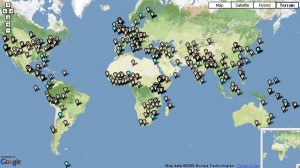
Considering we haven’t been geo-referencing from the beginning, I think that’s not too bad a geographic coverage of the world’s agriculture. A few gaps, though. We’ll see what we can do about that.