…when you find the pumpkin (kahurura) plants defoliated to colour the mashed potatoes.
Crops, livestock, microbes, pollinators, wild relatives, agroecosystems, foodways …
…when you find the pumpkin (kahurura) plants defoliated to colour the mashed potatoes.
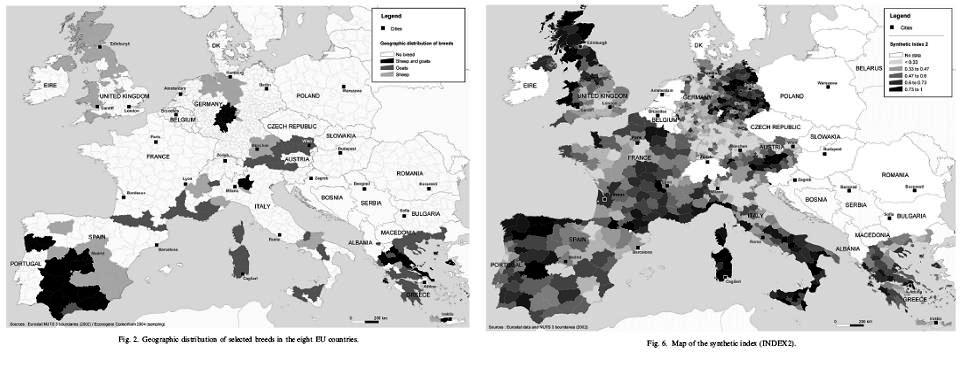
Visually, by comparing the map of INDEX2 (Fig. 6) [right] with the one of the distribution of breeds (Fig. 2) [left], it can be seen that the studied breeds seem to be consistently located in regions defined as marginal by the indices.
Well, maybe. Click on the image to see better. But it seems a stretch to me, and the more rigorous logit analysis that the authors subject the data to isn’t exactly overwhelming. If I understand it correctly, the best that a combination of various proxies for marginality can do in predicting the presence of local sheep and goat breeds is 19%. And that’s with breed distribution data which seems to be biased towards marginal areas anyway.
Local sheep and goat breeds are generally argued to be remarkably well adapted to marginal rural areas.
That’s certainly a dominant meta-narrative, and not just for livestock, for agrobiodiversity as a whole. I may even believe it. But not a huge amount of evidence for it here.
Dock Street Brewery … announces the release at the West Philadelphia brewery and restaurant of Sudan Grass Sorghum Ale, a draft-only beer “inspired by the traditional fermented sorghum beverages found in Africa”. And that ain’t all.
Tony Knipling of Vecenie Distributing notes that the Millvale distributor has several interesting new brews, including “Pittsburgh’s first Slovenian import,” Lasko Club; Brasserie Pietra brews from Corsica, one brewed with chestnuts and another with with myrtle, strawberry, rockrose and spices; Scottish craft brews (including one made with guarana, kola nuts and poppy seeds) from Brew Dog; and Sah’tea, described as a “modern update of Finnish beer” brewed with black tea, juniper berries and other spices and hot river rocks, from Delaware’s always-edgy Dogfish Head.
Hot river rocks? Luigi will be sampling in due course.
A 10-year study of Tanzanaia’s Kagera region concludes that:
Good news, you might have thought, unless you were loaded for vampire.
Tom Hoegemeyer very kindly replied to my query about rescuing Pawnee corn, and agreed to have his email published here. Thanks, Tom, and very best wishes with your work with the Pawnee.
I was out at the Pawnee homecoming and have been attempting to help them grow some of their old varieties (some had been in storage in homes for years and has low germination and vigor). We have been successful with some varieties, but others appear to be dead. I have also visited with several of the Pawnee “corn keepers” concerning the varieties, their culture and history. Some of the Pawnee varieties may be listed under other names as well—the Arikara are blood relatives, having separated from the Pawnee, moved north and settled on the Elkhorn and Missouri Rivers. Also, their history of inter-tribal warfare lead to the “theft” of some of their varieties by other neighboring tribes—Oto-Missouria , several Sioux groups, and Omaha in particular. I would not be surprised if the same, or nearly so, varieties may have been collected from other areas. One way to test this would be by DNA, as I have been given samples of a couple of varieties we have had no luck in growing, even with seed treatment, surface sterilization, ATP supplementation, embryo rescue, etc.
Some history as to why I am involved: One of my technicians has an uncle who is a photographer and writer for “Nebraskaland” magazine, and he asked his nephew and me if we would help them recover varieties.
I had done some looking in GRIN, but there seems to be little information, sourcing for Pawnee varieties. The issue is not the fault of GRIN, but the fact that the Pawnee were moved to Oklahoma around 1877. The white settlers brought their seed with them from the east (e.g. Illinois) and the Pawnee varieties were not kept locally. And apparently, they had difficulty growing them in Oklahoma. So other than a few plants/ears from their home gardens, there is no direct seed source. As soon as I have time, I intend to do some searching in GRIN for varieties that may be related to these recalcitrant Pawnee varieties. I would be very open to help, advice, etc. Some of the varieties that have been regrown trace to only a few plants, so there is a sampling/inbreeding issue. Even for these it may be helpful to see if other related sources exist in GRIN.
The Pawnee have a serious issue with obesity and Type II diabetes. They feel that if they could return to their original diet, perhaps there would be fewer health issues. (I suspect that the gardening and hiking to hunt large and small animals would be more important.) There is also a cultural/emotional/religious aspect to their desire to recover these varieties, so I have found it interesting to try to help!
Scientifically, I think it would be interesting to do a small study of these native varieties to analyze their relationships, and the relationship of them to the “Corn-belt Dents”, which as I understand were mostly developed east of the Mississippi. I suspect that there may also be interesting alleles in these.
The Pawnee trace their heritage to the proto-Aztecs, and there is some linguistic evidence for that. Apparently a group moved northeast to present day East Texas and Louisiana, and are known as the Caddo. Some of the Caddo moved north to Kansas/Nebraska and became the four tribal groups of the Pawnee, and the linguistic evidence for their Caddo connection is VERY strong.
Before this situation came up, I had never thought of using genebanks for this sort of cultural purpose. I found several of the Pawnee very interesting. They sincerely feel a connection to the land, fauna and flora. Several of the corn varieties are associated with rituals, and all of them are involved in “sacred bundles”. They stored artifacts, momentos, historical items and specific corn varieties in the bundles. They kept about a dozen varieties each of corn, beans, and squash/pumpkin, and always planted each corn variety at distances of about 500 paces—near the modern seed certification isolation distance! When the stars were in the correct position each spring, the corn was planted with a ceremony. After it reached about knee high, they hoed it to control weeds, followed by a ceremony, after which they would leave for the summer buffalo hunt. Late summer/early fall they would return to their permanent log and earthen houses and start the crop harvest and storage. After harvesting (and more ceremonies) they would go out on the fall hunt, then return to their homes for winter.
Different corns were used for different foods, including a popcorn. I have found the whole experience—reading and meeting the “corn sisters”, and learning a bit about the culture fascinating.