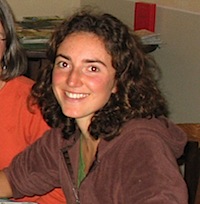
Renee Ciulla is an American graduate student studying Agroecology at the University of Kassel in Germany. She wrote to offer a small description about her course, her personal experiences on organic farming with a European perspective and some ongoing research projects. Sure, we said, and here it is. Thanks, Renee.
You could write something too; just contact us.
 As an American passionate about the global food system and how we can foster more organic farming and local food initiatives, I have devoted two years to getting my MSc in Agroecology studying in various European countries including Norway, Italy, Germany and Holland interacting with a plethora of different food cultures, nationalities, and physical environments. For anyone interested in organic or biodynamic farming, agricultural biodiversity, renewable energy, soil biology, plant nutrition, or organic food quality, processing and marketing, I would highly recommend checking out this graduate program.
My first few days in Witzenhausen, Germany as an exchange student at the University of Kassel’s International Organic Agriculture program kept bringing memories into my head about childhood fairy tales. The perfectly painted half-timbered homes, meticulously groomed trails through surrounding thick, mystical forests, and castles dotting the rolling farmland outside the town create an enchanting experience. Set in the Werra River Valley in central Germany, Witzenhausen is the smallest University town in the country. This means that after a few weeks you can’t leave your room without seeing someone you know and it seems to have resulted in a close-knit community of very friendly down-to-earth people. The rolling farmland surrounding the University is full of cherry trees that blossomed into brilliant white flowers in early April and have now become loaded with delectable deep red bursts of sweet cherries. I’m looking forward to helping some local farms harvest cherries in late June, but until then I’m distracted by the dozens of incredible types of sourdough wholegrain breads from the small bakeries throughout town. Organic enthusiasts can feel instantly at home by the plethora of organic food in all the supermarkets, a wonderful health food store, many community garden plots, a large student garden and a weekly farmers’ market. There are also several local, organic farms producing honey, meat, vegetables, grain, dairy, berries and fruit where it is easy to grab a shovel, get dirty and attempt the tongue-twisting German language.
One of my favorite things about this program is the diversity of “organic themes” offered through the 23 different academic Faculties. Some examples of Departments include Agrobiodiversity, Soil Biology & Plant Nutrition, Organic Farming & Cropping Systems, Ecological Plant Protection, Agricultural Engineering, Biodynamic Agriculture, Economics & Agricultural Policy, and Organic Food Quality & Food Culture. Although I hadn’t planned on studying renewable energy here, once I visited the outdoor lab for Agricultural Engineering and saw the student windmills (which generate some of the electricity for the University), solar distillation and solar herb drying experiments and several of the solar panels being utilized, I was intrigued to try following a German course in this subject. Furthermore, it has been enlightening to learn about the various current and past agrobiodiversity projects led by Professor Hammer which include an EU-Project about networking on conservation and use of plant genetic resources in Europe and Asia, analyses of agrobiodiversity on national and international levels under tropical and subtropical conditions (including home gardens), the biodiversity of wheat and barley in Oman, Iran, and Ethiopia as well as several underutilized and neglected crop plants in the Mediterranean area, Iran and Oman.
Classes are generally small and professors are easy to approach with research ideas or questions about how to bike to a nearby farm for a weekend festival. If you are interested in a career in international agricultural work this program is particularly fitting because you are in contact with students from every corner of the globe. A bulk of research is being conducted in tropical and subtropical areas as well as arid regions such as Africa. There is a Tropical Crops greenhouse on campus founded in 1902 which is open to the public. It houses 350 agricultural species from semi-arid to higher altitude crops and is the largest facility of its kind in Germany. Students are welcome to take part in research in the greenhouse as well as at the large campus research farm located near Kassel where grazing cattle and fields of cereals and vegetables are found. Furthermore, professors have contacts with countless numbers of influential international agricultural organizations (such as the FAO in Rome and FiBL in Switzerland) and countless other Universities in Europe. The worldwide umbrella organization for organic farming, the International Federation of Organic Agricultural Movements (IFOAM) is located in Western Germany and BioFach (the largest annual World Organic Trade Fair and lectures) takes place in Southern Germany.
I am pleased to continue my exploration into the complexities and dramas of our planet’s food supply in the hopes that I can teach others about the importance of sustainably managing a biologically diverse soil, growing their own food and eating as local and organic as possible. Please feel free to contact me with any questions regarding studying in Witzenhausen or general European organic agriculture inquiries (especially related to Italy).