…took place in Bologna last week. The programme looks interesting. Anyone out there go? The abstracts will be on Acta Horticulturae in due course. Via.
Getting the aroma into rice

Researchers from Myanmar and Thailand have a paper in Field Crops Research 1 describing how they managed to get the prized gene for fragrance into a local rice variety which smelled, well, ordinary.
They started out with Manawthukha, a very well-liked but alas non-fragrant variety from Myanmar, and Basmati, which of course is the most famous of the fragrant rices, due to the badh2 allele. They did four cycles of back-crossing the latter with the former, always using progeny in which they could detect the DNA marker for the Basmati allele, and finally selfed the result. They then looked again for the tell-tale badh2 allele using molecular tools, hoping to find it in its homozygous state. Which they did, in 12 lines. Agronomic evaluation of these proved that they behaved essentially like Manawthukha, but were also nice and fragrant. QED. The authors say that the use of DNA markers to identify the gene for fragrancy right from the early cycles of selection considerably sped up the whole process of getting it into the Manawthukha genome.
Which sounds like a pretty good result. But I ran the paper past a rice expert of my acquaintance and he had an interesting question. Why did…
…Thai scientists collaborating with Myanmar choose to source the fragrance gene from Basmati, not from their own Khao Dawk Mali or other Thai aromatic varieties, nor from Myanmar’s own range of aromatic varieties? The alleles are identical in Basmati, Khao Dawk Mali and most of the Myanmar aromatics.
Any ideas?
But there’s more.
Some of the Myanmar aromatic varieties get their fragrance from a different gene, and one of them has twice the concentration of the main aromatic compound. Does that variety have both genes?
Good question. And no doubt there are people working on that. But I wonder whether other national programmes will be wanting to use that doubly fragrant Myanmar variety in their own efforts to have their own fragrant rice.
O well biodiversity yes
Molly Bloom recalls:
God of heaven theres nothing like nature the wild mountains then the sea and the waves rushing then the beautiful country with fields of oats and wheat and all kinds of things and all the fine cattle going about that would do your heart good to see
Climate change: predictions hotting up
Faced with pessimistic predictions of the impact of climate change, it’s too easy to throw your hands up in the air and cry “there’s nothing to be done”. Or, as a few people still do, to throw your hands up in the air and cry “there’s no need to do anything”. But if they turn to the latest issue of Global Environmental Change, policy-makers, plant breeders and genebank managers should be able to throw their hands in the air with a cry of joy: “This is what we need to do.”
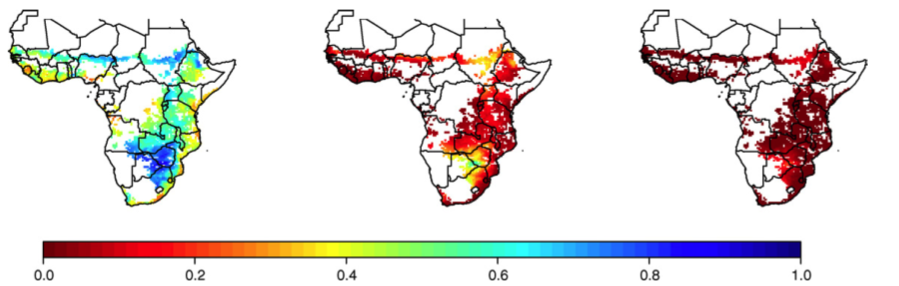
The authors of Shifts in African crop climates by 2050, and the implications for crop improvement and genetic resources conservation are Marshall Burke and David Lobell of the Program on Food Security and the Environment, at Stanford University, and our own Luigi Guarino, wearing his Global Crop Diversity Trust hat. 2
The approach is quite straightforward. First, they ask how crop climates will change across Africa. This involves taking historical data for a particular place and comparing the climate there to the predictions of a whole bunch of climate change models. They then ask how quickly the predicted changes will push local climate outside the limits of recent local experience. In addition, they looked at different climates across the continent, asking whether future climates are currently present somewhere in the country, or elsewhere on the continent. The goal is
[T]o identify both future problem regions with no analogs on the continent in today’s climate, and countries whose current crop areas appear likely analogs to many future climates, with the latter case representing promising areas for genetic resource collection and preservation.
They do so for the three primary rain-fed crops of sub-Saharan Africa: maize, sorghum and pearl millet, which provide roughly a third of the calories consumed, and almost two-thirds in some countries.
The big predicted change of all the models is in temperature, which gets hotter almost everywhere, with much less agreement among the models of how much rainfall will change. Skipping over just how fast climates are changing (“rapidly”) and keeping in mind the large time lags involved in breeding crops suited to changed climates, Burke et al. warn that their results “suggest a pressing need to develop breeding programs that anticipate these rapidly warming growing environments.”
So there’s one thing people can do, now.
Where will the raw material for those breeding programmes come from? Genebanks, natch. Alas,
African cereals are often poorly represented in international genebanks, and national genebanks on the continent are frequently resource-constrained and not always representative of the crop genetic diversity in the country.
Burke, Lobell and Guarino look at the spatial distribution of climate analogues and calculate “self-overlap,” overlap of the extremes of projected climate with today’s climate within the country. 3 There’s a nifty graph of the overlap for each of the three crops in all the countries, but the take home message is that despite the lack of overlap in some places, there’s still enough variation that a country might be a good source of variability for its own needs. On the other hand, future temperature regimes are likely to be so hot that even those countries that have large self-overlaps will likely have to look outside their own borders for varieties that will thrive in their expected climates.
Many countries with low self-overlap nevertheless have five or more countries that overlap 75% with their new climates.
For these countries, breeding efforts to cope with warming could greatly benefit from accessing genetic resources beyond their own borders.
Something else to do, now.
There are, however, also countries, most of them in the Sahel, that have low self-overlap and fewer than 5 analogs in other countries. They’re already the hottest climates in Africa, and likely to become hotter, so it ought not to be a surprise that their options are going to be limited.
Unfortunately, primary centers of maize diversity outside Africa, such as in Mexico, enjoy much cooler climates than much of Africa. If breeding efforts cannot sustain yield for maize for these hottest climates in the face of warming temperatures, switches to potentially more heat- and drought-tolerant crops, such as sorghum and millet could be necessary.
Then there are the happy countries whose current climates contain analogues to many future novel climates. Their genetic diversity will be valuable for future breeding efforts. Are they safe?
Sudan, Nigeria, Cameroon, and Mozambique … are particularly poorly represented in national and international genebanks. The top ten analog countries for maize — those which overlap most with anticipated novel climates on the continent — each have fewer than 150 landrace accessions in major genebanks. These countries appear as particularly high priorities for urgent collection and conservation of maize genetic resources. … The results for sorghum and millet show qualitatively similar patterns as the results for maize.
There’s a lot more meat in the paper, which repays close reading. It really does contain evidence-based policy advice, on how best to make use of a limited pot of cash by setting the right priorities and establishing the right kinds of cooperative efforts.
Is anyone (who matters) listening?
The boom in heritage turkeys
I sent my post asking what is behind rocketing turkey numbers to DAD-Net and received this interesting comment from Marjorie Bender, Research & Technical Program Director, American Livestock Breeds Conservancy, which she kindly agreed to share here:
The growth is reported as occurring in the US, but the reported numbers are much larger than make sense to me.
The American Livestock Breeds Conservancy has been actively researching and promoting non-industrial, naturally mating turkey varieties for over 10 years. ALBC has periodically censused this population. In 1997 the breeding population (male and female) of naturally mating turkeys was 1335. In 2003, the breeding population had more than tripled, rising to 4412. In 2006, the population had more than doubled again, reaching a total of 10,404 breeding birds.
I don’t know where their numbers came from, or how they are counting. ALBC counts breeding stock, not number of head raised.
In 1997 ALBC initiated some research on the health of the immune systems of several varieties of naturally mating turkeys and an industrial strain. The naturally mating turkeys had a significantly more robust immune system. At about the same time Slow Food USA contacted ALBC about getting ‘heritage turkeys’ on their members’ dining tables. We provided them with contacts for hatcheries and breeders and they linked them up with consumers. The main food editor at the New York Times taste-tested several and LOVED them. She wrote a wonderful article raving about them. People started looking for Heritage Turkeys, and folks started raising them but with trouble. ALBC developed a production manual and workshop — How to Raise Heritage Turkeys on Pasture — which has educated a number of people. ALBC also conducted breeder selection clinics to improve the quality of the varieties – most of which had suffered from lack of selection of the decades. The market has continued to grow, as has the motivation to produce these.
Thanks, Marjorie.
And W. Stephen Damron, a professor at the Animal Science Department at Oklahoma State University had this to add.
I’m guessing that part of this is better reporting (perhaps just separating out the turkeys from chickens in the counts) and part of it is that turkey is perceived as a “cut above” chicken as a food and is probably being used more in some developing countries (those with population segments that can afford it) as a stepping stone to “better” diets.
If you look at heirloom breeds of turkeys (not the modern big breasted type), you find that the turkey is actually much hardier than it is given credit for and can forage for itself in situations where the chicken can’t.