“Ex-situ gene banks have an important role to play. But we’ve been trying to save seed in gene banks for the last half century, with more failures than successes. To ensure a sustained supply of useful germplasm and a more dynamic system of keeping diversity alive, we must support farmers in maintaining seed in their field. If we lose this living diversity Africa and the world will not be able to adjust to climate change,” Worede said.
Identifying plants online
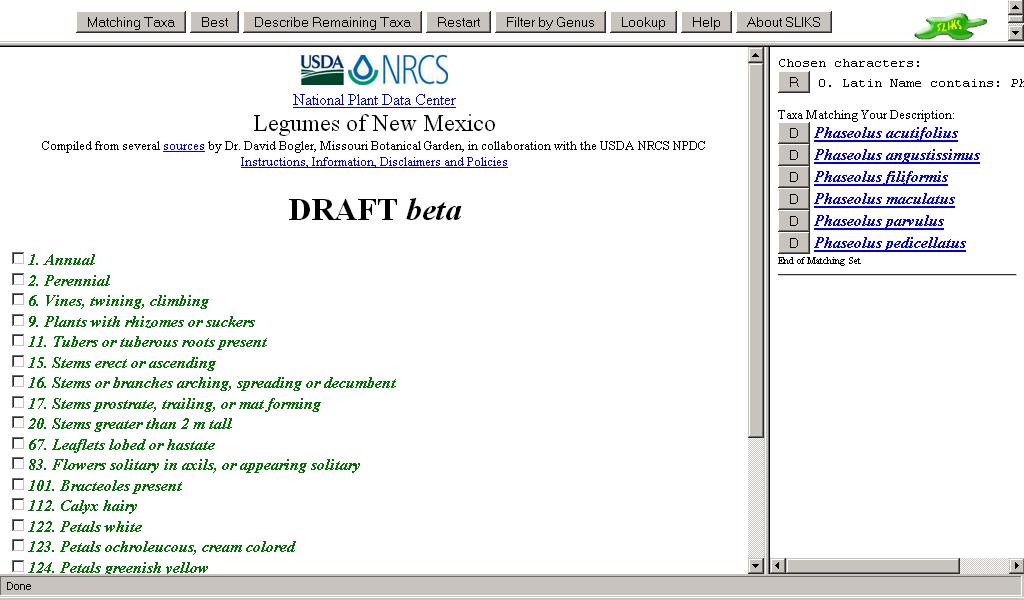
The USDA’s Natural Resources Conservation Service has online (and, indeed, downloadable too), interactive, polyclave identification keys for American grasses and legumes, by state. It’s unclear to me from the introduction whether these cover all grasses in each state, or only the ones which occur in wetlands. In any case, they are for testing purposes only at this stage. But the multi-entry keys are much easier and efficient to use than conventional dichotomous keys. And there are a lot of crop wild relatives included (e.g. see Phaseolus in New Mexico in the screenshot thumbnail below). I don’t think the keys have been build using LUCID (at least I don’t see any reference to it), which seems a bit like re-inventing the wheel, but anyway, better keys are always worth having.
African cooking in the spotlight
…there is no African cuisine.
What? Hang on, take it easy, don’t jump to conclusions, read the rest of the post at BetumiBlog.
Africa, agriculture and climate change
“If agriculture in developing countries becomes more sustainable, if it increases its productivity and becomes more resilient against the impact of climate change, this should help to reduce the number of currently around one billion hungry people and offer better income and job opportunities,” said Alexander Mueller, FAO Assistant Director-General.
“Millions of poor farmers around the globe could help in reducing greenhouse gas emissions,” said Peter Holmgren, FAO focal point for the UN climate change negotiations. 1
OK. But what about preparing those self-same farmers to cope with climate change by giving them access to agricultural biodiversty?
Africa’s market for milk, meat and staple food crops such as maize, banana, sorghum, rice and millet stands at over $150 billion a year which is more than what it fetches from pet cash crops like coffee, tea and flowers.
Researchers say that seven out of ten Africans earn their living by engaging in subsistence farming making the sub-sector to be the continent’s market leader.
It is for this reason that the farmers are encouraged to embrace modern farming methods to produce more food in order to make economic sense.
On the other hand, governments are obliged to ensure that farm inputs are affordable and farmers have access to markets to sell their harvests at competitive prices to reap fruits of the labour. 2
OK. But does “modern farming” mean abandoning their agrobiodiversity and the skills to use it? And why is it government’s responsibility to make sure inputs are affordable? If government distorts price signals, we can’t blame farmers for doing the most profitable thing in the short term, even if it means losing their agricultural biodiversity and the skills to use it in the longer term.
Featured: unripe fruit
Greenfruit fan (we know who you are) weighs in on Unripe for plucking:
Unripe fruits as food are common in many cultures, including South and Southeast Asia, the Pacific, the Americas and the Caribbean. For their refreshing tartness or light sweetness, or unusual flavor.
Jeremy’s English Lesson: “Don’t eat those blackberries. They’re red. That means they’re green.”