“Eeyew. What’s wrong with that chicken?”
We were sitting on the shaded verandah of Nico, a lovely man who, after training as an architect in the US, chucked it all in to live off the grid and as sustainably as possible in a converted hovel in the west of Crete. No electricity, no running water, a wild garden and wilder chickens foraging through it.
Naturally I peered at the chicken, and there it was: naked-necked as I live and breathe.
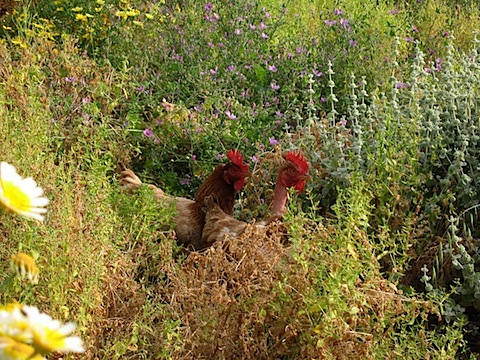
“Golly, a naked-necked chicken, here on Crete.”
Nico, meanwhile, was answering my friend, and explaining that it was that way naturally and didn’t seem to be any different from the other chickens in his flock.
I waded in with information about the naked-necked chickens of Transylvania and elsewhere, citing the very latest thoughts on the subject, to-whit:
The use of single or combined dominant genes for feather restriction (Na) and feathering structure (F), as well as the sex-linked recessive gene for reduced body size (dw), has been found to be particularly relevant for the tropics (Horst, 1989; Haaren-Kiso et al., 1995). Research into the effects of these genes on economic factors has been undertaken in Malaysia (Khadijah, 1988; Mathur and Horst, 1989). For example, the feather restriction (Na) or Naked Neck gene results in 40 percent less feather coverage overall, with the lower neck appearing almost “nakedâ€. This considerably reduces the need for dietary nutrition to supply protein input for feather production, and protein is a limiting factor in many scavenger feed resource bases. Barua et al., (1998) has reviewed the available information on the performance of indigenous Naked Neck fowl in the hope that it will draw the attention of scientists worldwide to its interesting characteristics and facilitate future research.
I asked Nico whether the naked-necked birds were more efficient egg layers, or suffered less in the heat, but he didn’t know. I said I’d be happy to return to conduct a thorough investigation, but I haven’t had a reply yet.
The photo took some doing too, the birds treating me as an overlarge predator definitely up to no good. Which they should.