A discussion on DAD-Net about the identity of a particular goat (or was it sheep?) specimen elicited this wonderful contribution from Carol Snyder Halberstadt, president and cofounder Black Mesa Weavers for Life and Land, Inc.
There is another breed of sheep among which many have have four horns–both ewes and rams, although there are also two-horned and also some without any horns.
These are the rare and endangered Navajo-Churro sheep, which descend from the first domesticated sheep in the Americas. Brought to the Southwest in the 1500s by the Spanish (and brought to Spain possibly by the Moors?) the Iberian churra — an ancient breed that is likely related very closely to the first sheep domesticated in the Near/Middle East about 9,000 years ago — was recognized and welcomed by the Dinè as the promised gift from Etsáanadléhee [Asdzaa nádleehé] (Changing Woman) herself, and developed by them into a unique breed, with a double-coated fleece that produces one of the finest and strongest weaving wools in the world, with glowing whites and an amazing array of natural colors.
Those with four horns, which is a very rare trait among sheep, was one of the characteristics that marked them as sacred to the Dinè.
The Churro have survived several efforts by the U.S. government to drive them to extinction, starting in 1863, when the army was sent to remove the Dinè from their ancestral homeland by slaughtering their Churro, burning their peach orchards, food stocks, and homes, and forcing about 9,000 Dinè on the “Long Walk,” hundreds of miles to Hweeldi (“The Place of Sorrow”), at Fort Sumner, New Mexico, imprisoned there in an internment camp, where thousands died. A few thousand Dinè evaded the U.S. Army and were able to hide with their remnant flocks in remote areas of what is today Arizona and Utah: the Black Mesa region.
In 1868, after four years of suffering, about 3,000 surviving Dinè were allowed to return from Fort Sumner to a portion of their homeland, where they rebuilt their lives, their culture, and their Churro herds.
Not long after, a government-imposed attempt to “improve” the Navajo-Churro forced interbreeding with sheep such as Rambouillet and Merino, further threatening Churro survival and identity,
Nevertheless, by the 1930s, the Churro had increased to more than a million. They were again threatened when stock reductions were ordered (largely the result of restricted grazing regulations that disallowed traditional Navajo grazing practices), citing a need to control overgrazing and erosion. Considered worthless by the government, about a million Churro were slaughtered, their bodies left to rot — a trauma recalled by many Dinè alive today.
By the mid-1970s, the breed was near-extinct, with only about 450 surviving, mainly in the Black Mesa region of Arizona. Today, through the efforts of Dinè and non-Dinè organizations and breeders, there are about 2,000 Navajo-Churro registered nationwide, with an estimated 1,000 in all Dinè Bikéyah (Navajoland). Of these, in the Black Mesa area, some 550-600 Churro continue to form an integral part of the land and Dinè lifeways.
This is a very brief summary. I would be very interested in knowing more about the Uruguay Criollo breed, which might be related to the Churro — since the Spanish introduced their churra to the U.S. Southwest, as well as into Mexico and South America.
There’s a lot to digest in this tragic tale, and a lot more to learn. I want to know, for example, about how it happened that the Dinè (what the Navajo called themselves — it means, as these things often do, The People) recognized this sheep as the gift of Etsáanadléhee. And about how the Dinè and their flocks managed to hide out in Black Mesa. But I’ll just pursue one little, very minor thing here.
The U.S. Army burned the Dinè’s peach orchards. Peach orchards? Where did they get peaches from, and why did they keep orchards? It seems so incongruous somehow. A basically pastoralist, semi-nomadic people planting orchards of exotic fruits? Well, first, it seems clear that peach orchards did indeed exist. They’re mentioned, for example, in a book on Native American “resistance to genocide, ecocide and colonization.” By the mid-1860s, flocks and orchards had been established “over several generations at the bottom of Canyon de Chelly.”
How many trees were there? One source on the Navajo Peach Tree Incident says five thousand, but others three and seven thousand. A lot of trees, anyway:
- This time, though Carson employed the mercenary Utes over several months until the Navajo were found in the canyon. That’s when he destroyed 5000 peach trees — the pride of the Navajos — and most of their food supplies so that their harsh-winter food stockpile vanished.
- The Navajo never forgave Carson for what he did to their peach trees.
Another source, a travel writer visiting the Canyon de Chelly, adds:
Gabriel hands me a wedge of pottery whose geometric pattern reminds me of mesas. “Made by Hopi,” Gabriel says. The Hopis lived here too, planting the first peach trees in the 1600s, which were later cut down by Carson’s men. When the Navajo returned from the Long Walk, they reconstructed the peach orchards, adding apple and apricot trees.
And again, more on the Hopi connection from a study of the origins of Navajo pastoralism:
Life in Canyons de Chelly and del Muerto followed the rhythms of the seasons. In summer, green patches of corn and beans and melons dotted the bottoms, and here and there stood small groves of peach trees, at least some of which had been planted by a Hopi clan that for a time took refuge here.
So from the Hopi to the Navajo, and traded as dried fruit, but where did all these peach trees come from originally? Spanish missions, perhaps? Following that train of thought took me to a familiar book, Sauer on the Historical Geography of Crop Plants, which confirmed the outlines of the history of the peach in the American southwest that had emerged from all the snippets I’d collected.
I just had no idea that the Native American tribes of New Mexico had taken up peach cultivation with such fervour. Which of course leads to a whole series of other questions. Foremost among which is: why peaches in particular? But also: are any of these old peaches still around, despite Carson’s best efforts, and do they represent varieties long gone in Europe? After all, the Churro survived…
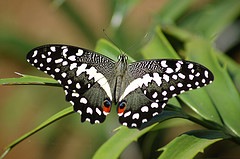 The Kenya Forest Service is one of the forces behind butterfly farming projects around the country. According to the latest KFS annual report (which I found out about from ASNS), household incomes have really benefited from the project, mostly by exporting butterfly pupae to collectors and butterfly farms abroad, mostly in the United States and the United Kingdom. The report, launched last week, says: 1