A modest proposal from the Network Semences Paysannes:
Levy a tax on the sale of seeds which cannot be freely reproduced, and earmark the money for the financing of seed houses and collaborative breeding programmes.
That’ll work.
Crops, livestock, microbes, pollinators, wild relatives, agroecosystems, foodways …
A modest proposal from the Network Semences Paysannes:
Levy a tax on the sale of seeds which cannot be freely reproduced, and earmark the money for the financing of seed houses and collaborative breeding programmes.
That’ll work.
 People say that introducing high-yielding crop varieties threatens agricultural biodiversity. Farmers adopt the modern varieties and abandon their traditional varieties, so that the overall genetic diversity falls as a result. They’re right, but not every time. A new paper published online in Field Crops Research 1 shows that genetic erosion need not be the unintended consequence of high-yielding varieties, especially if the modern varieties count farmer varieties among their parents.
In the early 1990s, while a PhD student at Bangor University in the UK, our friend Bhuwon Sthapit, now a senior scientist at Bioversity International, was instrumental in breeding three new varieties of rice suitable for upland rice farms in Nepal. This was no ordinary breeding programme, however. Sthapit worked closely with farmers, who both set the goals of the breeding programme and participated in the selection of the final varieties from the many crosses. The varieties were selected from crosses of Chhomrong Dhan, a local landrace well adapted to the cold conditions of high-altitude rice farms in Nepal, with Fuji 102 and IR36, more productive material from international breeding programmes.
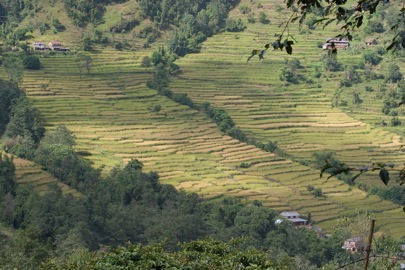
Farmers selected three lines: Machhapuchhre-3 (M3), Machhapuchhre-9 (M9, which is similar to M3 but with lower cold tolerance) and Lumle-2 (L2, like M3 with better grain quality and easier threshing). Only M3 was officially released, but M9 and L2 have been adopted widely thanks to informal seed exchanges among farmers. By 2004 about 60% of the land in the study villages was sown to one of the three COB (client-oriented breeding) varieties, while traditional varieties occupied the remaining 40%. In adopting the COB varieties, many farmers had dropped traditional landraces, but there was no clear pattern to which landraces were dropped in which villages. The variety dropped most commonly was Chhomrong Dhan, one parent of all three COB varieties.
To assess genetic diversity, Sthapit and an international team of the researchers from Bangor and Nepal analyzed DNA from the three COB varieties, a random selection of landraces and a control group of modern varieties. Overall, genetic diversity was greatest in the landraces, and least in the COB varieties. However, there was no loss of genetic diversity across the district as a whole, at least as long as the three COB varieties were adopted on less than about 65% of the land. Indeed, because the high-yielding parental varieties contribute alleles not previously known in the area, there is an increase in diversity as the COB varieties are adopted .
Another crucial result is that although some farmers grow COB varieties on 100% of their land, nevertheless, at least 11 diverse landraces survived on some 40% of the land. These landraces clearly meet needs not fulfilled by the COB varieties. For example, although the most commonly dropped variety was Chhomrong Dhan, farmers in the Gurung community continued to grow that variety.
“It is the preferred rice for preparation of the dish Madeko Bhat used during funerals and other ritual and social ceremonies,” Sthapit told us.
“The conclusion is clear,” Sthapit added. “Participatory breeding and client-oriented breeding programmes should choose locally adapted varieties as parents for breeding. It ensures that landrace genes are conserved and increases the likelihood that the breeding programme will succeed.”
On seeing our recent post on the tahr, Carol Halberstadt contacted us saying that she had written the following poem in 2000 after reading an article in the Boston Globe about hunters killing the last Arabian wolf and the last tahr. Unfortunately, I can’t find the article in question, but clearly the demise of the tahr was exaggerated.
Imagine the loneliness
of the last wolf, her howl
unheard in the wilderness,
his place unmade.
What small tear in time remains?
They are lost with the untamed sheep,
gone from the hills.
Horns that summoned
the birthday of the world
are still, the rock
their feet wore, emptied,
the paths unfilled.
The bison walk this way,
shaggy and gentle.
(©2/29/00 Carol Snyder Halberstadt – used by permission)
Prof. Heywood gives us holiday advice:
In fact, Phoenix theophrasti grows in nine coastal localities in Crete. See here (scroll down to the English text!). That at Moni Preveli, which I have visited several times, is an inlet by a popular tourist beach and you can view the Phoenix populations by pedalo! Very laid-back way of botanising.
Sounds ideal!
The Gatsby Charitable Foundation, which funds plant science research in the UK, established Gatsby Plants as a National Teaching Facility for Plant Sciences 4 years ago. The project has received continued funding until 2011.
Gatsby Plants aims to enthuse undergraduate students to study plant science further through two initiatives which expose them to the exciting developments in plant science and the scientists leading this research. These are:
- an annual Summer School for high-achieving 1st year undergraduate students from UK Universities
- a Teaching Resource providing plant science lecturers with access to novel and inspiring teaching material
Very worthy. I’ve been having a look at the teaching materials in particular. You need to register to get access.
The majority of materials have been kindly contributed by members of the plant science research community (see Terms of Use for how to credit their efforts). Gatsby Plants has also negotiated access to material from some commercial organisations and is actively involved in generating novel content.
There’s a number of lectures with definite agrobiodiversity interest, for example one by Prof. Peter Beyer, University of Freiburg, Germany on “Golden Rice on a Mission” and another from Dr Peter Craufurd on “Crop Science for Development: A Journey from the Laboratory to Farmers’ Fields in the Tropics.” And another: Prof. Monique Simmonds of Kew entitled “Plants in our Lives: from Beauty to Death.” You get a video of the lecturer delivering the talk, with accompanying slides. If you want your students to view the lecture you contact Gatsby Plants and they send you a username and password which allows access to a URL.
You also get practicals (there’s one on pea genetics), images and movies.
I would imagine they could be very useful to trainers, although I must say it would have been nice to be able to also download the presentation and adapt it to one’s particular situation and audience. Anyone out there with training resources on agricultural biodiversity to share? How about on CWRs, for example?