- A global-scale expert assessment of drivers and risks associated with pollinator decline. “Key findings: 1) risks to human well-being from pollinator decline are higher in the Global South; 2) there is a clear lack of knowledge about pollinator decline in Africa; 3) loss of managed pollinators (e.g. honey bees) is only a serious risk to people in North America.” That’s according to the main author Dr Lynn Dicks on Twitter.
- Agrochemicals interact synergistically to increase bee mortality. Stress on pollinators is more than the sum of its parts.
- Evolutionary innovations driving abiotic stress tolerance in C4 grasses and cereals. Major C4 crops need more stress.
- Deep scoping: a breeding strategy to preserve, reintroduce and exploit genetic variation. You may not need a separate pre-breeding programme to introduce new diversity into your breeding programme without wrecking it.
- Genomic resources for lupins are coming of age. Maybe we could have a pre-breeding programme now?
- Six new species of coffee (Coffea) from northern Madagascar. Including 4 really narrow endemics. I wonder what they taste like. Start evaluation and pre-breeding?
- Refugee camps and deforestation in Sub-Saharan Africa. Much, much less of an impact that you’d think.
- Suitability of root, tuber, and banana crops in Central Africa can be favoured under future climates. More than you’d have thought.
- Proportional sampling strategy often captures more genetic diversity when population sizes vary. Sample more than you normally would from bigger populations of rare wild species.
- Plant pathogen infection risk tracks global crop yields under climate change. Where yields go up, fungal/oomycete infection risk goes up; where yields go down, so does infection risk. Assemblages will change especially in temperate regions.
- Developments in Subsistence Practices from the Early Bronze Age through the Iron Age in the Southern Levant. From pigs, wild animals and emmer to zebu, camelids, and free-threshing wheats.
Did millet cause the Black Death?
The latest episode of the wonderful Ottoman History Podcast is about the Black Death. Or, rather, the Black Deaths. It’s an interview with Dr Monica H. Green, an historian of medicine specializing on the medieval period, who has brought together textual, archaeological and genetic evidence to question the dominant, Eurocentric — she calls it Boccaccian — narrative of the plague.
As she explains, prior outbreaks of plague in 13th-century Asia occurred at the edges of the ascendant Mongol Empire, roughly a century before the plague arrived in Western Europe. In our conversation, we learn how Green uncovered the new story of the “four Black Deaths” and in doing so, explore the historiography of the Black Death and how genetics, archaeology, and a fresh approach to textual sources have brought us to a deeper understand of one of history’s deadliest pandemics.
What’s this got to do with agrobiodiversity? Well, Dr Green summarized her findings in a tweet back in December (slightly modified for clarity):
- the Black Death started in the 13th, not the 14th Century
- it wasn’t just a Mediterranean or European phenomenon
- it originated with a spillover out of the marmot plagues reservoir in the Tian Shan mountains, leading to a Big Bang expansion in four directions
- it likely spread through the Mongol Empire via grain supplies
Whoa, grain supplies? Apparently.
In the foothills of the Tian Shan mountains, Mongol supply chains gathered up grain to feed their campaigning troops, particularly a kind of millet unique to the region. Sacks of grain were then transported to the fortresses and cities where the Mongols laid their greatest sieges between the 1210s and the 1250s, as far distant as Kaifeng in China and Baghdad in Persia. Something so insignificant as a few sacks of millet, into which a few plague-infected rodents crawled, might account for the worst scenes of human suffering the world has witnessed.
So much for that particular superfood. Whichever millet it is.
The baobab infographic we’ve been waiting for
The International Year of Fruits and Vegetables is as good an excuse as any for another baobab factsheet, and infographic.
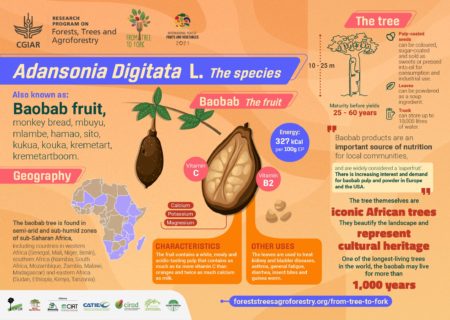
Not that an excuse has ever been needed. Anyway, this particular latest example of the genre is courtesy of From Tree to Fork, and the first of many, it seems. No mention of using the fruit to make booze, though.
Brainfood: Diversification, Diverse diet, Urban forests, Local seed systems, Heterosis, Oil palm core, Black Sigatoka resistance, Pearl millet diversity, Alfalfa diversity, Barley evaluation x2, Ganja origins, Apple origins, Millet diversity, Pepper diversity, Grapevine domestication, Vanilla diversity
- A global database of diversified farming effects on biodiversity and yield. Always good to have the data.
- Dietary agrobiodiversity for improved nutrition and health outcomes within a transitioning indigenous Solomon Island food system. Maybe we should have a database of diversified farming effects on health and nutrition too?
- Exploring ‘beyond-food’ opportunities for biocultural conservation in urban forest gardens. Always good to have more trees.
- Community seed network in an era of climate change: dynamics of maize diversity in Yucatán, Mexico. Always good to have landraces. And neighbours.
- Microbe-dependent heterosis in maize. Maize hybrids need microbes.
- Assessment of genetic diversity and population structure of oil palm (Elaeis guineensis Jacq.) field genebank: A step towards molecular-assisted germplasm conservation. 30% seems a lot for a core collection. But it’s good to have the data.
- Sources of resistance to Pseudocercospora fijiensis, the cause of black Sigatoka in banana. 11 resistant accessions out of 95 seems pretty good, on the other hand.
- GWAS unveils features between early- and late-flowering pearl millets. Based on a national-level core collection in Senegal. Presumably this will scale?
- Germplasm Collection, Genetic Resources, and Gene Pools in Alfalfa. Lots of work has been done. More work is needed on the wild relatives though.
- Assessment and modeling using machine learning of resistance to scald (Rhynchosporium commune) in two specific barley genetic resources subsets. Fancy maths helps to identify the barley genebank accessions you really need.
- Strategic malting barley improvement for craft brewers through consumer sensory evaluation of malt and beer. More fancy maths, this time applied to a hedonic data in the service of beer. Germplasm evaluation we can all get behind. No FIGS, alas.
- Large-scale whole-genome resequencing unravels the domestication history of Cannabis sativa. 4 genetic groups: primordial (located in China, not Central Asia, and going back 12,000 years), 2 medicinal, 1 fibre. Now for the hedonic evaluation.
- The Origins of the Apple in Central Asia. Probably domesticated to cope with the munchies.
- Genetic Divergence and Population Structure in Weedy and Cultivated Broomcorn Millets (Panicum miliaceum L.) Revealed by Specific-Locus Amplified Fragment Sequencing (SLAF-Seq). There are interesting genetic differences between wild and feral forms, and between eastern and central-western cultivated forms. The Silk Road trifecta.
- Global range expansion history of pepper (Capsicum spp.) revealed by over 10,000 genebank accessions. Spoke too soon. The Silk Road had a role in pepper movement too. Among other trade routes. Interesting, and unsurprising, that genes for pungency show distinct geographic patterns.
- Genomic evidence supports an independent history of Levantine and Eurasian grapevines. First domestication in the Caucasus, and then in the Levant, but not clear if from local sources. No word on hedonic evaluation.
- Genotyping-By-Sequencing diversity analysis of international Vanilla collections uncovers hidden diversity and enables plant improvement. Belize seems to be a real hotspot. The Silk Road not involved.
Better seed systems through SeedSystems
I don’t think I’ve been sufficiently explicit in my occasional shout-outs for SeedSystem.org, a collaboration involving CIAT, PABRA, CRS and USAID.
SeedSystem.org provides practical (‘how-to’) guidance and strategic thinking to help professionals design seed-related assistance.
We aim to foster productive, resilient, and market-oriented seed systems, even in times of emergency and chronic stress.
Well worthwhile subscribing to their newsletter. The latest edition brings together a bunch of useful recent papers. Not terribly active on social media, though, what’s up with that?