A couple of fun stories about the historical dimension of the exploitation of aquatic biodiversity from Britain’s Daily Mail this morning. First, how Google Earth revealed a thousand-year-old fish trap off the coast of Wales. And second, how the reintroduction of the beaver, absent since it was hunted to extinction in the 16th century, could reduce water bills.
Featured: Passion fruit
Our friend Xavier Scheldeman nails the passion flower problem:
While rather similar to Passiflora mollissima (now classified as Passiflora tripartita var. mollissima), the fruit in the picture actually is Passiflora tarminiana, a species that was only described in 2001 (by Geo Coppens d’Eeckenbrugge, who was working in Bioversity’s office for the Americas at that time).
Read the whole comment here.
Ghanaian women not ready for biofuels
“Destruction of economic trees such as shea-nut and dawadawa trees actually deny community members, especially women their source of livelihood. It also restricts the hitherto extensive traditional rearing of animals in the affected communities.”
Bad news alert, from AllAfrica.com.
(Some) Indian women ready for climate change
In Zaheerabad, dalit (broken) women forming the lowest rung of India’s stratified society, now demonstrate adaptatation to climate change by following a system of interspersing crops that do not need extra water, chemical inputs or pesticides for production.
The women grow as many as 19 types of indigenous crops to an acre, on arid, degraded lands that they have been regenerated with help from an organisation called the Deccan Development Society (DDS).
Good news alert, from InterPress Service.
Do you know this fruit?
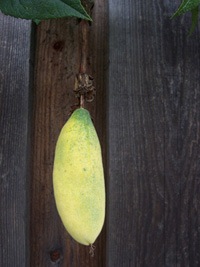 The folks over at The Human Flower Project are trying to identify this fruit, which apparently can be found in abundance in Oakland, California. They think they’ve pinned it down to Passiflora mollissima, but maybe you know better. I grew P. mollissima once, in an unheated greenhouse, and although it flowered well enough it didn’t set fruit. So although the flowers look familiar, the fruit remains a mystery. One of the reasons I wanted to grow it was to do this:
“The pulp is eaten out-of-hand or is strained for its juice, which is not consumed alone but employed in refreshing mixed cold beverages. In Bolivia, the juice, combined with aguardiente and sugar, is served as a pre-dinner cocktail. Colombians strain out the seeds and serve the pulp with milk and sugar, or use it in gelatin desserts. In Ecuador, the pulp is made into ice cream.â€
Those treats remain a fond hope. I had a quick look to see whether the juice or pulp might be available commercially in Europe, but couldn’t find anything. Is it?