Mathilda had a post a few days ago which caught my eye, but I forgot to nibble it. Better late than never. She discusses a recent paper reporting on the archaeological excavation of Uan Afuda and other Early Holocene sites of the Acacus mountains, in the Libyan Sahara, and in particular the layers of animal dung that excavations uncovered. The paper suggests that these “dung layers are related to a forced penning of a ruminant, very likely Barbary sheep (Ammotragus lervia),” and that this is evidence of delayed use of resources designed to cope with lean periods. Mathilda goes on to hypothesize that cattle domestication keeping 1 may have started in the Sahara — before the growing of crops — in a similar way.
Agriculture blogged in Copenhagen
Climate Feedback is a blog hosted by Nature Reports: Climate Change to facilitate lively and informative discussion on the science and wider implications of global warming.
There’s not a huge amount on agriculture normally, but a post yesterday from the Copenhagen conference mentions not one but two people whose (independent) work on the effect of climate change on agriculture we’ve mentioned a number of times, Marshall Burke from Stanford and Andy Jarvis from Bioversity International.
Iraqis let down again
Talking of disasters… Drought, salinity, violence, higher paying jobs in construction, the Coalition Provisional Authority and its Order 81, a corrupt Australian; and before that Saddam Hussein and the embargo: Iraqi agriculture has had a lot to deal with over the years. 2 The genetic erosion must have been phenomenal. But there’s always ex situ, right? Well:
ICARDA scientists are uncertain … about the fate of Iraq’s research facilities, especially its genebank. Prior to the war, the Abu Ghraib national genebank contained some 1,400 accessions of different crops. According to Shideed, virtually all of the country’s agricultural research centers have been destroyed or severely damaged. Large quantities of genetic materials for crops and livestock animals are feared lost, he said.
We now know that the Iraqi genebank was in fact destroyed, but that copies of the material had previously been sent to ICARDA. I wish I could say that such ex situ collections of Iraqi material maintained around the world are adequate in the face of what’s been happening there. But SINGER gives 1147 accessions, 402 of which geo-referenced, and these are all from the north of the country.
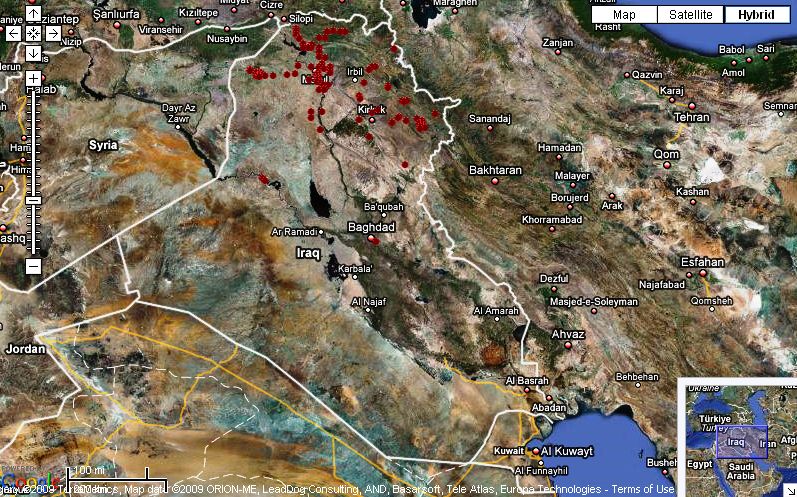
And GRIN returns 1150 hits. I just don’t think that can possibly fully represent the diversity that was present in even the main staples 20-30 years ago, let along the vegetables and fruits.
Ok, it’s probably not all gone on farm. But who’s going to go out and collect it?
Disaster anthropology and agrobiodiversity
A post at antropologi.info, which covers anthropology in the news, discusses a recent master’s thesis by Uy Ngoc Bui which “looks at the role of NGOs, the state and the people themselves” in the efforts to recover from typhoon Durian after it hit Bến Tre province in Southern Vietnam on 5 December 2006. Although there’s nothing specifically on agrobiodiversity in the article, this quote from the thesis struck me as very relevant:
My experience is that more research should be done on the bridging of relief aid with long term reconstruction and development. Relief aid has become more efficient and standardised, which is positive, but this is only short term help for people who are in a vulnerable situation. Decreasing their vulnerability and strengthening their capacity to overcome disasters in the future should be the key foci of anthropologists and NGOs.
I would guess she’s mainly thinking about the sort of relief that involves the shelter and health of victims, but one could say very much the same thing about seed relief after disasters — and indeed, it has been said. “Decreasing [people’s] vulnerability and strengthening their capacity to overcome disasters in the future should be the key foci” not only of anthropologists but also of agronomists and breeders.