Big cheer for the terraces

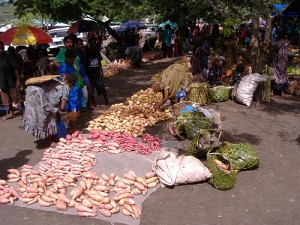
People work the Ifugao rice terraces. Photo PPDO Ifugao.Is this old news or not? The Global Environment Facility (GEF) in concert with FAO’s Globally Important Agricultural Heritage Systems, is funding the restoration and maintenance of the Ifugao rice terraces in the Philippines. My confusion arises because when I last nibbled Ifugao, 1 I don’t recall seeing anything about FAO’s involvement, and yet it seems to have been going since 2002. The “news” is announcing a second phase, which I think started in 2007. So perhaps my confusion is justified. In any case, it does seem important that these astonishing human impacts on the environment are used, rather than pickled, and that seems to be the goal of the project.

I’m rather hoping that someone in the Philippines, or who knows more about the project, will be along soon to enlighten me further.

The Cure of Agues

ResearchBlogging.orgThe Royal Society Digital Journal Archive, dating back to 1665, is freely accessible until 1 February 2009. Enjoy it while it lasts, and read papers by Isaac Newton, Michael Faraday and Stephen Hawking.

In its announcement, the Society mentions a paper representing an applied biodiversity breakthrough: Edward Stone’s discovery that willow bark cured fevers, leading to the discovery of salicylic acid and later the development of aspirin. It is the best substance I have ever used. 2

In his letter to the Royal Society (and they really were letters back in 1763), Stone explains how he did it. After accidentally (no further explanation) tasting willow bark, and noticing its bitterness, he suspected it might have properties similar to that of the Peruvian bark (i.e., of the cinchona tree, containing quinine). That willows grow in swampy areas was also a reason to suspect its usefulness against agues (malaria and other fevers), following “the general maxim that many natural maladies carry their cures along with them.” I suppose that today this maxim could be used for integrated pest management.

Then he applies the scientific method. Literature review: no mention of medicinal properties of the willow. Methods: 5 years, 50 persons, dose, comparisons and mixes with quinine, evaluation of side effects. The only thing missing in the 1760s is a control treatment. But who needs a placebo if the medicine never fails to cure?

Great man, great discovery? Well, willow had been in use for millennia, but perhaps Stone did not know, he did not have wikipedia.

The wikipedians also note that the use of willow “was forgotten by doctors in the middle ages but lived on in folk medicine.” This makes the accidental tasting a bit fishy. Sounds to me like the story of a bio-prospector who took off along a winding path, talked to an old lady, and was too vain to acknowledge her. Pure speculation, and I am glad he did the experiments and wrote that letter.

Stone was a terroirist: “Few vegetables are equal in every place; all have their peculiar soils, where they arrive to a greater perfection than in any other place.” Mustard seed from Durham; saffron from particular spots in Essex and Cambridgeshire; cider apples from Herefordshire; valerian from Oxfordshire and Glocestershire.

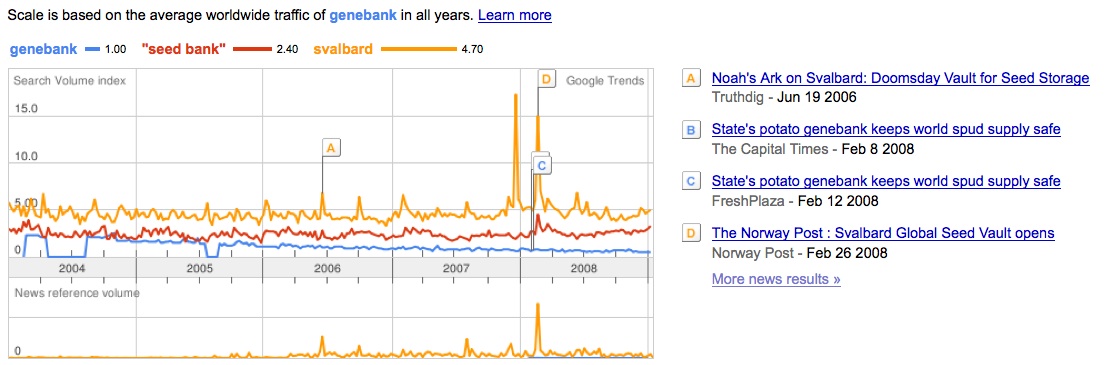
He gathered his willow bark from trees in northern Oxfordshire, where “soils are chiefly dry and gravelly”. And thus he suspected that stronger stuff could be found in other – moist and moory – parts of the kingdom. A modern genebank manager could have reasoned the same way.

Any other nuggets on agricultural biodiversity in these archives? We have until February to dig for them. After that: please report on all peculiar tasting substances you encounter, particularly if bitter, and whether ingested by accident or not.

Combining intervention and research

By Jacob van Etten.

ResearchBlogging.orgDo you know the PLEC Serv List? Harold Brookfield and Helen Parsons select a peer-reviewed article on agrobiodiversity management and write a fairly long, but always interesting, summary of it, placing it in its wider context. Even though the agrobiodiversity project after which the list is called ended several years ago, Brookfield and Parsons faithfully continue it. Subscription highly recommended.

Harold Brookfield and Edwin A. Gyasi now write in Geoforum about geographical action research. They argue it is time for geographers to get their hands and boots dirty. PLEC and the Wageningen-led Convergence of Sciences (CoS) project illustrate that research and service can and should go hand in hand. Geographers are late to recognize this, and in sister-discipline anthropology there is a far longer tradition of activism.

PLEC started by making inventories of farmers’ practices and knowledge in the areas they worked. As a result, the researchers got to know the most knowledgeable and innovative farmers. These farmers, they write, are likely to be hiding in the corners.

They cite Kojo Amanor’s poetic comment that “rather than sitting under the fig tree at the chief’s palace with dignitaries, [indigenous environmental knowledge] is best explored by taking off along the winding paths and discovering the extremities of the village, the chop bars with their bush-meat soup, the drinking spots, the jokers, the old women with their pithy comments, and the young women carrying water.”

The contacts with innovative farmers helped to set up networks in which knowledge was exchanged and new things were tried. Projects like this demonstrate how much academic scientists have to offer to the people among whom they work, and how research interests can be both broadened and deepened in so doing. There is profit in combining a measure of intervention with research.

I agree with the main thrust of the article, but I also think there are many thorns on the road. Many of the problems encountered by the Wageningen researchers lay in the institutional domain, leading to frustrated comments like “the only dependable institution in the West African rural scene is the market trader with her sense for business and entrepreneurship.”

The other problem is that working with farmers takes time, more time than normal project cycles. Only toward the end of the project did the full value of combining service with research begin to become apparent.

PLEC was discontinued. Even so, PLEC and similar projects continue to live on in other incarnations. Brookfield and Gyasi encourage others to set up similar research projects. And share their experiences.

Discourse for dinner

This is not just any blog. It is a local blog. Or at least you could pretend I live in your street, and shop in your mall. Does that makes this post more palatable?

It seems to work that way with food. At least where I come from, a dish that is “from our own garden” is supposed to be of high quality, not a sign of poverty. Chad Nilep, in an elegant post on the Linguistic Anthropology blog reflects on the Japanese preference for “naichimai”, Japanese grown rice 3:

Thus (I thought to myself this afternoon), while consuming naichimai, Japanese consumers enjoy not only the material element of the rice itself, but also the melancholic discourses of national nostalgia, imagined though they may be.

But you could also imagine that I live in a far and exotic place where we produce and eat food that you can only envy. Europe is full of that tradition: ham and cheese from Parma, bubbly wine from Champagne. You name it.

Ask for the main discourse the next time you are eating out.