The International Year of the Potato gives way to the International Year of Natural Fibres. That include hemp?
Williams honoured
Congratulations to our friend and colleague David Williams. He was co-author on a paper about ancient squash seeds that made Archaeology’s Top 10 Discoveries of 2007. Sorry we didn’t catch it earlier…
Traditional African vegetables hit the mainstream
It’s not really all that long since we brought together researchers on that overlooked portion of African agrobiodiversity that is its traditional vegetables for one of the first ever times. I wonder how many of us ever thought that in little more that 10 years we would be able to buy terere and managu and the like wrapped in plastic and barcoded in supermarkets in Kenya:

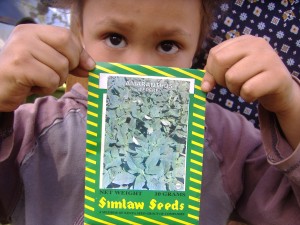
Or indeed buy nicely packaged and labelled seed from small agricultural suppliers in places like Limuru:
Preparation is time-consuming and fiddly, sure:
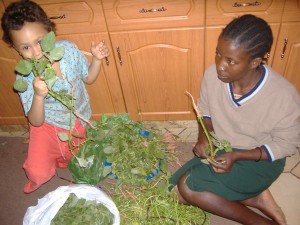
But the taste and nutrients are worth it, as more and more people are finding out. We had some Amaranthus for Christmas lunch, from grandma’s shamba. Can’t get much more mainstream than that.
Asweddumized
As designated rice-editor at the Agricultural Biodiversity Weblog, this clipping from The Nation, a Sri Lankan newspaper, landed on my desk. But I am not sure what to make of it.
Researchers (or farmers?) have discovered a (new?) type of rice that can be vegetatively propagated:
The long Mavee rice plant can be cut in pieces and sown to grow as any normal rice. It took the researchers nearly six years to find the specific qualities in the Mavee cultivation, and those plants that contained this quality were later named as Maha Mavee.
Mavee is a variety, maha means wet season (as opposed to yala, the dry season). And as it grows up to “10 feet during flash floods” (that’s quick!) I suppose it is a ‘deep-water’ or ‘floating’ rice type.
So what? Well, the newspaper calls them miracle plants. According to “attorney-at-law and a renowned environmentalist,” Jagath Gunawardane, this is a big deal:
The discovery of this new method of vegetative propagation is likely to revolutionise the entire industry. The Government now needs to help the farmers maintain this cultivation technique, and also prevent companies from claiming patent rights for this ground breaking breakthrough in the agricultural field.
Presumably because of savings in seed cost. Interesting. But then again there are four or five “miracle rices” discovered every year…
To briefly go off on a tangent in an area that I am not a total dummy about, I recently learned the word “asweddumized.” I came across it in the (English language) agricultural statistics of Sri Lanka. I was told that the word was first introduced in 1958 by S.W.R.D. Bandaranayaike, then the Sri Lankan Prime Minister. It stems from the Sinhala word “aswaddanawa,†meaning converting forest land into cultivatable land that has bunds for retaining either irrigation or rainwater, mainly for rice.
But back to the subject at hand. What do you think the prospects are for Maha Mavee? Are there examples of normally seed propagated crops that become vegetatively propagated? Fruit trees through grafting is one example, but that is for a different reason: the propagation of a particular genotype, rather than saving seeds.
People have tried the opposite with potatoes. It seems obvious: ‘true’ (botanical) potato seed is much cheaper than seed tubers, carries fewer diseases, can be stored, etc. But this has not been very successful. Potato was too variable from seed (which makes it so much fun to try this at home), as quality (uniformity and size) is important in the market, and yields were lower. The International Potato Center (CIP) has worked on these issues, and Hubert Zandstra (a former director of CIP) remains optimistic about these seeds, and particularly about their benefits to poor farmers. He thinks that early ‘bulking’ (the formation of tubers) and apomixis may save the day for true potato seed.
Featured comment: citrus
Onkel Bob on Show Yourself (not that it has any relevance to that):
Why didn’t Turks create the same garden scheme as the Persians? Is it their pastoral roots? One would think they would want citrus fruits in their winter pastures. Even after settling in Anatolia, (what we currently call Turkey) the Seljuks and subsequent Turkish migrations never developed the garden schemes we see in SW Asia/Levant.