Some people have emailed me from the blog and accused me of saying Indian people must stay poor and we must go back to the stone age. This is not at all what I believe.
Adam Forbes, after a year in search of seeds, tells us what he does believe.
Agricultural Biodiversity Weblog
Agrobiodiversity is crops, livestock, foodways, microbes, pollinators, wild relatives …
Some people have emailed me from the blog and accused me of saying Indian people must stay poor and we must go back to the stone age. This is not at all what I believe.
Adam Forbes, after a year in search of seeds, tells us what he does believe.
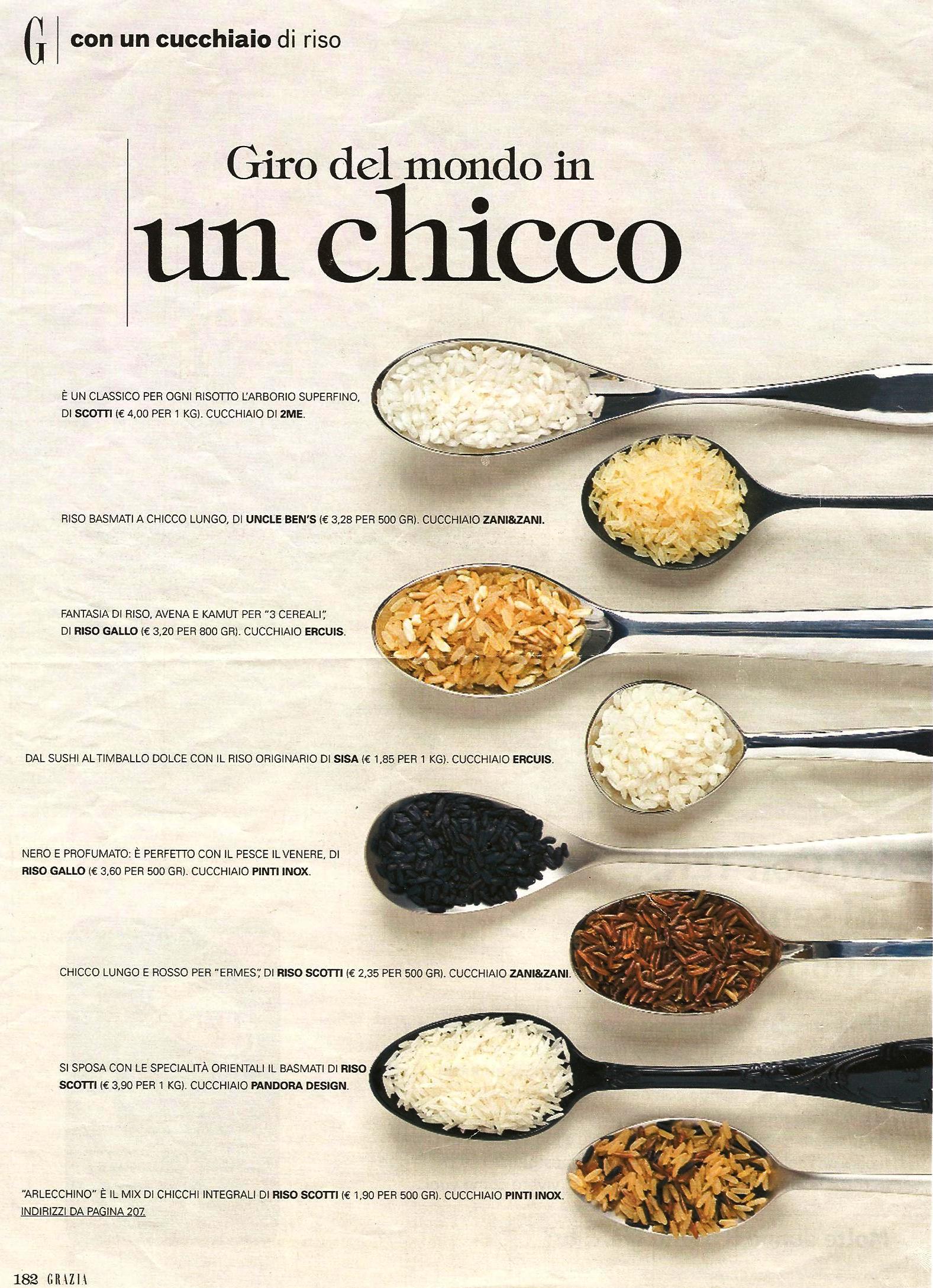
A great image of agrobiodiversity from Italian Grazia magazine, with thanks to Linda for cutting it out and saving it for me. It’s not online, so this is a scan. Click on the image to enlarge it. The spoonfuls are, from the top:
1. arboreo rice for risotto
2. long-grain basmati rice
3. mixture of rice, oats and Khorasan wheat
4. Sisa rice for sushi
5. black Venere rice
6. long-grain red rice
7. basmati again
8. mixture of unmilled rices
Jacob casts gentle doubts on chile pepper domestication:
Intriguing explanation. But I wonder why the disperser birds and mammals are needed.
The thing is, he may be correct.
We need to look at food security not only in terms of quantity of food but the quality of food, that will have an impact on health outcomes. And that requires diverse diet based on a broad use of local agricultural biodiversity.
Emile Frison, Director-General of Bioversity International, in a Q&A with Sabina Zaccaro and Miren Gutierrez of IPS.