- WorldCuP: A database of checklists documenting the World’s Cultivated Plants and their distributions. Cool new database records 1,444,325 occurrences representing 91,358 accepted cultivated plant species across 2,718 regions in 156 countries. Geographic coverage is extensive but uneven, with notable gaps in parts of Africa, southwest and central Asia, and Oceania. Most of the taxa recorded are not in existing major crop and useful-plant databases.
- Integrating multiple disciplines to locate the origins of domestication of crops. Combining evidence from botany, biogeography, genetics, archaeology, linguistics, and history overturns the traditional Mesoamerican hypothesis for cacao origins, supporting domestication in western Amazonia, probably involving multiple events. Peach palm’s domestication is best placed in southwestern Amazonia. Cupuaçu remains unresolved. Now for the other 91,355 species.
- Plant Species Mentioned in Abrahamic Scriptures: Implications for Biodiversity and Traditional Agriculture and Horticulture. Olive, grapevine and fig, together with cereals such as wheat and barley, occur prominently across the three scriptural traditions examined, while date palm is particularly prominent in the Qur’an. Not clear whether scriptures qualify as checklists.
- Crop landrace conservation, status, challenges and motivations in Great Britain. A national inventory (checklist even) identifies 566 landrace populations maintained on farms by 197 growers, alongside 1,876 British-origin genebank accessions, representing a total of 1,201 distinct landraces. Cereal and vegetable landrace cultivation has gone up since 2004, but forage diversity is increasingly threatened. Climate change, labour shortages and lower yields are the main challenges reported by growers.
- An inventory, threat and conservation assessment of UK wheat landrace diversity. The UK currently has 27 wheat landrace varieties growing on more than 700 hectares, an increase in both variety numbers and cultivated area since 2009. Interviews with 50 farmers identify insufficient market demand and limited seed availability as key constraints. So, not climate change, labour shortages and lower yields.
- Strong differentiation between source and ex situ populations of rare plant species revealed by next-generation sequencing. Across four rare plant species, ex situ populations showed significant genetic differentiation from their wild sources despite only one generation in cultivation, while overall genetic diversity and inbreeding did not differ significantly. Unrepresentative seed collection, unconscious selection during propagation or genetic drift could explain the differences. Something to test on all those British landraces, labour permitting?
- Rethinking the vineyard of Santorini in a changing climate and preserving an historic wine region. Recommends a staged transition from vineyard recovery to ecological regeneration, prioritising soil organic matter, drought management and indigenous grapevine diversity. Sounds like lots of labour will be needed.
- Conservation dilemmas: Xylella fastidiosa and the future(s) of olive farming. In Puglia, disease management is pushing olive farming towards competing futures: intensive, mechanised production vs the preservation of ancient trees as cultural landscapes. The fate of traditional groves depends less on technical disease solutions than on whether markets, subsidies and labour arrangements make their continued care economically viable. Well that doesn’t sound promising. Maybe try prayer?
Weed all about it
I think I vaguely knew that USDA had a hemp collection, but I would definitely not have been able to tell you that it was located in Geneva, NY, that it may be the largest in the world, or that it only started in 2021. Fortunately, though, the researchers responsible for the collection organized a USDA Hemp Stakeholder Event at Cornell AgriTech on September 10, and the good people at the International Hemp Podcast are summarizing the proceedings in a series of four episodes. Episode 1 is out, and it includes those tidbits I began with, as well as lots of other interesting information, about hemp in particular but also more generally about how the US genebank system works. Well worth a listen.
But does USDA in fact have the largest hemp collection in the world? Well, the podcast says it has over 800 accessions, and GRIN does indeed return 871 (714 active, 92 available) hits. However, Genesys, which gets its USDA data from GRIN, says 569, which is at least closer to the “N > 600 accessions” on the webpage of the USDA Hemp Germplasm Laboratory. As it’s a fairly new collection, this all probably just means that its numbers go up fairly frequently and USDA just hasn’t updated either its website or its data on Genesys lately. Anyway, that would still give it more accessions than at VIR (491), though fewer than in Ukraine (610). That Ukraine number is split over two institutes, however. So it does look like USDA has managed to put together the world’s largest hemp collection in just 5 years. Pretty impressive. Too bad the podcast doesn’t go into how they did it.
Give farmers room to grow
Farmers conserve and improve the crop diversity around them. They have been doing it for millennia. Their livelihoods depend on it. But how much more might they be able to do?
Consider the coconut. Farmers know which palms have characteristics they value, but with ordinary open pollination they can choose the mother but not the father of future coconuts. A recent paper proposes relatively simple techniques that would allow farmers to control pollination and thus choose both parents and produce more predictable seednuts. It won’t turn them into breeders, but it could help them produce — and maybe even sell — better planting material.
Tamarind presents a different version of the same problem. Much of the African crop still comes from scattered, semi-wild trees. Harvesters know which trees are best, but turning a particularly good tree into a reliable source of planting material is hard. Seedlings don’t necessarily reproduce the parent’s characteristics, and tamarind takes years to mature. Grafting and other forms of vegetative propagation exist, but have not been widely adopted, according to a recent review.
There’s a nice example from southern Africa that gives a glimpse of what might be. Researchers are identifying exceptionally productive wild fruit trees in the miombo woodlands and cloning them through grafting and air-layering. A tree that might otherwise take around a dozen years to fruit can produce within four or five when propagated this way.
But it doesn’t have to be a researcher doing that. A farmer or harvester who knows a particularly productive tree, or one with especially good fruit, could propagate it through cloning rather than relying on whatever seedlings happen to arise.
Coconut and tamarind aren’t the same, and neither are the technologies needed. But the principle is similar. We sometimes fall into the error of thinking that conserving and improving crop diversity are things done for farmers, whether in a genebank, a breeding programme or a research station. But they already do these things. Sometimes they just need a little room to try doing them a little bit differently.
Africa gets behind genebanks
The African Union Commission organized a Seed Summit under the theme “Resilient Seed Systems for a Food Secure Africa”, hosted by the Kingdom of Eswatini from 5-7 October 2026.
The results are summarized in the Ezulwini Outcome Document, which includes the following:
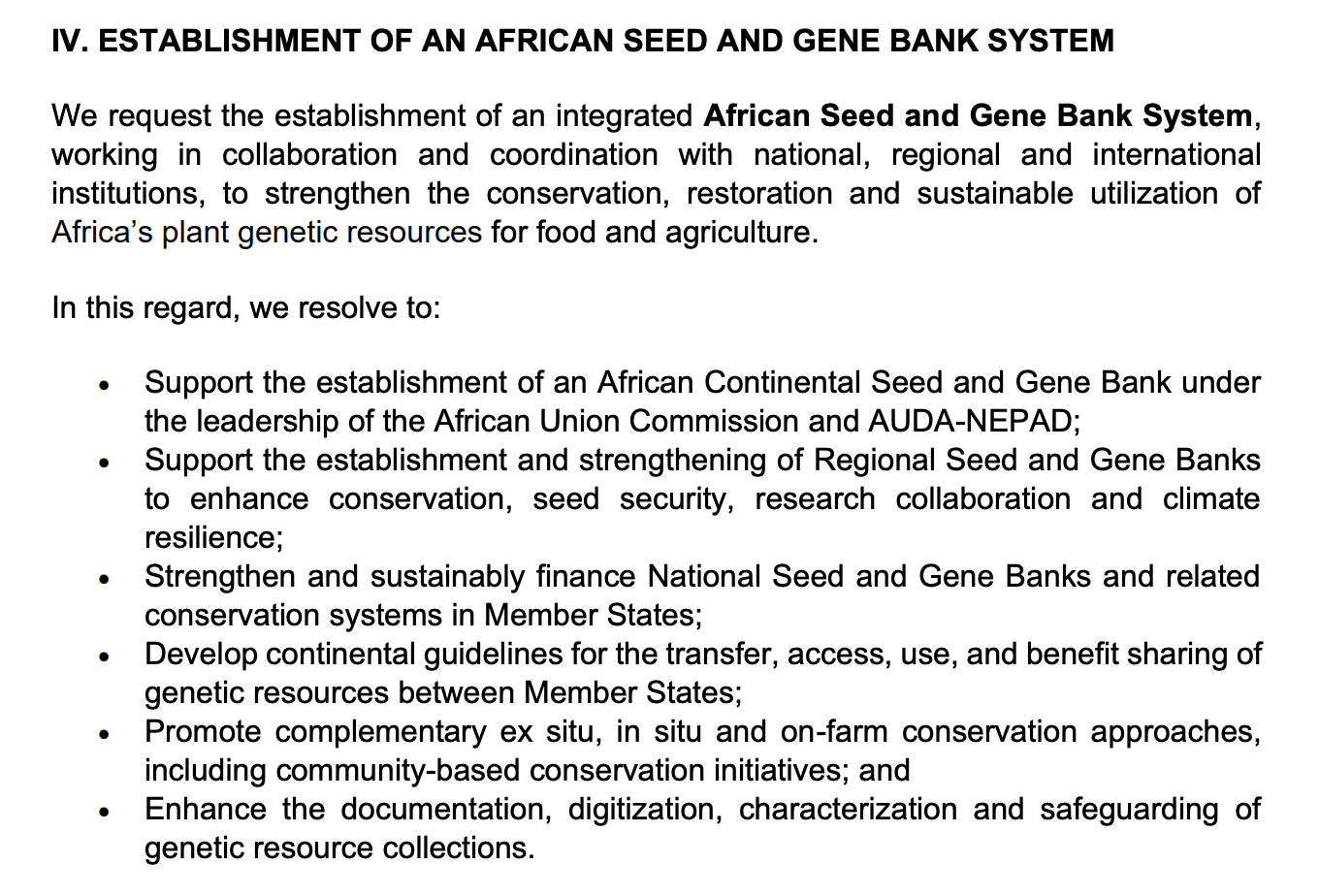
Given the precarious state of many national genebanks, it’s really good to see the call to “strengthen and sustainably finance…” them “…in Member States.” Though I would have preferred to see that phrased as “…by Member States.”
The document is a ministerial outcome that I believe still has to go through AU policy organs for validation and endorsement, so nothing here is binding yet. It sets no funding figures, timelines or locations for the continental genebank, and it uses verbs like “support” and “request” rather than “establish.” Nevertheless, the recognition of the importance of genebanks is very welcome. We will keep a beady eye on how this develops.
Rounding off the 20th anniversary celebrations
I’ve been celebrating 20 years of the blog with deep dives into its past, focusing on my favourite recurring themes. I did one post a day for a week, but I could have gone on for a month, I reckon. By way of summary, here are the links:
- genebanks in trouble to kick the whole thing off
- Pompeii grapevines
- cassava
- Carolina Gold rice
- gap analysis
- “lost” Ecuadorian chocolate
- apples
- early warning system
Let me know in the comments or on social media if you have your own favourite subject you’d like explored in the archives, and I’ll see what I can do. Or you can do it yourself and send me the results and I’ll share them on the blog.
BTW, since we’re reminiscing, this is what Jeremy had to say about the blog on its 15th birthday.