- Plea from taxonomist to nutritionists and food people: use scientific names and get them right.
- Cooking writer doesn’t get the hint.
- New Scientist rounds up bunch of recent animal domestication studies.
- DIY bio-char; Muck & Mystery has some ideas.
- Diverseeds has videos of diverse seeds.
- “For one week, 2500 people from Noirmoutier use all their might to harvest this precious La Bonnotte potato by hand.”
- Barcoding bananas: useful for field genebanks?
A date with wild dates
A friend is going to Crete for his holidays, so I naturally suggested that he visit the populations of the wild relative of the date palm, Phoenix theophrasti, which is rare, endangered and sort-of endemic to the island. Actually there are apparently some populations in southern Turkey too, but I didn’t know that at the time. Ok, but where exactly do I find it, he asked? Give me lat/longs.
Well, I’m not sure if I managed that, but after a certain amount of googling I happened across what seems to be the mother lode of P. theophrasti information. And all conveniently packaged in a pdf pamphlet. It’s been produced as part of an intriguing project called “CRETAPLANT: A Pilot Network of Plant Micro-Reserves in Western Crete.” Great that one of the plants/habitats being targeted is a crop wild relative. Coincidentally, the genome of the crop itself has just been sequenced.
A.B. Chapman Lectures in Animal Breeding and Genetics
I’m informed by DAD-Net that the A.B. Chapman Lectures in Animal Breeding and Genetics have been presented annually at the University of Wisconsis-Madison since 1994 by leading international scholars in the genetic improvement of animals, and that this year’s lectures were given by Prof. Miguel Angel Toro, Departamento de Produccion Animal, Universidad Politecnica de Madrid, Spain, on May 4 and 5. Prof. Toro gave two talks, on “Principles of Conservation of Animal Genetic Resources” and on “Mating Allocation in Genomic Selection.” Did anyone out there see them, in particular the first, either in person or live on the internet? Let us know. In any case, it looks like they’ll eventually be available for downloading.
Diversity on air
I’ve been listening to a radio programme about diversity in action. Called The Evolution Boomerang, from Soundprint, it examines three cases where diversity is important to agriculture and the environment. There’s a segment on GMO cotton and insect resistance, a segment on the need for genetic diversity at salmon hatcheries, and a segment on selecting bacteria to degrade a chemical that had never existed on Earth before humans manufactured it.
All good stuff, if you have half an hour to spare. You will need Real Player to listen.
Mapping Ugandan wetlands to protect them
Want to know where Ugandans can make the most money from harvesting papyrus? Here you go:
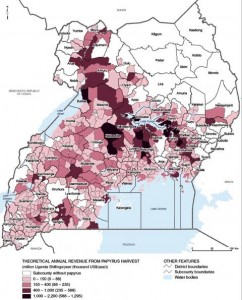
This map is one of a whole series on Ugandan wetlands — their potential and the threats they face — that has just been published by the World Resources Institute 1 under the title Mapping a Better Future: How Spatial Analysis Can Benefit Wetlands and Reduce Poverty in Uganda.
One of the co-authors, Paul Mafabi , commissioner of the Wetlands Management Department in Uganda’s Ministry of Water and Environment, had this to say at the launch:
These maps and analysis enable us to identify and place an economic value on the nation’s wetlands. They show where wetland management can have the greatest impacts on reducing poverty.
There are probably some wild rice relatives lurking in these wetlands too, let’s not forget.