- Need seed? Ask a bihana-maa, at least if you are in Orissa.
- Decline in UK honeybees reveals that crops not so dependent on them after all. Huh?
- A new strawberry for aesthetically-minded home gardeners.
- Wild Chilli group of Europe to visit Experimental Garden and Genebank of the Radboud University of Nijmegen. Send us a report?
- A free talk about the importance of perpetuating food plant resources for the future on Thursday, July 14. Oh, it’s on Hawaii. Send us a report?
Brainfood: Medic systematics, Fruit wine, Alfa paper, Marula diversity, Cardamon pollination, Protein, Ants, Peanuts, Truffles, Ethiopian barley, Citrus diversity, Biofuel trees, Honeybush, Czech garlic
- Genetic similarity based on isoenzyme banding pattern among fifty species of Medicago representing eight sections (Fabaceae). People are still using isozymes? I find that oddly endearing.
- Preparation and evaluation of antioxidant capacity of Jackfruit (Artocarpus heterophyllus Lam.) wine and its protective role against radiation induced DNA damage. In other news, you can make wine from jackfruit.
- Pulping and papermaking properties of Tunisian Alfa stems (Stipa tenacissima)—Effects of refining process. Yep, a paper on paper.
- Phenotypic variations in fruits and selection potential in Sclerocarya birrea subsp. birrea. There’s a lot of it.
- Pollination studies in large cardamom (Amomum subulatum Roxb.) of Sikkim Himalayan region of India. It needs a native bumblebee.
- Effect of proteins from different sources on body composition. Hard to be sure, but probably no difference between animal and plant protein. If you’re trying to lose weight, that is.
- Ants as biological control agents in agricultural cropping systems. More common than you think, but can’t be taken for granted.
- Origin of triploid Arachis pintoi (Leguminosae) by autopolyploidy evidenced by FISH and meiotic behaviour. Maybe that was they key step on the road to the edible peanut.
- The biochemistry and biological properties of the world’s most expensive underground edible mushroom: Truffles. Not just a pretty smell.
- Ethnobotany, diverse food uses, claimed health benefits and implications on conservation of barley landraces in North Eastern Ethiopia highlands. Landraces “just” liked for culinary qualities are having a hard time.
- Comparative analysis of genetic diversity in Citrus germplasm collection using AFLP, SSAP, SAMPL and SSR markers. Boys with toys.
- Tree legumes as feedstock for sustainable biofuel production: Opportunities and challenges. Pongamia pinnata is the thing, apparently, but it’ll need research. NIMBY!
- Honeybush (Cyclopia spp.): From local cottage industry to global markets — The catalytic and supporting role of research. South African bush tea a blueprint for the development of a neglected/underutilized species? Yeah, why not.
- Diversity of S-alk(en)yl cysteine sulphoxide content within a collection of garlic (Allium sativum L.) and its association with the morphological and genetic background assessed by AFLP. Czech genebank follows up Brassica genetic diversity study with one on garlic. SACS is an important end-use trait, and varies among genetic groups.
Berry Go Round No. 41
 Having recently taken on a bit of the management responsibility for Berry Go Round, I am duty bound to give it perhaps more room than we might have in the past. 1 Mr Subjunctive at Plants are the Strangest People has done a bang up job of serving some botanical delights from the blogosphere. Head on over there for links to quasi-carnivorous plants, orchids galore, and much else besides. And here’s the stuff that’s more relevant to us. 2
Bizarrely, someone submitted the Wild Taro Research Project, which of course ought to be of great interest to lots of people here. But here’s the weird part: it’s password protected. So, now what? You’ve drawn attention to yourself and what you have to offer, but you won’t let us go any further? There’s a name for that kind of behaviour, and it isn’t very nice.
Hort Log has something called a flat and maroon ginger, but doesn’t know what actually to call it. Does Kaempferia qualify as a wild relative of Zingiber? No idea.
Christie Wilcox over at Observations of a Nerd lays into the Nature paper that asked whether alien species deserve their bad reputation. Her dissection of the argument may not make much sense if you can’t get at the original paper, but if you can, I hope you’ll enjoy her skewering as much as I did. It’s a gem. And, of course, some invasives are agricultural, and some invasives threaten agricultural species, so we’re happy both ways.
This one’s kinda meta, inasmuch as Farmscape’s post is in fact about another post; German artist Uli Westphal has been chanelling the ghost of Esther Rantzen 3 to collect images of outlandishly-shaped vegetables. Westphal calls the project Mutatoes. I didn’t check to see whether any oca had snuck in there. Another project documents tomato diversity. And hey, Uli, if you’re reading this, get in touch; we may be able to help you get to grips with taxonomy.
Mr Subjunctive also serves up Annals of Botany’s blog post on date sex, and really, some of the non-ag links are absolutely fascinating too. There’s a lot there.
The next Berry Go Round will be hosted at Beyond the Brambles, 4 and you can submit anything you come across, not just stuff you produced yourself.
50% is the new 75%
Experts estimate that we have lost more than half of the world’s food varieties over the past century.
An apple a decade
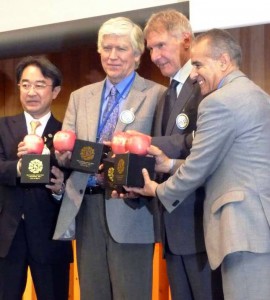 So word has it that the Convention on Biological Diversity people will be handing out apples (or models of apples) with the logo of the Decade of Biodiversity on them during the 66th session of the UN General Assembly in New York City this September. Including to President Obama. The only photograph I’ve been able to find of these fruits comes from Nagoya last year, but they don’t look like heirloom varieties to me. An opportunity missed?